Sump Pump Running Constantly? Causes and How to Fix It
TL;DR
- Look in the pit first. What the water is doing tells you which problem you have.
- Pit empty but the pump keeps running: the float switch is stuck or failed. Unplug the pump now, or it will burn out.
- Pump turns on and off every minute or two, with a rush of water after it stops: the check valve is missing or failed. It's a $15 to $40 fix.
- Pump runs nonstop and the water level holds or rises: either water is coming in faster than the pump can move it, or something is stopping the water from leaving (a clog, an air lock, or a frozen discharge line).
- Pump runs often in dry weather: suspect a high water table, discharge water flowing back toward the house, or a plumbing leak.
- Unplug the pump before you touch anything in the pit. Water and electricity share that hole.
A sump pump that runs during a storm is doing its job. One that runs all the time, won't shut off, or clicks on every minute is telling you something is wrong. Left alone, constant running overheats the motor and can wear out a pump in a fraction of its normal life, usually right before the next big rain.
The good news: there are only a handful of causes, and most can be narrowed down in five minutes by looking in the pit and listening.
How a Sump Pump Should Cycle
It helps to know what normal looks like:
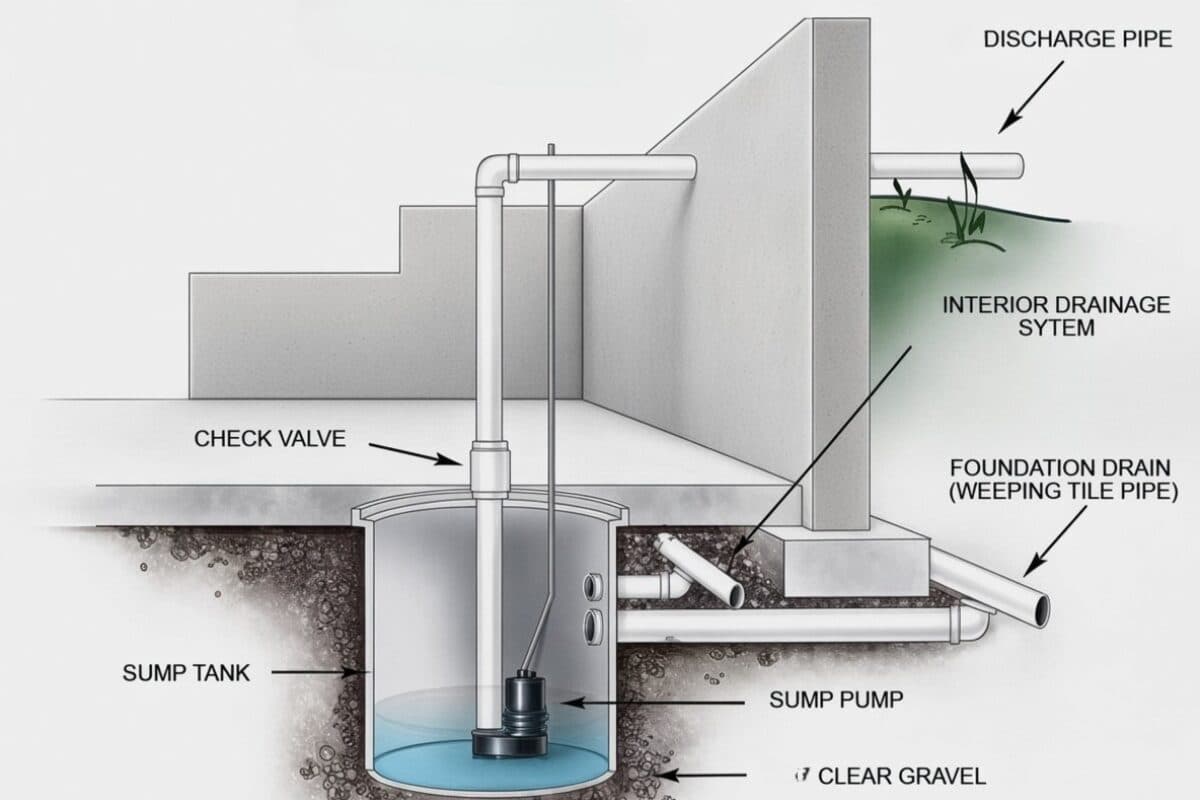
- Water drains into the pit from the drain tile around your foundation.
- As the water rises, it lifts the float switch.
- At the "on" level, the float turns the pump on.
- The pump pushes water up the discharge pipe and out of the house.
- As the water drops, the float drops with it. At the "off" level, the pump shuts off.
- The check valve on the discharge pipe snaps shut so the water in the pipe can't fall back into the pit.
During heavy rain or a spring thaw, a pump might cycle every few minutes for hours. That's normal. The problems start when the pump runs with nothing to pump, can't keep up, or restarts over and over in dry weather.
Safety First
A sump pit is a hole full of water with an electric motor in it. Before you touch anything:
- Unplug the pump before your hands go anywhere near the pit, the float, or the pump. Never reach into the water while it's plugged in.
- Make sure the pump is plugged into a GFCI-protected outlet, the kind with test and reset buttons, or one on a GFCI breaker. If it isn't, have an electrician fix that.
- Don't stand in water to reach the outlet. If the floor around the pit is wet and the outlet is low, turn off the breaker first.
- Don't use an extension cord for the pump. If the cord doesn't reach, the outlet needs to move.
- Wear gloves. Pit water can carry sewage or bacteria, especially if the floor drain or laundry drains into it.
- If you smell burning, see sparks, or the breaker keeps tripping, leave it unplugged and call a pro.
Every fix below starts with unplugging the pump, for this reason.
The Pit-Level Rule
Look in the pit while the pump is running. What the water is doing points to the cause.
| What you see | Most likely cause | Jump to |
|---|---|---|
| Pit is empty or nearly empty, pump keeps running | Stuck or failed float switch | Cause 1 |
| Pump shuts off, then you hear water rush back into the pit, and the pump restarts a minute later | Missing or failed check valve | Cause 2 |
| Pump runs and hums, but the water level isn't dropping | Air lock, clogged intake or impeller, or blocked or frozen discharge | Causes 3 and 4 |
| Pump runs nonstop, water level holds steady or rises, and water is clearly pouring into the pit | More water coming in than the pump can handle | Cause 5 |
| Pump cycles often in dry weather, water coming in is clear and steady | High water table, discharge water returning, or a plumbing leak | Cause 6 |
| Pump turns on and off very quickly, even with plenty of water coming in | Oversized pump, small pit, or float set too close | Cause 7 |
| The backup pump is the one running, or you hear water running at a water-powered backup | Main pump failing, or a backup valve or float stuck | Cause 8 |
5-Minute Diagnostic
You'll need a flashlight and, ideally, a second person.
- Look in the pit. Is it empty, half full, or full? Is water pouring in from the drain pipes, trickling, or not coming in at all?
- Watch the float. Is it moving up and down with the water, or stuck against the side of the pit, the pump, or the cord?
- Time a full cycle. Note how long the pump runs and how long it stays off. Write it down.
- Listen when the pump stops. A whoosh or gurgle of water falling back into the pit means the check valve isn't holding.
- Listen while it runs. A steady pumping sound means it's moving water. A hum with no change in water level means it's running without pumping. Grinding or rattling points to debris or a worn impeller.
- Go outside. Find where the discharge line comes out. Is water flowing out when the pump runs? Is the outlet buried, frozen, or crushed? Does the water run back toward the house?
- Think about the weather. Has it rained in the last few days? Is snow melting? Is it dry?
If the pit is empty and the pump is running, stop here and unplug it. Running dry is the fastest way to destroy a pump. Then go to Cause 1.
Cause 1: Stuck or Failed Float Switch
Signs: the pump runs with an empty or nearly empty pit, and it never shuts off on its own.
The float switch is the most failure-prone part of a sump pump. If it's stuck in the "up" position, the pump thinks the pit is full and runs forever.
Why floats stick:
- Tethered floats (a ball on a cord) swing in an arc and can get caught on the pit wall, the pump body, the discharge pipe, or the power cord, especially in a narrow pit.
- Vertical floats slide up and down a rod and can jam on sediment, mineral buildup, or debris.
- Electronic switches have no moving float, but they can fail closed.
- The switch itself can fail electrically and stay on even when the float is down.
How to fix it:
- Unplug the pump.
- Look at the float. If it's caught on something, free it, and move or secure whatever it was caught on. Zip-tie loose cords to the discharge pipe so they stay out of the float's path.
- If it's a vertical float, clean the rod and float so it slides freely.
- Clean any debris or silt out of the bottom of the pit.
- Plug the pump back in and pour water into the pit to test a full cycle.
How to test the switch itself: many pumps use a piggyback plug, where the pump plugs into the back of the float switch's plug. Unplug both, then plug the pump directly into the outlet. If the pump runs, the motor is fine and the problem is the switch. Unplug it again right away so it doesn't run dry.
If you have a pedestal pump: the motor sits on a column above the pit, and a float ball rides on a vertical rod. Two small stops (clips or collars) on the rod push the switch on and off as the float rises and falls. These pumps run constantly when the float ball sticks or fills with water, the rod binds against the pit wall or the column, or the upper stop slips down so the switch never gets pushed off. Unplug the pump, check that the ball floats and slides freely, straighten or clean the rod, and reset the stops to the positions in the manual. See our submersible vs. pedestal sump pump guide for how the two types differ.
When to replace the switch: if the float moves freely but the pump still won't shut off, the switch has failed. A replacement vertical piggyback float switch is a common, inexpensive fix that works with most pumps, and vertical switches are less likely to snag in tight pits. If your pump has a built-in switch, you may need to replace the pump.
Cause 2: Missing or Failed Check Valve
Signs: the pump shuts off, you hear water rush back down into the pit, and the pump turns back on a minute or two later, all day long, even in dry weather.
The check valve is a one-way valve on the discharge pipe, usually a foot or two above the pump. When the pump shuts off, it closes so the water already in the pipe can't fall back into the pit. Without it, a few gallons drain back down every cycle and refill the pit, and the pump has to pump the same water again and again.
That wastes electricity, adds wear on the motor and switch with every restart, and makes a normal pump look like it's running constantly.
How to check:
- Look for a check valve on the discharge pipe. It's usually a short section with rubber couplings or unions on each end and an arrow showing the flow direction.
- Watch and listen right after the pump shuts off. A rush of water back into the pit means there's no valve, or the one you have is stuck open.
- Check the arrow. A valve installed upside down won't work.
How to fix it:
- Unplug the pump.
- Loosen the couplings and remove the old valve. Have a bucket and towels ready, since the pipe above it is full of water.
- Install a new sump pump check valve sized to your discharge pipe (usually 1-1/2 inch), with the arrow pointing up, away from the pump.
- Tighten the couplings and test a few cycles.
A note on noise: some check valves close with a loud thunk that can be heard upstairs. Quiet-close models have a spring-loaded flap that shuts more gently.
Cause 3: The Pump Is Running but Not Moving Water
Signs: the pump hums or runs, but the water level in the pit doesn't drop, and little or no water comes out outside.
Air Lock
When a pump starts, air trapped in the pump body or pipe between the pump and the check valve can keep it from pushing water. The motor spins, but nothing moves. This is common right after a new pump or check valve is installed.
The fix: many pump manufacturers call for a small relief hole, often called a weep hole, drilled in the discharge pipe between the pump and the check valve, usually about 1/8 to 3/16 inch and a few inches above the pump. It lets trapped air escape. Check your pump's manual for the exact size and placement before drilling. A small stream of water spraying back into the pit from that hole while the pump runs is normal.
Clogged Intake or Impeller
Silt, gravel, and debris get pulled into the pump's intake screen and can jam or wear the impeller, the spinning part that moves the water.
The fix:
- Unplug the pump.
- Disconnect it from the discharge pipe and lift it out of the pit.
- Clean the intake screen and the area around the impeller.
- Clean the bottom of the pit. A pump sitting directly on a silty pit floor sucks up debris. Setting it on a flat brick or paver keeps it above the sediment.
- Reinstall it and test.
If the impeller is cracked or badly worn, or the pump grinds after cleaning, it's time for a new pump.
Cause 4: Blocked or Frozen Discharge Line
Signs: the pump runs, the water level barely drops, and little or nothing comes out of the discharge outlet. In winter, this is one of the most common causes.
What blocks it:
- Ice. The outdoor end of the discharge line freezes first, especially if it's corrugated hose lying on the ground or a buried line.
- Debris. Leaves, dirt, or small animals at the outlet.
- Crushed or kinked pipe, often from a lawn mower, a car, or snow piled on top.
The fix:
- Unplug the pump.
- Go outside and find the outlet. Clear any debris, snow, or ice.
- If it's frozen, thaw it with warm water or a hair dryer. Never use an open flame on plastic pipe.
- Replace crushed or kinked sections.
- Test a full cycle and confirm water flows out.
To keep it from freezing again, see the discharge line section of our winterize your basement guide, which covers slope, rigid pipe, and freeze guard fittings.
Cause 5: More Water Is Coming In Than the Pump Can Handle
Signs: the pump runs nonstop, water is visibly pouring into the pit from the drain pipes, and the level holds steady or keeps rising.
During a heavy storm or fast snowmelt, some constant running is normal. The question is whether the pump is keeping up. If the level is stable or dropping slowly, it's working hard but winning. If the level rises toward the top of the pit, it's losing.
Why it can't keep up:
- Undersized pump. Smaller pumps (often 1/3 HP) can be overwhelmed by a high water table or a big storm, especially with a long or tall discharge run.
- Worn pump. Pumps lose capacity as they age. A pump that kept up five years ago may not now.
- Long or high discharge. Every foot of vertical lift and every bend in the pipe reduces how much water a pump can move.
- Discharge water coming back. If the outlet is too close to the house or on ground that slopes back toward it, the same water drains right back into the pit. See Cause 6.
What to do now: if the water is close to the top of the pit, don't unplug the pump. Monitor it, and if you have a backup pump, make sure it's ready. Our guide to why a basement floods even with a sump pump covers what to do if water starts coming over the edge.
Long-term fixes:
- Upgrade to a larger pump sized for your water and discharge height. Our sump pump buying guide explains sizing, and our best sump pumps lists picks.
- Add a second pump in the same pit, set to turn on a little higher than the main pump. Many backup systems do this and also cover power outages.
- Fix the outside water sources: gutters, downspouts, and grading.
Cause 6: Water Keeps Coming In During Dry Weather
Signs: it hasn't rained in days, but the pump still cycles often, and clear water steadily flows into the pit.
Possible causes:
- High water table. In some areas, especially near lakes, rivers, or low ground, the groundwater sits close to the basement floor for weeks or months, particularly in spring. The pump is doing its job. It just has a lot of job to do.
- Discharge water returning. If the discharge outlet is a few feet from the foundation, or the ground slopes back toward the house, the water you pump out soaks back down to the drain tile and into the pit. This makes a loop. The outlet should be well away from the house, often 10 to 20 feet, on ground that slopes away.
- Downspouts or irrigation. Downspouts that empty near the foundation and lawn sprinklers that soak the ground beside the house both feed the pit.
- A plumbing leak. A leaking water line, a running well pump, or a broken irrigation line can send a steady flow into the drain tile. If the inflow is steady day and night and smells or looks like tap water, turn off the main water shutoff for an hour and watch whether the inflow slows.
How to tell: after a long dry spell, a high water table produces slow, steady inflow that changes with the seasons. Discharge water returning shows up as inflow that spikes a few minutes after each pump cycle. A plumbing leak produces steady inflow that stops when you shut off the water.
Fixes: extend and redirect the discharge line, fix downspouts and grading, and repair leaks. For a true high water table, a properly sized pump, a backup, and possibly better drainage are the long-term answer. See our interior basement drainage systems guide.
Cause 7: Oversized Pump or Small Pit
Signs: the pump turns on and off in rapid bursts, every few seconds or every minute, even when water is coming in steadily.
A pump that's too powerful for the pit empties it almost instantly, shuts off, and restarts as soon as the water rises again. The same thing happens when the pit is small or the float's on and off points are set too close together. Every start puts wear on the motor and switch.
Fixes:
- If your float switch is adjustable, widen the gap between on and off so the pump runs longer and less often.
- Make sure the check valve is working (Cause 2), since a missing valve makes short cycling much worse.
- If the pit is small, a contractor can install a larger basin.
- When you replace the pump, size it to your actual water flow rather than buying the biggest one available.
Cause 8: The Backup Pump Won't Stop
Signs: the backup pump is the one running, its alarm keeps going off, or you hear water running near a water-powered backup when nothing should be on.
Backup pumps sit in the same pit, usually set to turn on a few inches higher than the main pump. If the backup is running often, it's usually telling you about the main pump.
Battery backup running often:
- The main pump is failing or can't keep up. The water rises past the main pump's level and the backup kicks in. Work through Causes 1 through 5 for the main pump.
- The backup's float is set too low, at or below the main pump's float, so it turns on first. Raise it so it sits a few inches above the main pump's "on" level.
- The backup's float is stuck, the same way a main pump's float can stick. Free it and clear the cords around it.
- The battery is draining. A backup that has run a lot may leave the battery low. Check its charge and age, since most batteries need replacing every few years.
Water-powered backup running constantly:
- These use city water pressure to pump water out, and they send the water they use down the discharge line too. If the valve sticks open or the float hangs up, it keeps running, which you'll hear as running water and see on your water bill.
- There's nothing to unplug. Close the shutoff valve on the water line that feeds the backup, then check the float and clean any debris around it. If it still runs when you reopen the valve, the valve inside the unit has failed and needs repair or replacement.
- Water-powered backups don't work on a private well during a power outage, since the well pump needs power too.
See our guides to backup power for sump pumps and battery vs. water-powered backups.
Protect the Pump While You Fix It
- Add a high water alarm. A battery-powered high water alarm sits in the pit and sounds if the water rises above where the pump should have turned on. It costs far less than a flooded basement and warns you if the pump fails while you're fixing something else.
- Consider monitoring. Smart pumps and Wi-Fi sensors can send alerts when the pump runs too long, cycles too often, or the water rises. See our smart sump pumps guide and best water leak detectors.
- Have a backup. A pump that's been running constantly may be close to failing. See our guide to battery vs. water-powered backup pumps.
Is It Time to Replace the Pump?
Replace the pump if:
- The motor runs but won't move water after you've cleared clogs, air locks, and the discharge line
- It's loud, grinding, or rattling after cleaning
- It's tripping the breaker or the GFCI outlet
- It overheated and shuts off by itself, then restarts (a thermal overload cycling on and off)
- It can't keep up even though inflow is normal
- It's more than about 7 to 10 years old and has been running hard
When you replace it, fix the underlying cause too. A new pump with the same stuck float, missing check valve, or returning discharge water will have the same problem. See our sump pump replacement cost guide and submersible vs. pedestal sump pumps.
Cost Breakdown and 10-Year Total Cost of Ownership
| Fix | DIY cost | With a pro | Notes |
|---|---|---|---|
| Free a stuck float, clean the pit | $0 | Service call | Most common fix |
| Replace a check valve | $15 to $40 | Service call plus parts | Pays for itself in reduced wear |
| Replace a float switch | About $20 to $60 | Service call plus parts | Vertical switches snag less |
| Drill a weep hole | $0 | Service call | Check the pump manual first |
| Clear or thaw the discharge line | $0 to $20 | Service call | Prevent with a winter setup |
| High water alarm | About $15 to $30 | Not needed | Cheap insurance |
| New pump | See our sump pump cost guide | See our sump pump replacement cost guide | Fix the root cause too |
| Second pump or battery backup | See our backup power guide | Same | Protects against both failure and outages |
What constant running costs: most residential sump pumps draw roughly 400 to 700 watts, depending on size. Running nonstop, that's about 10 to 17 kWh a day, or roughly $1.75 to $3 a day at 18 cents per kWh, about $50 to $90 a month. That's on top of the wear, which is the bigger cost.
The 10-year view: a check valve, a float switch, and an alarm together typically cost under $150. A pump that's run to failure means an emergency replacement, often during the storm that broke it, plus whatever water gets in before it's fixed. See our basement flooding cleanup guide for what that involves.
Common Mistakes
- Letting it run dry. If the pit is empty and the pump is running, unplug it now.
- Unplugging it during a storm. If water is pouring in, the pump is doing its job. Monitor it instead.
- Replacing the pump without fixing the cause. A new pump with a missing check valve or a stuck float has the same problem.
- Installing the check valve upside down. The arrow points up, away from the pump.
- Letting cords dangle in the pit. They're the most common thing a tethered float snags on.
- Setting the pump on the silty pit floor. It sucks up debris that clogs the intake and wears the impeller.
- Dumping discharge water next to the house. It drains right back into the pit.
- Ignoring the outside end of the discharge line in winter. A frozen outlet can burn out the pump in a day.
When to Call a Pro
- The pump keeps running after you've freed the float and checked the valve and discharge line
- Water is close to overflowing the pit
- The pump trips the breaker or GFCI, or you smell burning
- You need a larger pit, a second pump, or a new discharge line
- Steady inflow in dry weather suggests a high water table or drainage problem
- The pit is hard to reach or the pump is wired directly instead of plugged in
- The pump isn't on a GFCI-protected outlet, or the outlet is too far for the cord to reach
- A water-powered backup keeps running after you've checked its float
DIY-friendly: freeing a float, cleaning the pit and intake, replacing a check valve or piggyback float switch, clearing the discharge line, and adding an alarm.
Get Free Sump Pump Repair Quotes
Frequently Asked Questions
Why does my sump pump run constantly?
The most common causes are a stuck or failed float switch, a missing or failed check valve, a clogged or frozen discharge line, an air lock, a pump too small for the water coming in, or water returning from a discharge outlet too close to the house. Look in the pit first: if it's empty and the pump is running, it's the float switch.
Is it bad if my sump pump runs constantly?
Yes, unless it's keeping up with heavy rain or snowmelt. Constant running overheats the motor and shortens its life, and running with an empty pit can burn it out quickly.
How often should a sump pump cycle?
It depends on the weather and your water table. During heavy rain, cycling every few minutes is normal. In dry weather, frequent cycling usually means a check valve problem, water returning from the discharge, or a high water table.
Why does my sump pump turn on every minute?
Most often because the check valve is missing or failed, so water in the pipe drains back into the pit after each cycle. An oversized pump or a float set too close together can cause it too.
Can I unplug my sump pump if it won't stop running?
If the pit is empty, yes, unplug it right away to protect the motor. If water is pouring in, leave it running and monitor it, since unplugging it could flood the basement.
How do I know if my sump pump float is stuck?
The pump runs while the pit is empty or nearly empty. Unplug the pump and look: the float is usually caught on the pit wall, the pump, the discharge pipe, or the power cord.
What is a weep hole in a sump pump pipe?
A small hole drilled in the discharge pipe between the pump and the check valve. It lets trapped air escape so the pump doesn't air lock. Many manufacturers require one. Check your manual for the size and location.
How long should a sump pump last?
Often around 7 to 10 years, but a pump that runs constantly or cycles too often can wear out much sooner.
Glossary
- Float switch:
- The switch that turns the pump on when water lifts it and off when water drops.
- Tethered float:
- A float on a short cord that swings up and down in an arc.
- Vertical float:
- A float that slides straight up and down a rod, which takes less room in the pit.
- Piggyback switch:
- A float switch whose plug goes into the outlet, with the pump plugged into the back of it.
- Check valve:
- A one-way valve on the discharge pipe that stops water from draining back into the pit.
- Short cycling:
- A pump turning on and off rapidly, which wears out the motor and switch.
- Air lock:
- Trapped air in the pump or pipe that keeps the pump from moving water.
- Weep hole:
- A small hole in the discharge pipe that lets trapped air escape.
- Impeller:
- The spinning part inside the pump that pushes water.
- Water table:
- The level below ground where the soil is saturated with water.
Related Guides
The Home Guide Network Editorial Team
Our guides are researched and written by the editorial team at The Home Guide Network, an independent publisher covering home systems for homeowners. We cover garages, basements, septic systems, and wells across four dedicated guide sites. Learn more at thehome.guide.
Affiliate disclosure: As an Amazon Associate we earn from qualifying purchases. Links to Amazon on this page use our affiliate tag and may earn us a commission at no extra cost to you.