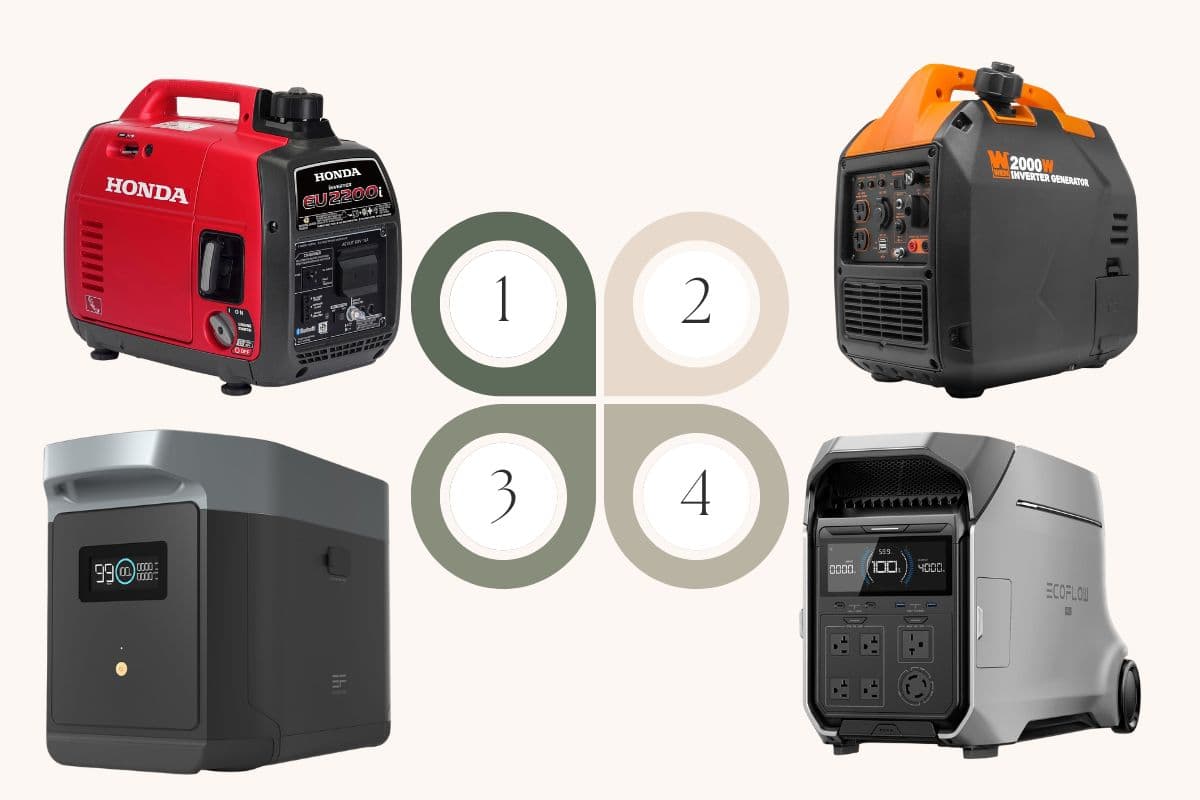
Backup power for sump pumps refers to any power source that keeps a sump pump running when the primary electrical supply fails, covering the four main options: dedicated battery backup sump pumps, portable power stations, portable inverter generators, and permanently installed standby generators. Each option differs in cost, runtime, automatic activation capability, maintenance requirements, and whether it can power other devices beyond the pump itself. Choosing the wrong option is common because homeowners focus on price rather than the combination of surge watt capacity and runtime their specific pump and outage risk require. A sump pump that cannot start due to insufficient surge capacity is as useless as no backup at all, which is why matching the backup’s surge rating to the pump’s starting wattage is the most important specification to verify before purchasing.
Your sump pump is most likely to fail at the exact moment you need it most—during a heavy storm that knocks out power. Without backup power, your pump sits idle while water rises. According to FEMA, just one inch of flooding can cause $25,000 in damage. This guide covers every backup power option for your sump pump, from $200 portable power stations to $10,000 whole-house generators, with honest recommendations on what’s actually worth buying.
What Size Generator Do I Need for a Sump Pump?
Short answer: at minimum, you need a generator or power station that can handle 2,000–3,000 surge watts and 800–1,500 running watts.
Sump pumps draw far more power at startup than during operation. When the motor kicks on, it creates a brief surge that can be 2–3x the running wattage. If your generator can’t handle that surge, the pump won’t start—period.
| Pump Size | Running Watts | Surge (Starting) Watts |
|---|---|---|
| 1/4 HP | 500–600W | 1,000–1,800W |
| 1/3 HP | 800W | 1,300–2,900W |
| 1/2 HP | 1,050W | 2,150–4,100W |
| 3/4 HP | 1,500W | 3,000–4,500W |
Most homes have a 1/3 HP or 1/2 HP pump. A generator rated at 2,000 watts continuous with a 3,000-watt surge capacity covers both comfortably and leaves room to plug in a light or charge your phone.
Not sure what pump you have? Check the label on the motor housing—it will list the horsepower, voltage, and amperage. Our sump pump Reviews explains how to read these specs.
Best Backup Power Options Compared
There are four main ways to keep your sump pump running during an outage.
| Option | Cost Range | Runtime | Auto-Start? | Maintenance |
|---|---|---|---|---|
| Battery backup sump pump | $600–2,000 | 5–12 hrs | Yes | Replace battery every 3–5 yrs |
| Portable power station | $300–2,000 | 2–8 hrs | No* | Near-zero |
| Portable inverter generator | $400–2,500 | 8–20 hrs | No | Oil, fuel, annual service |
| Standby whole-house generator | $5,000–15,000 | Unlimited | Yes | Annual professional service |
*Some portable power stations offer auto-switchover UPS mode that activates in under 20ms—fast enough for most sump pumps.
Best Portable Inverter Generators for Sump Pumps
If you want long runtime, the ability to power more than just your sump pump, and don’t mind storing gasoline and doing occasional maintenance, a portable inverter generator is the best value. Inverter generators produce clean, stable power (low THD) that’s safe for motor-driven appliances like sump pumps.
Important Safety Warning
Gas generators must be operated outdoors—never in a garage, basement, or enclosed space. Carbon monoxide is lethal. Run an extension cord from the generator outside to your sump pump inside. Use at least a 12-gauge cord (10-gauge for runs over 25 feet).
Honda EU2200i
- 2,200W surge / 1,800W running
- Ultra-quiet: 48–57 dBA
- 47 lbs—genuinely portable
- Runtime: 8 hrs at 25% load on 0.95 gallons
- CO-Minder auto-shutoff for safety
- 3-year warranty
The gold standard for residential inverter generators. It will comfortably start and run any 1/3 or 1/2 HP sump pump while being quiet enough not to wake the neighbors. The downside is price—you’re paying a premium for Honda’s engine quality and reliability.
Check Price on AmazonChampion 2500W Dual Fuel Inverter
- 2,500W surge / 1,850W running
- Runs on gasoline or propane
- 39 lbs
- Runtime: 11.5 hrs on gas at 25% load
- Quiet Technology: 53 dBA
- 3-year warranty + lifetime tech support
The best bang-for-buck in the generator space. The dual fuel option is a real advantage—propane doesn’t go stale in storage the way gasoline does, so the generator is more likely to actually start when you grab it six months later during a storm. Roughly 90% of Honda’s performance at roughly half the price.
Check Price on AmazonWEN 56203i Super Quiet 2000W
- 2,000W surge / 1,700W running
- 51 dBA—one of the quietest in class
- 39 lbs
- Runtime: 10.8 hrs at 25% load
- Parallel-capable (link two for 4,000W)
- 2-year warranty
A solid entry point. It handles a 1/3 HP pump without issue and can start most 1/2 HP pumps (check your specific surge requirement). If you just need to keep the sump pump running and maybe a light on, this gets it done at the lowest cost.
Check Price on AmazonGenerator Maintenance Reality Check
A generator you don’t maintain is a generator that won’t start when you need it. Gasoline goes stale in 30–60 days. Ethanol-blended fuel will gum up the carburetor if left sitting.
- Run it for 15–20 minutes every 2–3 months under load
- Use fuel stabilizer in every fill-up, or run non-ethanol gas
- Change the oil at least once per year
- Use the fuel shutoff valve to run the carb dry before storage
Or buy the Champion dual fuel and store it with a propane tank attached—propane doesn’t degrade.
Best Portable Power Stations for Sump Pumps
Portable power stations are the newer alternative. They’re essentially large lithium battery packs with built-in inverters. No gas, no fumes, no maintenance, dead silent, and safe to use indoors right next to your sump pump.
The trade-off is runtime. A gas generator runs as long as you have fuel. A power station runs until the battery is drained, and recharging during a power outage requires solar panels.
What to Look For
- Pure sine wave inverter—non-negotiable for motor-driven appliances. Modified sine wave can damage your pump motor.
- Surge capacity must exceed your pump’s starting watts. This is where cheap power stations fail.
- Battery capacity (Wh) determines runtime. For a 1/3 HP pump cycling on/off, 1,000Wh gives you roughly 3–5 hours; 2,000Wh gives 6–10 hours.
- LiFePO4 (LFP) battery chemistry—longer lifespan (3,000–4,000 charge cycles vs. 500–800 for standard lithium-ion), better thermal stability, and safer for indoor basement use.
EcoFlow DELTA 2 Max
- 2,400W continuous / 4,800W surge (X-Boost)
- 2,048Wh capacity (expandable to 6,144Wh)
- LFP battery—3,000 cycle rating
- Recharges to 80% in 43 minutes from wall outlet
- UPS mode—auto-switchover in 20ms
- 6 AC outlets, USB-C, USB-A, 12V DC
Probably the most practical sump pump backup on this list. The 4,800W surge handles even a 1/2 HP pump without blinking. The UPS mode means you can plug your sump pump into it while it’s plugged into the wall—when power drops, it switches to battery in 20ms, fast enough that the pump never notices the interruption. No running outside in a storm to start a generator.
Check Price on AmazonJackery Explorer 1000 Plus
- 2,000W continuous / 4,000W surge
- 1,264Wh capacity (expandable to 5,056Wh)
- LFP battery—4,000 cycle rating
- Solar panel compatible
Solid option if you don’t need as much capacity. The 4,000W surge handles most residential sump pumps. The lower price point makes it a good entry into battery backup, and you can add expansion batteries later. Doubles as camping/tailgating power.
Check Price on AmazonEcoFlow DELTA Pro 3
- 4,000W continuous / 8,000W surge
- 4,096Wh capacity (expandable to 12,288Wh)
- LFP battery
- Smart home panel integration available
If you want to power the sump pump, a dehumidifier, a fridge, and lights during a multi-day outage, this is the unit. The 8,000W surge is overkill for a single sump pump but makes sense if you’re treating it as whole-basement or partial-home backup. The optional smart home panel lets it function almost like a standby generator with automatic switchover at the breaker level.
Check Price on AmazonPump Partner Sump Pump Backup
- 2,500W output
- 2,048Wh LFP battery—4,000 cycles
- Fully automatic—always plugged in, auto-switches on outage
- All-metal enclosure designed for basement environments
- No app required—completely hands-off
A newer product designed specifically for sump pump backup. Unlike general-purpose power stations, it’s meant to sit in your basement permanently, stay charged, and activate automatically when power drops. No buttons, no apps, no configuring. If you want the simplest possible set-and-forget solution and don’t care about portability or powering other devices, this is worth a look.
Check Price on AmazonStandby Whole-House Generators
If power outages are frequent in your area or you’re protecting a finished basement worth $30,000+, a permanently installed standby generator is the ultimate solution. These run on natural gas or propane connected to your home’s supply, start automatically within seconds of a power outage, and run indefinitely.
They cost $5,000–$15,000 installed, require a transfer switch at your electrical panel, and need annual professional maintenance. Brands like Generac, Kohler, and Briggs & Stratton dominate this space.
For most homeowners, a standby generator is overkill if your only concern is the sump pump. But if you’ve already finished your basement and want to protect the full investment—HVAC, dehumidifier, sump pump, and lighting—it starts to make sense.
Which Should You Choose?
Get a dedicated battery backup sump pump if:
- You just want the sump pump covered and nothing else
- You want fully automatic, zero-effort protection
- Power outages are rare and short (under 8 hours)
- Budget: $600–$2,000 installed
Our battery vs. water-powered backup comparison covers these dedicated systems in depth.
Get a portable power station if:
- You want indoor-safe, silent, zero-maintenance backup
- You also want to use it for camping, tailgating, or general emergency prep
- Power outages are moderate (8–24 hours)
- Budget: $800–$3,000
Get a portable inverter generator if:
- You want the longest possible runtime (limited only by fuel)
- You want to power multiple appliances (fridge, lights, pump)
- You’re comfortable with basic small-engine maintenance
- Budget: $400–$2,500
Get a standby generator if:
- Power outages are frequent or multi-day
- You’re protecting a high-value finished basement
- You want fully automatic, unlimited-runtime protection
- Budget: $5,000–$15,000
How to Connect a Generator or Power Station to Your Sump Pump
The simplest method: unplug your sump pump from the wall outlet, plug it directly into your generator or power station’s AC outlet. Done.
Safety Notes
- Extension cords matter. If the generator is outside and the pump is in the basement, use a heavy-duty outdoor extension cord rated at 12-gauge (10-gauge for longer runs). A cheap 16-gauge cord will cause voltage drop that can starve the motor during startup.
- Never backfeed your panel. Don’t plug a generator into a wall outlet to power your house. This is illegal, extremely dangerous to utility workers, and can destroy your equipment. If you want your generator connected to your breaker panel, hire an electrician to install a transfer switch ($200–$800).
- Keep generators outdoors. At least 20 feet from windows, doors, and vents. Carbon monoxide from generators kills roughly 85 people per year in the U.S.
- Place power stations on elevated, dry surfaces. Even though they’re indoor-safe from an emissions standpoint, electronics and standing water don’t mix. Put it on a shelf or concrete block above the potential water line.
Frequently Asked Questions
What is the difference between a battery backup sump pump and a portable power station?
A dedicated battery backup sump pump is a complete secondary pump system installed directly in the sump pit alongside the primary pump, powered by a 12-volt marine battery that charges continuously while grid power is available and activates automatically when the primary pump fails or loses power. It is purpose-built for one job and requires no human intervention during a storm. A portable power station is a large rechargeable lithium battery pack with a built-in AC inverter that powers your existing primary pump through a standard outlet, giving you more flexibility to power other devices but requiring the unit to be plugged into your pump and charged before the outage. The key practical difference is automation: a battery backup pump activates on its own with no action required, while a portable power station requires your primary pump to be plugged into it (some models with UPS mode handle this automatically). For most homeowners who want set-and-forget protection for the pump only, a dedicated battery backup is simpler. For homeowners who also want to power a dehumidifier, lights, or phone during an outage, a portable power station provides more value. See our battery vs water-powered backup comparison for a full breakdown of dedicated backup pump systems.
Will a 2,000-watt generator run a sump pump?
Yes—a 2,000W generator will run most 1/3 HP sump pumps comfortably. For a 1/2 HP pump, check the specific surge wattage on your pump’s label. Some 1/2 HP pumps surge above 3,000W, which would require a larger generator. When in doubt, size up.
Can I use a portable power station indoors for my sump pump?
Yes, and that’s one of their biggest advantages over gas generators. Power stations produce zero emissions and are safe to operate in your basement right next to the sump pit. Just keep them elevated and dry.
How long will a portable power station run my sump pump?
It depends on the battery capacity and how often your pump cycles. A 2,000Wh station running an 800W pump that cycles on for 30 seconds every 5 minutes would last roughly 10–15 hours in real-world use. During heavy rain with frequent cycling, expect 4–8 hours from a 2,000Wh unit.
Should I get a battery backup pump instead of a generator?
If your only goal is keeping the sump pump running, a dedicated battery backup is the simplest solution—it installs directly in the pit and activates automatically. But it only protects the pump, and runtime is limited to 5–12 hours. A generator or power station gives you more flexibility and can power other things.
What happens if my sump pump fails during a power outage and I have no backup?
Water accumulates in the pit, overflows, and floods your basement. Depending on how fast water enters and how long power is out, you could be looking at inches to feet of standing water. Cleanup, drying, mold remediation, and repairs commonly run $5,000–$25,000. The cost of any backup on this list is a fraction of one flood event.
How much does it cost to install a sump pump with backup power?
A new sump pump installation runs $600–$2,500. Add $600–$2,000 for a battery backup system, or $400–$2,000 for a portable generator or power station. Total system cost for full protection: $1,200–$4,500 depending on your choices.
Glossary of Backup Power Terms
Surge Watts (Starting Watts)
The peak wattage a generator or power station must supply for a fraction of a second when a motor-driven appliance like a sump pump first starts. Sump pump motors draw 2 to 3 times their running wattage at startup. If a backup power source cannot meet the surge demand, the pump will not start even if the running wattage is within range. Always match backup surge capacity to your pump’s starting wattage, not its running wattage.
Running Watts (Continuous Watts)
The steady wattage a sump pump draws during normal operation after the motor has started. Lower than surge watts. Used to calculate runtime on a battery-powered unit. A 1,000 Wh battery running an 800W pump continuously would last roughly 1.25 hours, but since sump pumps cycle on and off rather than running continuously, real-world runtime is typically 3 to 5 times longer.
Pure Sine Wave
The type of AC power output required for motor-driven appliances like sump pumps. Produces smooth, consistent power that matches utility grid power. The alternative, modified sine wave, is cheaper to produce but can damage pump motors, void warranties, and cause inefficient operation. All quality portable power stations and inverter generators produce pure sine wave output. Confirm this specification before purchasing any backup power device for a sump pump.
LiFePO4 (Lithium Iron Phosphate)
A battery chemistry used in premium portable power stations that offers significantly longer cycle life (3,000 to 4,000 charge cycles vs 500 to 800 for standard lithium-ion), better thermal stability, and safer operation in basement environments. A power station with LiFePO4 chemistry used weekly would last over 10 years before the battery degrades to 80 percent capacity. The preferred chemistry for basement backup applications.
UPS Mode (Uninterruptible Power Supply Mode)
A feature on some portable power stations that allows the unit to stay plugged into wall power while simultaneously powering connected devices, switching to battery in under 20 milliseconds when grid power fails. Fast enough that a sump pump experiences no interruption. Eliminates the need to manually connect the pump during a storm. The EcoFlow DELTA 2 Max and similar units with UPS mode effectively function as a transparent backup that activates without any human involvement.
Inverter Generator
A generator type that uses electronic circuitry to produce stable, clean AC power with low total harmonic distortion (THD), making it safe for sensitive motor-driven appliances like sump pumps. More fuel-efficient and significantly quieter than conventional generators at partial load. The correct generator type for sump pump backup. Conventional (non-inverter) generators produce dirtier power that can damage pump motors over time.
Related Guides
Sump Pump Reviews
How to choose the right sump pump for your home.
Battery vs. Water-Powered Backup
Dedicated backup pump systems compared.
Sump Pump Installation Cost
Full cost breakdown for sump pump installation in 2026.
Smart Sump Pumps & Leak Sensors
IoT flood prevention systems that text you before disasters.
Why Your Basement Still Floods
Common reasons your sump pump isn’t keeping up.
Best Sump Pumps 2026
Top-rated submersible and pedestal sump pumps reviewed.