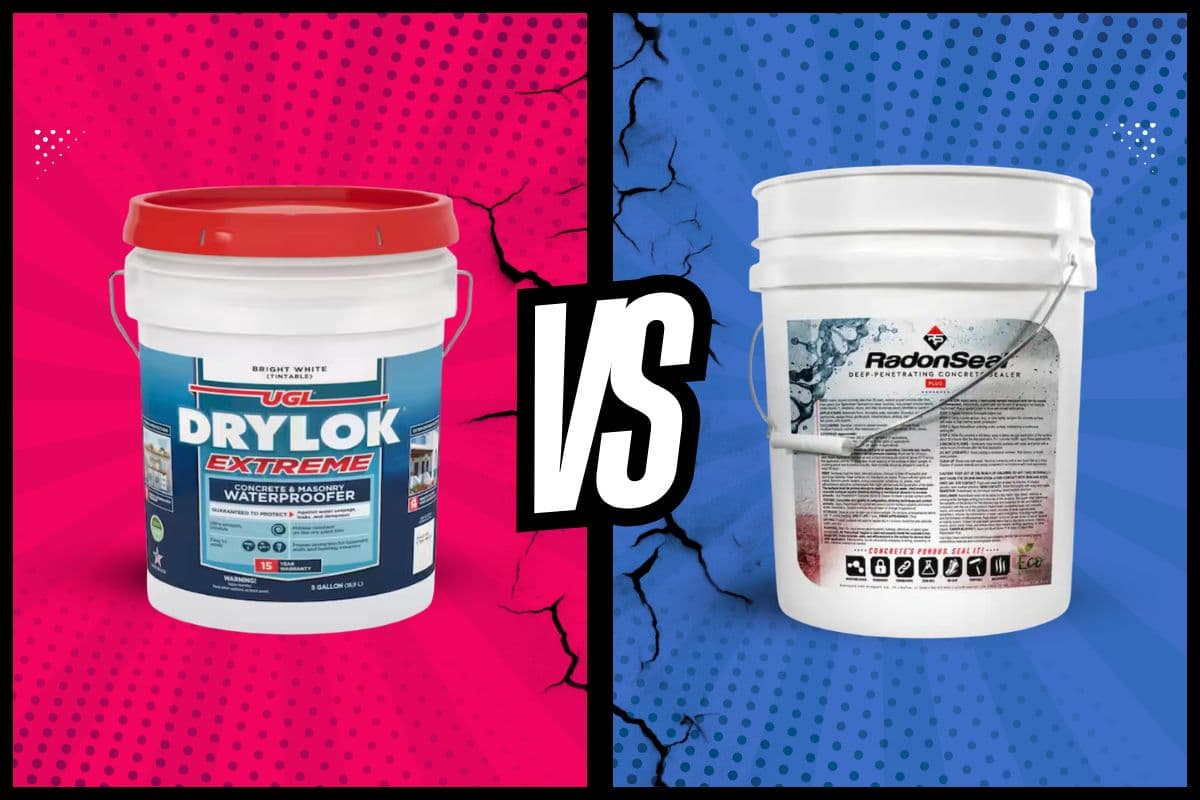
Choosing the right sealer for your basement walls can make all the difference between a dry, usable space and ongoing battles with moisture, mold, and even radon gas. Drylok and RadonSeal are two popular options, but they work in very different ways. Drylok is a surface-coating waterproofing paint that creates a barrier on top of your concrete or block walls, while RadonSeal is a penetrating concrete sealer that soaks deep into the pores to seal from within.
In this comparison, we break down the pros, cons, key differences, costs, application tips, and real-world recommendations. Whether you are dealing with minor dampness, efflorescence, or full-on leaks, understanding Drylok vs RadonSeal will help you pick the best basement wall sealer for your needs.
Drylok and RadonSeal represent two different product categories that address basement moisture at different points in the problem: Drylok is a surface barrier that sits on top of the concrete and resists moisture from penetrating inward, while RadonSeal is a penetrating treatment that reacts chemically with the concrete matrix to seal pores from within the material itself. The critical limitation shared by both products is that neither is a substitute for a drainage system when active hydrostatic water is entering the basement under pressure — sealers of either type work best for vapor transmission, minor dampness, and efflorescence control rather than for water that is flowing through the wall under load. In practice, the two products are often complementary rather than competing: RadonSeal is applied first as a permanent base treatment that hardens the concrete and blocks pores, then Drylok is applied over it to provide a painted surface finish and an additional moisture barrier for the wall face. Understanding this layered relationship prevents the common mistake of choosing one product over the other when the right answer for a specific wall may be both in sequence.
Quick Comparison Table: Drylok vs RadonSeal
| Feature | Drylok Extreme | RadonSeal Plus |
|---|---|---|
| Type | Surface coating (latex paint) | Penetrating silicate sealer |
| Application | Brush, roller, or sprayer (2 coats) | Low-pressure sprayer (1–2 coats) |
| Penetration Depth | Surface only (1/16 inch) | Up to 4 inches into concrete |
| Lifespan | 5–10 years | 20+ years |
| Waterproofing | Good for minor seepage | Excellent for hydrostatic pressure |
| Radon Reduction | Minimal | Up to 99% |
| Mold Resistance | Built-in biocide (Extreme) | Reduces efflorescence |
| Cost (5-gal) | $100–$150 | $150–$250 |
| Coverage per Gallon | 75–100 sq ft | 200–250 sq ft |
| Best For | Quick DIY, painted look | Long-term, unfinished walls |
National average cost for a full basement application (500–1,000 sq ft): $500–$1,500 for materials plus labor if needed.
What Is Drylok and How Does It Work?
Drylok is a masonry waterproofing paint made by United Gilsonite Laboratories (UGL). It comes in versions like Drylok Original (basic) and Drylok Extreme (with added mildew resistance). You apply it like thick paint to interior basement walls, where it dries to form a flexible, watertight barrier. It is designed to withstand up to 10–15 psi of hydrostatic pressure, making it a solid choice for minor water issues.
Pros of Drylok
- ✓ Easy DIY application – no special tools needed
- ✓ Affordable and widely available at Home Depot
- ✓ Gives walls a clean, painted finish
- ✓ Mildew-resistant formula in Extreme version
- ✓ Quick drying – 2–3 hours between coats
Cons of Drylok
- ✗ Surface-only protection – can peel under high pressure
- ✗ Needs reapplication every 5–10 years
- ✗ Does not block radon gas effectively
- ✗ Walls must be clean and dry for adhesion
- ✗ Not ideal for very porous or crumbling surfaces
📌Our Pick: Drylok Extreme – $120 per 5-gallon bucket on Amazon. Best for its built-in mildew fighter.
What Is RadonSeal and How Does It Work?
RadonSeal is a deep-penetrating concrete sealer from Novion Technologies. It is a silicate-based formula that reacts chemically with the concrete to fill pores and capillaries from the inside out. Available in Standard (for lighter use) and Plus (for tougher jobs), it hardens the surface while allowing vapor to escape, preventing trapped moisture.
Pros of RadonSeal
- ✓ Deep penetration up to 4 inches – permanent protection
- ✓ Strengthens weak concrete and reduces efflorescence
- ✓ Excellent radon mitigation – blocks up to 99% of gas. For more on radon risks, check this EPA guide on radon.
- ✓ Long-lasting – 20+ years with minimal maintenance
- ✓ Higher coverage rate means less product needed
Cons of RadonSeal
- ✗ More expensive upfront – requires pump sprayer
- ✗ No painted finish – leaves walls natural
- ✗ Multiple coats needed on very porous block walls
- ✗ Not effective on painted/sealed surfaces without stripping
- ✗ Strong odor during application – needs ventilation
📌Our Pick: RadonSeal Plus – $200 per 5-gallon bucket on Amazon. Best for long-term sealing and radon control.
Head-to-Head: Key Things to Consider
Effectiveness Against Water
RadonSeal wins for severe hydrostatic pressure because it seals pores internally, reducing the chance of failure. Drylok is better for light dampness or as a quick barrier.
Radon and Health Concerns
If radon is a worry (test your home – levels over 4 pCi/L need action), RadonSeal is the clear choice. Drylok offers little radon blocking.
DIY Friendliness
Drylok is easier for beginners – just paint it on. RadonSeal requires more prep (acid etching for smooth concrete) and a sprayer, but it is still DIY-able.
Cost and Value
Drylok saves money short-term ($0.50–$1 per sq ft), but RadonSeal’s longevity makes it cheaper over time ($0.75–$1.25 per sq ft with better coverage).
Aesthetics and Finishing
Drylok provides a smooth, paintable surface ready for finishing. RadonSeal keeps things raw but can be painted over once cured.
Pro tip: In wet climates or older homes with block walls, combining them works well. Apply RadonSeal first for deep sealing, then Drylok for a finished look.
Recommendations and Advice
Choose Drylok If…
- You want a budget-friendly, quick fix for minor dampness
- You are prepping walls for paint or finishing
- You need a small DIY project like sealing a utility room
Choose RadonSeal If…
- You need long-term protection against leaks or radon
- You have efflorescence or a high-moisture area
- You have unfinished basement walls or plan a base layer before finishing
Always fix external issues first – gutters, grading – no sealer works if water pools outside. Test for radon and moisture before starting.
Which Product Is Right for Your Situation?
| Your Situation | Recommended Product | Reason |
|---|---|---|
| Minor dampness or condensation on bare concrete walls | RadonSeal first, then Drylok over it | Best combination for long-term moisture and vapor control |
| Quick DIY fix, walls need painted finish | Drylok Extreme | Applies like paint, dries fast, affordable and widely available |
| Radon levels between 2 and 4 pCi/L, no active drainage system yet | RadonSeal Plus | Up to 99 percent radon reduction through treated concrete |
| Radon levels at or above 4 pCi/L | Active sub-slab depressurization system, RadonSeal as supplement | Sealer alone is not sufficient at EPA action threshold |
| Efflorescence on walls, moisture migrating through | RadonSeal first to address pore pathways, then Drylok | Penetrating sealer more effective at reducing efflorescence long-term |
| Active water seeping through wall under pressure | Neither — install interior drainage system first | Neither sealer stops active hydrostatic water intrusion |
| Walls previously painted, cannot strip | Drylok over existing sound paint | RadonSeal requires bare concrete; Drylok can go over sound paint |
| Walls previously painted, stripping is possible | Strip, apply RadonSeal, then Drylok | Full performance of both products requires bare concrete |
| Unfinished basement, permanent long-term protection | RadonSeal Plus only | 20-plus year lifespan, no reapplication needed |
| Planning to finish basement with drywall | RadonSeal base coat, Drylok finish, then vapor barrier and stud wall | Layered approach before organic finishing materials are installed |
| Block walls with high porosity | RadonSeal (2 coats), then Drylok | Multiple coats of RadonSeal needed for dense block pore filling |
| Budget under $200, small area | Drylok Original | Most affordable entry-level option for minor moisture control |
| Long-term value, willing to invest upfront | RadonSeal Plus | Lower 20-year cost than repeated Drylok reapplication cycles |
Frequently Asked Questions
Which is better for basement walls, Drylok or RadonSeal?
For long-term performance, radon reduction, and permanent concrete sealing, RadonSeal is the better product because its silicate chemistry penetrates up to 4 inches into the concrete and creates a permanent internal seal that does not peel, crack, or require reapplication. For quick DIY surface protection, a painted finish, and minor dampness control, Drylok is the more practical choice because it applies like paint, dries quickly, and is widely available at home improvement stores. The most complete approach for unfinished basement walls is to apply RadonSeal first as a base treatment, allow it to cure fully, then apply Drylok over it for the surface barrier and finished appearance. Neither product is appropriate as the sole solution for walls with active water seepage under hydrostatic pressure — in that case, a drainage system addresses the water source before any sealer is applied. The question of which is better is ultimately a question of what problem you are trying to solve and on what timeline. See our complete basement waterproofing guide for how sealers fit into a complete waterproofing approach.
Can I use Drylok and RadonSeal together?
Yes, and combining them in sequence is often the most effective approach for unfinished basement walls with moisture and radon concerns. Apply RadonSeal first as the base treatment, allowing it to penetrate and cure for the full recommended time before applying anything over it — typically 24 to 48 hours depending on concrete porosity and temperature. Once RadonSeal has cured, Drylok can be applied over it in two coats to provide the surface barrier, painted finish, and additional moisture resistance that RadonSeal alone does not deliver. The combination provides RadonSeal's permanent deep-penetrating seal and radon reduction alongside Drylok's surface protection and mildew-resistant painted appearance. Do not apply Drylok first if you intend to use RadonSeal, because Drylok's surface coating prevents RadonSeal from penetrating into the concrete as intended.
How much does Drylok vs RadonSeal cost?
Drylok Extreme costs $100 to $150 per 5-gallon bucket and covers approximately 75 to 100 square feet per gallon on porous masonry surfaces, making the material cost for a 500 square foot basement approximately $250 to $375 for two coats. RadonSeal Plus costs $150 to $250 per 5-gallon bucket but covers significantly more surface at 200 to 250 square feet per gallon, making the material cost for the same 500 square foot basement approximately $150 to $250 for one to two coats. On a per-square-foot basis, RadonSeal's higher coverage rate makes it cost-competitive with or cheaper than Drylok despite its higher price per bucket. The total project cost including materials and DIY labor for a full basement application of 500 to 1,000 square feet runs $500 to $1,500 depending on which product or combination is used. RadonSeal's 20-plus year lifespan versus Drylok's 5 to 10 year lifespan before reapplication is needed makes RadonSeal significantly more cost-effective over the long term despite the similar or slightly higher upfront material cost.
Is RadonSeal worth it over Drylok?
For homeowners who want 20 or more years of protection without reapplication, permanent concrete hardening, and meaningful radon gas reduction, RadonSeal is worth the investment because its permanent chemical bond with the concrete matrix cannot peel, flake, or be pushed off by hydrostatic pressure the way a surface coating can. For homeowners who need a quick, affordable solution for minor dampness on walls that will be painted or finished, or who need to apply a sealer in the short term while planning a more comprehensive waterproofing project later, Drylok provides adequate protection at a lower upfront cost and with simpler application. The 20-plus year lifespan of RadonSeal versus the 5 to 10 year reapplication cycle for Drylok means that a homeowner who applies Drylok will spend roughly the same or more money over a 20-year period while also investing the labor of reapplication every 5 to 10 years. If radon testing has shown levels above 2 pCi/L and a full sub-slab depressurization system has not been installed, RadonSeal's radon reduction benefit adds meaningful health value beyond its moisture control function. See our radon and basement waterproofing guide for how sealer-based radon reduction compares to active mitigation systems.
Does Drylok stop radon?
Drylok provides minimal radon reduction because it is a surface coating that sits on top of the concrete rather than penetrating into the pores and capillaries where radon travels from the surrounding soil into the basement. The EPA recommends taking action when indoor radon levels reach 4 pCi/L, and surface coatings like Drylok are not recognized as an effective radon mitigation method by either the EPA or the NRPP (National Radon Proficiency Program). RadonSeal Plus is specifically formulated and tested for radon reduction, with manufacturer data showing up to 99 percent reduction in radon transmission through treated concrete surfaces. However, even RadonSeal should be understood as a supplemental measure rather than a substitute for active sub-slab depressurization when radon levels are at or above the EPA action threshold. Test your home with a radon test kit before deciding on a mitigation approach, and consult a licensed radon mitigator if levels are above 4 pCi/L. See our radon testing and mitigation guide for the full testing and mitigation framework.
What if my walls are already painted?
If your walls are already painted with a standard latex or oil-based paint, RadonSeal cannot be applied effectively over the existing coating because the penetrating silicate chemistry requires direct contact with bare concrete or masonry to react and penetrate. To use RadonSeal on previously painted walls, the existing paint must be stripped using a wire brush, sandblasting, or chemical stripper, and the surface must be clean and bare before RadonSeal is applied. Drylok can sometimes be applied over existing paint if the existing coating is sound, fully adhered, and not peeling or flaking, though the manufacturer recommends testing a small area first and preparing the surface by cleaning and removing any loose material. If the existing paint is flaking or peeling, it must be removed entirely before applying either product, because a new coating applied over a failing surface will fail at the same rate as the layer beneath it. For walls that have been previously painted with Drylok specifically, new coats of Drylok can be applied directly over the existing Drylok once the surface is cleaned and any loose or peeling material is removed.
Quick Glossary of Basement Sealer Terms
- Hydrostatic Pressure
- The lateral and upward force exerted by water-saturated soil against a foundation wall or floor, which increases with soil moisture content and depth and is the primary driver of water intrusion in basements. Neither Drylok nor RadonSeal is designed to stop active hydrostatic water intrusion under significant pressure — both products work best for vapor transmission and minor dampness control, while active seepage under pressure requires an interior drainage system. See our complete basement waterproofing guide for how sealers fit alongside drainage systems in a complete waterproofing approach.
- Efflorescence
- The white, chalky mineral deposits that appear on concrete, brick, or masonry block surfaces when water migrates through the material, dissolves soluble salts, and evaporates on the interior surface leaving the salts behind. Efflorescence is not structurally damaging but is a reliable indicator that water is actively moving through the wall, and both Drylok and RadonSeal help reduce efflorescence by limiting the moisture migration that causes it. RadonSeal is more effective at reducing efflorescence long-term because its deep penetration addresses the pore pathways through which the moisture travels, while Drylok's surface barrier may blister or peel as moisture pressure builds beneath it. See our basement efflorescence guide for how to address the underlying moisture source.
- Penetrating Sealer
- A concrete treatment that is absorbed into the pore structure of the concrete and reacts chemically with cement particles to form insoluble compounds that fill the pores from within, as opposed to a surface coating that sits on top of the material. RadonSeal is a penetrating silicate sealer that penetrates up to 4 inches into concrete and becomes a permanent part of the concrete matrix that cannot peel, crack, or be pushed off by hydrostatic pressure. Penetrating sealers require bare concrete or masonry for proper penetration and cannot be applied effectively over existing paint or coatings. See our waterproof basement paint and sealers guide for a full comparison of sealer types.
- Surface Coating
- A barrier material applied to the face of a concrete or masonry wall that dries to form a layer on top of the surface, blocking moisture from passing through from the exterior side. Drylok is a surface coating that withstands up to 10 to 15 psi of hydrostatic pressure, making it effective for minor dampness and vapor transmission but vulnerable to peeling or blistering when water pressure from behind exceeds its rated limit. Surface coatings require good surface adhesion to perform as rated, which means walls must be clean, dry, and free of dust, oil, efflorescence, and existing coatings before application.
- Radon Mitigation
- The process of reducing indoor radon gas levels through one of several recognized methods, with sub-slab depressurization (installing a pipe and fan system that draws radon from beneath the slab and vents it outside) being the most effective active method and penetrating concrete sealers like RadonSeal being a recognized passive supplemental measure. The EPA recommends taking mitigation action when indoor radon levels reach 4 pCi/L, and levels between 2 and 4 pCi/L warrant consideration given the cumulative risk of long-term exposure. Penetrating sealers can reduce radon transmission through treated concrete surfaces by up to 99 percent but do not address radon that enters through gaps, joints, or the cove joint that sealers cannot fully cover. See our radon testing and mitigation guide for the full testing and active mitigation framework.
Final Advice
Drylok vs RadonSeal comes down to your needs – quick and cheap vs durable and deep. Start with a moisture test and fix drainage, then seal. For serious issues, combine them or consult a pro. Based on 2026 reviews, RadonSeal edges out for overall durability, but Drylok shines for ease of use. For more on keeping your basement dry, see our complete waterproofing guide and efflorescence guide.