Air Quality
Best Air Purifiers
for Basements 2026
Top Picks for Mold, Odors, and Clean Air
A basement air purifier is a HEPA filtration device designed to remove mold spores, dust, musty odors, VOCs, and other airborne pollutants from below-grade living spaces. The best basement air purifiers in 2026 cost $150 to $600, use H13 True HEPA or UltraHEPA filters that capture 99.97 percent or more of particles down to 0.3 microns, and include activated carbon layers for odor and chemical removal. This guide reviews the top 4 models and explains exactly how to choose the right one for your basement.
Basements trap more airborne pollutants than any other room in your home. The combination of limited ventilation, concrete walls that absorb and release moisture, stored chemicals, and proximity to soil creates air that can be up to 10 times more polluted than outdoor air. Mold spores, dust mites, radon decay products, VOCs from paint and adhesives, and musty odors accumulate in basement air because there is nowhere for them to go.
The right air purifier makes a measurable difference. But an air purifier alone is not enough. For a complete approach to healthy basement air, pair your purifier with a quality dehumidifier to control moisture, address any mold at the source, and test for radon if you have not already.
Quick Comparison: Best Basement Air Purifiers 2026
| Model | Coverage | Filter Type | CADR (Dust) | Noise (Low) | Price | Best For |
|---|---|---|---|---|---|---|
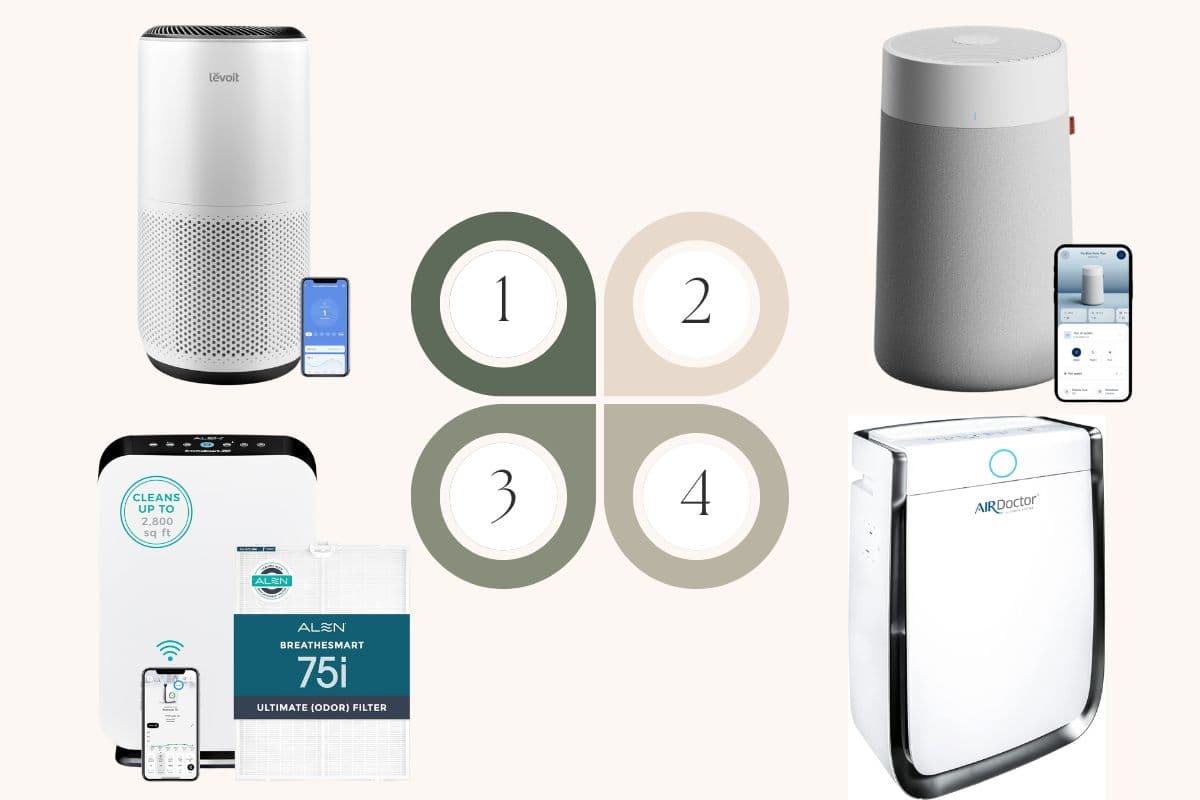
| Levoit Core 400S | 403 sq ft | H13 HEPA + Carbon | 260 CFM | 24 dB | $200 to $250 | Best overall |
| Blueair Blue Pure 211i Max | 550 sq ft | HEPASilent + Carbon | 350 CFM | 25 dB | $280 to $350 | Large basements |
| Alen BreatheSmart 75i | 1,300 sq ft | HEPA-Pure + Carbon | 347 CFM | 25 dB | $450 to $550 | Very large spaces |
| AirDoctor AD3500 | 638 sq ft | UltraHEPA + Carbon/Gas | 302 CFM | 30 dB | $400 to $550 | Mold and radon concerns |
Annual Cost of Ownership
The purchase price is only part of the cost. Filter replacements are the ongoing expense that most buyers overlook. Here is what each model costs to own over the first 3 years:
| Model | Purchase Price | Annual Filter Cost | 3-Year Total Cost | Filter Life |
|---|---|---|---|---|
| Levoit Core 400S | $200 to $250 | $50 to $70 | $350 to $460 | 6 to 8 months |
| Blueair Blue Pure 211i Max | $280 to $350 | $80 to $100 | $520 to $650 | 6 months |
| Alen BreatheSmart 75i | $450 to $550 | $70 to $100 | $660 to $850 | 9 to 12 months |
| AirDoctor AD3500 | $400 to $550 | $80 to $120 | $640 to $910 | 6 to 12 months |
How to Choose the Right Air Purifier for Your Basement
Match CADR to Your Room Size
CADR (Clean Air Delivery Rate) is the most important spec for any air purifier. It measures how many cubic feet of clean air the purifier delivers per minute. For basements, you want a CADR rating that can cycle the full volume of air in the room at least 4 times per hour.
The formula is simple: multiply your basement square footage by the ceiling height, then divide by 60 to get the minimum CADR you need for 4 air changes per hour. For a 500 square foot basement with 8-foot ceilings, that is 500 times 8 divided by 60, which equals a minimum CADR of approximately 267 CFM.
For basements with active moisture problems, mold concerns, or heavy odors, size up to 1.5 times your actual square footage. A 500 square foot musty basement should be treated as 750 square feet when selecting a purifier.
Prioritize True HEPA Filtration
Not all HEPA filters are equal. Look for H13 True HEPA or better, which captures 99.97 percent of particles at 0.3 microns. This includes mold spores (typically 1 to 30 microns), dust mites (10 to 40 microns), pollen (10 to 100 microns), and bacteria (0.3 to 10 microns).
Some manufacturers use terms like “HEPA-type” or “HEPA-style” that do not meet the true H13 standard. Avoid these for basement use where mold spore capture is critical.
Insist on Activated Carbon
Basements have odor and chemical problems that HEPA filters cannot address. HEPA captures particles but not gases or odors. An activated carbon filter adsorbs VOCs (volatile organic compounds) from stored paint, adhesives, cleaning products, and off-gassing building materials, as well as the musty smell caused by mold and mildew.
The more activated carbon in the filter (measured in pounds), the better the odor and chemical removal. Look for at least 1 to 2 pounds of activated carbon for a basement application.
Consider Noise Level
Basements used as bedrooms, home offices, or media rooms need quiet operation. Look for models that operate below 30 dB on the lowest setting, which is quieter than a whisper. Higher fan speeds will be louder — 40 to 55 dB is typical on medium to high — but the lowest setting is what you will use most of the time for continuous background purification.
Check Energy Usage
An air purifier running 24/7 in your basement adds to your electricity bill. Most quality units draw 30 to 60 watts on medium settings, which costs $25 to $50 per year in electricity. Energy Star certified models are the most efficient. This is a minor cost compared to filter replacements but worth considering over the life of the unit.
Our Top 4 Picks for 2026
1. Levoit Core 400S
Best Overall Basement Air Purifier
The Levoit Core 400S is our top pick for most basements in 2026. It delivers 260 CFM CADR in a compact, well-designed unit that covers up to 403 square feet. The H13 True HEPA filter captures 99.97 percent of particles at 0.3 microns, including mold spores, dust, pet dander, and pollen. A substantial activated carbon layer handles musty basement odors and VOCs effectively.
What sets the Levoit apart from budget competitors is its smart functionality. The built-in air quality sensor monitors PM2.5 levels in real time and displays them on the unit and in the VeSync smartphone app. Auto mode adjusts fan speed based on detected air quality, so the unit ramps up when conditions deteriorate and quiets down when the air is clean. You can also set schedules, check filter life, and control the unit remotely.
At 24 dB on the lowest setting, it is nearly silent. Filter replacements run $50 to $70 and are needed every 6 to 8 months in a typical basement environment. The washable pre-filter extends main filter life by capturing large particles before they reach the HEPA layer.
Specs: 403 sq ft coverage, 260 CFM CADR, H13 True HEPA + activated carbon, 24 dB low, Wi-Fi and app control, auto mode with PM2.5 sensor, 15 watts low to 44 watts high.
Pros
- ✓ Best balance of performance, smart features, and price
- ✓ Excellent odor elimination for musty basements
- ✓ Real-time air quality monitoring through app
- ✓ Washable pre-filter extends main filter life
- ✓ Modern design fits finished basements
Cons
- ✗ 403 square foot coverage may be tight for large basements
- ✗ No dedicated radon particle filtration
Best for: Most basements under 400 square feet seeking smart air purification with strong odor control. For larger basements, consider running two units or stepping up to the Blueair.
Price: $200 to $250
Check Price on Amazon2. Blueair Blue Pure 211i Max
Best for Large Basements
The Blueair Blue Pure 211i Max is built for larger basements up to 550 square feet. Its proprietary HEPASilent technology combines mechanical filtration with electrostatic charging to capture 99.99 percent of particles down to 0.1 microns, which is 3 times smaller than what standard H13 HEPA filters capture. This makes it exceptionally effective at trapping the smallest mold spores and fine particulates.
The heavy activated carbon filter is one of the largest in its class and tackles musty smells, chemical odors, and off-gassing VOCs aggressively. This makes it the best choice for basements that double as workshops, storage areas, or spaces with chemical odors from stored paint, solvents, or adhesives.
At 25 dB on low, it runs quieter than most competing units at this size. The trade-off is the physical size — the unit is larger than the Levoit — and filter cost (approximately $80 to $100 per year). Blueair offers a lifetime warranty when you subscribe to their filter replacement program, which partially offsets the higher filter cost.
Specs: 550 sq ft coverage, 350 CFM CADR, HEPASilent (mechanical + electrostatic) + heavy carbon, 25 dB low, Wi-Fi and app control, auto mode with particle sensor.
Pros
- ✓ Captures 99.99 percent of particles down to 0.1 microns
- ✓ Heaviest carbon filter in class for superior odor removal
- ✓ Lifetime warranty with filter subscription
- ✓ Extremely quiet at 25 dB on low
- ✓ 350 CFM CADR handles large basements effectively
Cons
- ✗ Bulkier unit may not fit tight spaces
- ✗ Filter replacements cost $80 to $100 per year
- ✗ Higher purchase price than the Levoit
Best for: Large finished basements, workshop basements, and basements with strong chemical or storage odors.
Price: $280 to $350
Check Price on Amazon3. Alen BreatheSmart 75i
Best for Very Large or Open Basements
For basements over 800 square feet or open-plan lower levels that flow into other living areas, the Alen BreatheSmart 75i is unmatched in coverage. Its 1,300 square foot rating means it can handle even the largest residential basements and still cycle air 4 or more times per hour.
The HEPA-Pure filter combined with a heavy carbon and gas trap layer tackles mold spores, pet odors, dust, and VOCs across the full space. The Alen comes with a lifetime warranty, which is the strongest warranty in the air purifier market. Filter replacements cost $70 to $100 and last 9 to 12 months, which is longer than most competitors.
The unit is whisper-quiet even on higher settings, making it ideal for basement bedrooms, home offices, and media rooms where noise is a concern. The main drawback is the lack of smart app integration. You get a remote control and on-unit controls but cannot monitor air quality or adjust settings from your phone. For homeowners who prioritize coverage area and long-term reliability over smart features, this is the best choice.
Specs: 1,300 sq ft coverage, 347 CFM CADR, HEPA-Pure + carbon/gas filter, 25 dB low, remote control, auto mode with particle sensor, lifetime warranty.
Pros
- ✓ Covers up to 1,300 square feet, the largest coverage in this roundup
- ✓ Lifetime warranty — best in class
- ✓ Filters last 9 to 12 months, longer than competitors
- ✓ Quiet operation even on higher settings
- ✓ Slim tower design fits along walls
Cons
- ✗ No Wi-Fi or smartphone app integration
- ✗ Higher purchase price ($450 to $550)
- ✗ Overkill for basements under 600 square feet
Best for: Large open basements, walkout basements connected to living spaces, and homeowners who want lifetime warranty coverage.
Price: $450 to $550
Check Price on Amazon4. AirDoctor AD3500
Best for Mold and Radon-Prone Basements
The AirDoctor AD3500 uses a proprietary UltraHEPA filter that captures particles 100 times smaller than what a standard HEPA filter captures, down to 0.003 microns. This makes it the most effective unit in this roundup at trapping microscopic mold spores, bacteria, viruses, and radon decay products (called radon daughters or radon progeny), which are solid radioactive particles that attach to dust and aerosols in the air.
The dual-action carbon and gas trap filter eliminates musty VOCs, chemical odors, and formaldehyde. Auto mode uses a built-in air quality sensor to adjust fan speed in real time. The unit covers 638 square feet and delivers 302 CFM CADR, placing it between the Levoit and Blueair in coverage.
Important note: no air purifier removes radon gas itself. Radon is a noble gas that passes through all consumer filtration. What the AirDoctor captures are radon decay products, the solid radioactive particles produced when radon breaks down. These decay products are what attach to lung tissue and cause the cancer risk associated with radon exposure. For actual radon gas reduction, you need a dedicated sub-slab depressurization system. See our radon testing and mitigation guide and radon and basement waterproofing guide.
Specs: 638 sq ft coverage, 302 CFM CADR, UltraHEPA (captures to 0.003 microns) + carbon/gas trap, 30 dB low, auto mode with air quality sensor.
Pros
- ✓ UltraHEPA captures particles 100 times smaller than standard HEPA
- ✓ Best option for radon decay product filtration
- ✓ Dual carbon and gas trap for VOCs and chemical odors
- ✓ Auto mode adjusts to real-time air quality
- ✓ Quiet operation with modern design
Cons
- ✗ Higher upfront cost ($400 to $550)
- ✗ Filter replacements are the most expensive ($80 to $120 per year)
- ✗ Does not remove radon gas itself, only decay products
Best for: Basements with known mold problems, elevated radon levels, or chemical off-gassing concerns. Pair with a radon mitigation system for complete radon protection.
Price: $400 to $550
Check Price on AmazonAir Purifier vs Dehumidifier: Do You Need Both?
An air purifier and a dehumidifier solve different problems. You likely need both.
- What an air purifier does: Removes airborne particles (mold spores, dust, pollen, pet dander) and adsorbs gaseous pollutants (VOCs, odors, chemicals) from the air using HEPA and carbon filtration. It does not remove moisture.
- What a dehumidifier does: Removes excess moisture from the air to maintain relative humidity below 50 percent, which prevents mold growth, condensation, and musty odors. It does not filter particles or chemicals. See our best basement dehumidifiers guide for product recommendations.
Why you need both: A dehumidifier prevents new mold from growing by keeping humidity low. An air purifier captures existing mold spores that are already airborne and eliminates the odors and VOCs that a dehumidifier cannot address. Running both provides complete basement air quality management. See our dehumidifier myths guide for common misconceptions about dehumidifier capabilities.
Where to Place Your Basement Air Purifier
Placement affects performance significantly. Follow these guidelines for best results:
- Center of the room when possible. An air purifier draws air in from all sides and pushes clean air out. Placing it in the center of the basement or at least away from walls allows maximum air circulation. If centering is not practical, place the unit at least 12 to 18 inches from any wall.
- Near the source of the problem. If your basement has a specific mold-prone area, a musty corner, or a workshop area with chemical fumes, place the purifier closer to that zone. The unit will capture pollutants at higher concentrations before they spread throughout the space.
- Off the floor. Elevating the purifier 12 to 24 inches on a table or shelf can improve air intake because many basement pollutants are heavier than air and concentrate at floor level. Some models are designed for floor placement, so check the manufacturer’s recommendation.
- Away from obstructions. Do not place the purifier behind furniture, in a closet, or in a corner where airflow is restricted on multiple sides. Leave at least 2 feet of clearance around the air intake and outlet.
- One per zone in large basements. If your basement has multiple rooms or an L-shaped layout, a single purifier may not reach all areas effectively. Two smaller units placed in different zones often outperform one large unit in a compartmentalized basement.
Frequently Asked Questions
Do air purifiers help with basement mold?
Yes. HEPA air purifiers capture airborne mold spores before they can settle on surfaces and establish new colonies. A quality H13 True HEPA filter removes 99.97 percent of mold spores from the air. However, an air purifier does not kill mold at the source or remove moisture that causes mold growth. For complete mold management, pair the purifier with a dehumidifier set below 50 percent relative humidity, fix any water intrusion, and address existing mold colonies with proper remediation. See our mold prevention guide and mold remediation cost guide for the full approach.
What size air purifier do I need for my basement?
Match the purifier’s CADR (Clean Air Delivery Rate) to your basement volume. For a standard 8-foot ceiling basement, multiply your square footage by 8, then divide by 60 to get the minimum CADR for 4 air changes per hour. A 400 square foot basement needs approximately 53 CFM minimum CADR. For damp or musty basements, size up to 1.5 times your actual square footage. A 500 square foot musty basement should use a purifier rated for 750 square feet or higher. When in doubt, a larger unit running on a lower fan speed is quieter and more effective than a smaller unit running on high.
Can an air purifier remove radon from my basement?
No consumer air purifier removes radon gas from the air. Radon is a noble gas that passes through all HEPA and carbon filters. However, some advanced purifiers like the AirDoctor AD3500 with UltraHEPA filtration can capture radon decay products (radon daughters), which are the solid radioactive particles produced when radon breaks down. These decay products attach to dust and aerosols and are what actually damage lung tissue when inhaled. Capturing them reduces your exposure risk. For actual radon gas reduction, you need a dedicated sub-slab depressurization mitigation system. See our radon testing and mitigation guide.
How often should I replace my basement air purifier filter?
Most HEPA filters last 6 to 12 months in a basement environment, with the wide range depending on how polluted your air is, how many hours per day the unit runs, and whether the unit has a washable pre-filter that captures large particles first. Basements with heavy dust, active mold, pet hair, or workshop use will exhaust filters faster (closer to 6 months). Clean, low-traffic basements with good moisture control may get 12 months from a filter. Most quality purifiers have a filter life indicator that tells you when replacement is needed. Never wash or vacuum a True HEPA filter as this damages the fine fibers and destroys its effectiveness.
Do I need both an air purifier and a dehumidifier in my basement?
For most basements, yes. A dehumidifier removes excess moisture from the air to prevent mold growth and condensation, but it does not filter airborne particles, mold spores, or chemical pollutants. An air purifier captures particles and adsorbs VOCs and odors, but it does not remove moisture. Running both provides complete air quality management — the dehumidifier prevents mold from growing, and the air purifier removes spores that are already airborne plus eliminates musty odors and chemical fumes. See our best basement dehumidifiers guide for dehumidifier recommendations.
Will an air purifier get rid of musty basement smell?
An air purifier with a substantial activated carbon filter will significantly reduce musty basement odor, but it may not eliminate it completely if the underlying moisture source is not addressed. Musty smell is caused by mVOCs (microbial volatile organic compounds) produced by mold and mildew colonies. An activated carbon filter adsorbs these compounds from the air. However, if active mold is growing behind walls, under flooring, or on hidden surfaces, the mold will continue producing mVOCs faster than the purifier can remove them. Fix the moisture source, address any visible mold, run a dehumidifier below 50 percent humidity, and the air purifier will handle the residual odor. See our musty basement smell guide for a complete troubleshooting approach.
How much does it cost to run an air purifier in a basement?
Running a basement air purifier 24/7 costs $25 to $50 per year in electricity for most models, which draw 30 to 60 watts on medium settings. The larger ongoing cost is filter replacement at $50 to $120 per year depending on the model and how often filters need changing. Total annual operating cost including electricity and filters ranges from $75 to $170. Over 3 years, total cost of ownership (purchase price plus filters plus electricity) ranges from $350 for the Levoit Core 400S to approximately $910 for the AirDoctor AD3500.
Are ionizer air purifiers safe for basements?
Ionizer-only air purifiers without HEPA filtration are not recommended for basements. Ionizers work by charging particles so they stick to surfaces, but they do not actually remove pollutants from the air. Some ionizers produce ozone as a byproduct, which is a lung irritant that is especially problematic in poorly ventilated basement spaces. If a purifier includes an ionizer as a supplementary feature alongside True HEPA filtration (like some Levoit models), the ionizer is safe to use but optional. Always prioritize True HEPA and activated carbon filtration over ionizer technology for basement applications.
Glossary of Air Purifier Terms
HEPA (High-Efficiency Particulate Air)
A filtration standard that requires the filter to capture at least 99.97 percent of particles 0.3 microns in diameter. H13 is the grade used in quality consumer air purifiers and is effective at capturing mold spores, dust mites, pollen, bacteria, and pet dander. Avoid filters labeled “HEPA-type” or “HEPA-style” as these do not meet the true H13 standard.
CADR (Clean Air Delivery Rate)
The volume of filtered air delivered by the purifier per minute, measured in cubic feet per minute (CFM). CADR is the single most important performance metric for comparing air purifiers. Higher CADR means faster air cleaning. For basement use, calculate your minimum CADR by multiplying square footage by ceiling height and dividing by 60.
Activated Carbon
A form of carbon processed to have millions of microscopic pores that adsorb (trap on the surface) gaseous pollutants including VOCs, odors, and chemical fumes. Activated carbon is the filter component that eliminates musty basement smell, paint fumes, and off-gassing chemicals. More carbon (measured in pounds) provides better odor and chemical removal.
VOCs (Volatile Organic Compounds)
Chemical gases released by paints, adhesives, solvents, cleaning products, new furniture, and building materials. VOCs are common in basements that store household chemicals or contain recently installed building materials. Activated carbon filtration removes VOCs from the air.
mVOCs (Microbial Volatile Organic Compounds)
Chemical compounds produced by mold and mildew colonies during their growth and metabolism. mVOCs are responsible for the characteristic musty smell in damp basements. An activated carbon filter adsorbs mVOCs from the air, but eliminating the smell permanently requires addressing the mold colony and moisture source.
UltraHEPA
A proprietary filtration standard used by AirDoctor that captures particles down to 0.003 microns, which is 100 times smaller than what standard H13 HEPA filters capture. UltraHEPA is effective at trapping the smallest mold spores, bacteria, viruses, and radon decay products.
Radon Decay Products (Radon Daughters/Progeny)
Solid radioactive particles produced when radon gas breaks down. These particles attach to dust and aerosols in the air and, when inhaled, lodge in lung tissue where they continue to emit radiation. UltraHEPA and True HEPA filters can capture radon decay products attached to dust particles, reducing inhalation exposure. See our radon testing and mitigation guide.
Pre-filter
A washable mesh or foam filter layer that captures large particles (dust, hair, lint) before they reach the main HEPA filter. Pre-filters extend the life of the more expensive HEPA filter by preventing it from clogging with large debris. Wash or vacuum the pre-filter every 2 to 4 weeks for best performance.
ACH (Air Changes per Hour)
The number of times an air purifier cycles the entire volume of air in a room per hour. For basement applications with mold or odor concerns, target at least 4 ACH. Higher ACH means cleaner air but requires a more powerful (and louder) purifier or a unit sized larger than the room.
Related Guides
Best Basement Dehumidifiers
How to Prevent Basement Mold
Mold Remediation Cost
Musty Basement Smell
Basement Humidity Guide
Dehumidifier Myths
Radon Testing and Mitigation
Radon and Basement Waterproofing
Complete Basement Waterproofing Guide
Basement Home Gym
Basement Insulation Guide
Basement Efflorescence
From Our Network
The Septic Guide covers septic odor causes and fixes, which addresses airborne odor problems from a different source but uses similar air quality management principles.
The Garage Guide covers garage ventilation, which addresses air quality in another enclosed space where VOCs and chemical fumes are common.