Basement Ventilation Guide: Exhaust Fans, Air Exchange, and Systems
The Basement Guide Editorial Team
Category: Article
TL;DR
Basement ventilation is air exchange: moving stale indoor air out and fresh outdoor air in. This is different from dehumidification, which removes moisture from existing air without replacing it. Most basements need both. The three main ventilation approaches are passive ventilation (windows and vents, lowest cost), mechanical exhaust fans (through-wall or inline duct fans, moderate cost), and balanced ventilation systems (HRV or ERV, highest cost and best performance). A basic through-wall exhaust fan costs $150 to $400 installed and solves stuffy-air problems in most finished basements. HRV and ERV systems cost $1,500 to $4,000 installed but maintain comfortable humidity and temperature while exchanging air. If your basement is stuffy but not damp, you need ventilation. If it is damp but not stuffy, you need dehumidification. If both, you need both.
Decision Rule
The Stale vs Wet Rule
If your basement air feels stuffy, stale, or makes your eyes water when you first walk down the stairs, you have a ventilation problem. If your basement feels damp, clammy, or shows condensation on walls and cold surfaces, you have a humidity problem. If both, you have both problems and need both a ventilation strategy AND a dehumidification strategy. Ventilation exchanges air between inside and outside; dehumidification removes water vapor from existing air. These are different functions solved by different equipment, and running a dehumidifier will not fix stale air the same way opening a window will not fix chronic dampness in a sealed basement. Diagnose what you actually have before buying equipment to fix it.
Do This First
The 5-Minute Diagnostic
Before buying any equipment, walk down to your basement and spend 5 minutes there. Answer these three questions:
- 1
Does the air feel stale, stuffy, or make your eyes water? (If yes, ventilation problem)
- 2
Does the air feel damp, clammy, or heavy to breathe? (If yes, humidity problem)
- 3
Do cold surfaces show condensation, or do walls feel cool and wet to the touch? (If yes, definitely a humidity problem)
Stuffy without damp means you need ventilation. Damp without stuffy means you need dehumidification. Both symptoms means you need both. If you can answer this diagnostic in 5 minutes with your own senses, you will save yourself several hundred dollars worth of wrong equipment. Homeowners who skip this step buy a $300 dehumidifier expecting it to fix stale air, or install a $500 exhaust fan expecting it to fix dampness, and then are frustrated when the problem does not go away. The equipment is doing exactly what it was designed to do; it is just not solving the problem you actually have.
Why Basements Need Ventilation
If your basement smells stuffy no matter how many dehumidifiers you run, the problem is not humidity. It is air. A basement can have perfectly managed moisture levels and still feel oppressive because no fresh air is moving through. Most residential basements have no mechanical ventilation at all. The air that was down there when the house was built is essentially the same air that is still down there today, minus whatever gets pushed out when someone opens a door or window. This is not how any other part of your house works.
Basements accumulate a specific set of air quality problems that do not affect upper floors the same way:
- Stack effect pulls air downward. In most homes, warm air rises and escapes through upper-floor gaps, which pulls outside air inward through lower-level gaps. Basements are the entry point for that makeup air, which means they collect whatever is in the ground around your foundation (radon, soil gas, moisture, and sometimes pesticides or fertilizers).
- Radon concentrates at the lowest level. Radon is a naturally occurring radioactive gas that seeps from soil into homes through foundation cracks and openings. The EPA estimates that radon is responsible for approximately 21,000 lung cancer deaths per year in the United States. Basements consistently show the highest radon levels in a home because they are closest to the soil source.
- Humidity lingers because the ground is cold. Basement walls and floors stay cold year-round because they are in contact with the ground. Cold surfaces cause condensation from whatever humidity is in the air, which is why basements feel damp even when the rest of the house feels fine.
- VOCs and off-gassing accumulate. Paint, carpet, foam insulation, pressure-treated lumber, and many common basement materials off-gas volatile organic compounds (VOCs) slowly over months or years. Without ventilation, these compounds accumulate rather than dispersing.
- CO2 rises with any use. If you spend time in your basement (home office, gym, bedroom, finished living area), you exhale CO2 and consume oxygen. In a sealed basement, CO2 levels can rise enough to cause headaches, drowsiness, and mental fog within hours.
The EPA's Indoor Air Quality guidance for remodeling explicitly states that basements should be included in a home's ventilation strategy, and that homes without mechanical ventilation should consider adding a system during any significant basement work.
Ventilation vs Dehumidification: The Core Distinction
This is the single most important concept in basement air quality, and most homeowners get it wrong. The two systems solve different problems:
Ventilation exchanges air. A ventilation system moves stale inside air out and brings fresh outside air in. It changes WHAT is in the basement air (removing accumulated pollutants, CO2, odors, VOCs, radon). It does not necessarily change how humid the air is. On a humid summer day, pulling outside air in can actually INCREASE basement humidity.
Dehumidification removes moisture. A dehumidifier pulls moisture out of the existing air without changing what else is in the air. It changes HOW MUCH water vapor is in the basement air. It does not introduce fresh air, remove VOCs or odors, or address CO2 buildup.
A basement with stale, musty, oppressive air but normal humidity needs ventilation. A basement with clammy, damp feeling and wet walls but otherwise odorless air needs dehumidification. A basement with stuffy, musty, AND damp conditions needs both.
This distinction matters because homeowners regularly buy the wrong equipment. A dehumidifier will not fix stale air; the air will just become dry and stale. An exhaust fan alone will not fix dampness in a humid climate; it may pull humid outside air in and make the problem worse.
For detailed guidance on the dehumidification side, see our basement humidity guide and best basement dehumidifiers review.
Types of Basement Ventilation Systems
Three distinct approaches cover the full range of basement ventilation needs. Choice depends on basement size, climate, existing HVAC, and budget.
Passive Ventilation
Passive ventilation uses natural air movement driven by pressure differences, temperature differences, and wind to exchange air without mechanical equipment. This is the simplest approach and costs almost nothing to implement, but it is also the least reliable.
- How it works:
- Open basement windows on opposite sides of the house to create cross-ventilation. Install non-closeable foundation vents. Use the stack effect (warm air rising, cool air falling) to drive natural air movement.
- Cost:
- $0 to $200 for vent caps and minor installations.
- Best for:
- Unfinished basements in mild climates, homes with existing basement windows that open, temporary solutions during specific seasons.
- Limitations:
- Weather-dependent (no airflow on still days), season-dependent (you cannot leave windows open in winter), security concerns with open windows, and does not work at all in basements without windows.
Mechanical Exhaust Fans
Mechanical exhaust fans use an electric fan to actively move air out of the basement, creating negative pressure that pulls makeup air in from the rest of the house or from passive vents. This is the workhorse category for most residential basement ventilation problems.
Three subtypes within mechanical exhaust:
Through-wall exhaust fans
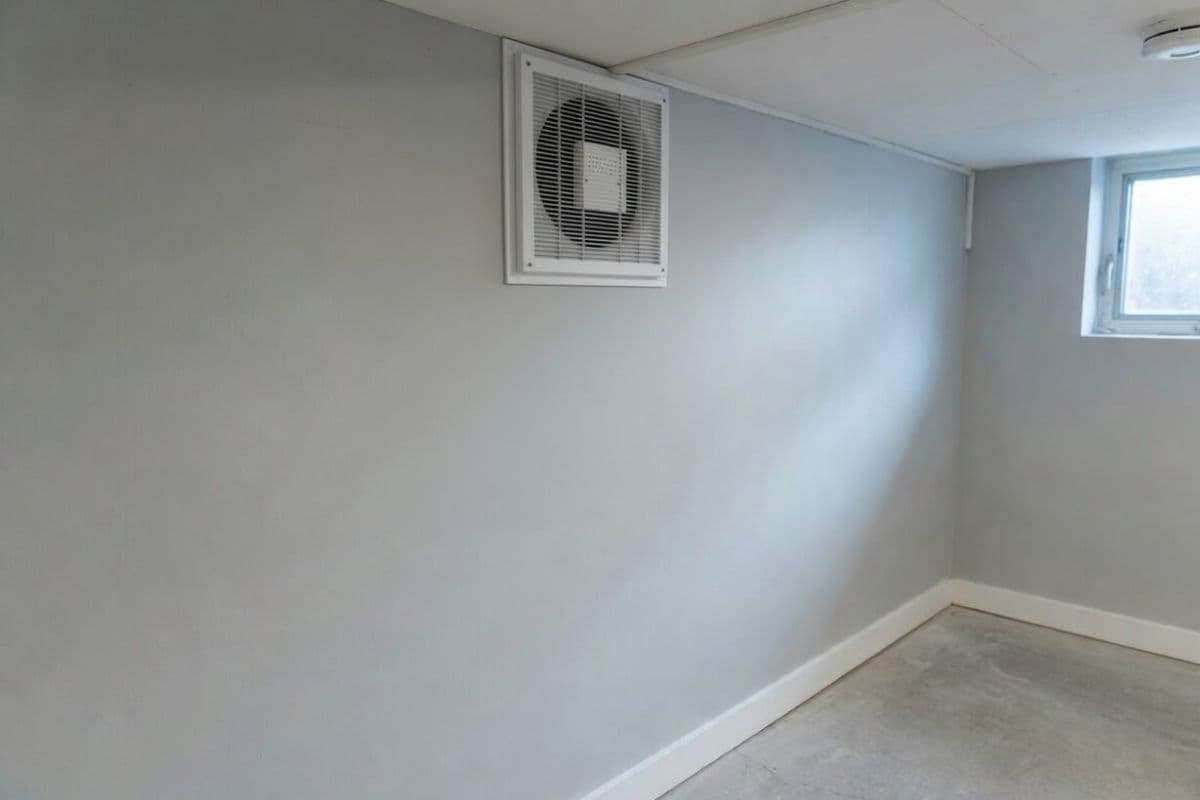
Through-wall exhaust fans mount directly into an exterior wall of the basement and vent to the outside. They are the simplest to install, require no ductwork, and work well for walkout basements or basements with at least one above-grade wall. A typical residential through-wall basement fan moves 70 to 290 CFM (cubic feet per minute) and costs $150 to $400 installed DIY.
The Broan-NuTone 509S is the leading through-wall option for basement ventilation, rated at 200 CFM with a built-in on/off switch and built-in exterior wall cap, which eliminates the need for separate ductwork or a separate wall switch. The galvanized steel housing adjusts for wall thicknesses from 4.5 to 9.5 inches, fitting standard basement wall construction. Installation requires cutting a hole in an exterior wall and wiring to a 20-amp circuit, which most DIY homeowners can handle in a weekend.
Inline duct fans
Inline duct fans mount inside existing ductwork or a custom duct run and push air through the duct to an exterior vent. These fans are more powerful than through-wall fans and can vent basements that lack a direct exterior wall. They require more installation work (running duct, cutting an exterior vent).
The AC Infinity CLOUDLINE S6 is a commonly recommended 6-inch inline duct fan for basement ventilation, rated at 402 CFM with a 10-speed controller and a 34 dBA noise level. The smaller CLOUDLINE S4 (205 CFM) works for smaller basements, and the budget CLOUDLINE A6 (352 CFM) offers similar performance at lower cost.
Bathroom-style ceiling fans
Bathroom-style ceiling fans can be adapted for general basement ventilation if you have a finished basement bathroom or can vent through a floor joist bay to an exterior wall. These fans move less air (50 to 110 CFM) than dedicated through-wall or inline fans but are simple to install and inexpensive.
- Cost:
- $100 to $500 for the fan itself, plus $100 to $300 for DIY installation materials (exterior vent hood, ducting, electrical). Professional installation adds $300 to $800.
- Best for:
- Most residential basements, finished or unfinished, where adding a single exhaust path to an exterior wall is feasible.
- Limitations:
- Exhaust-only ventilation creates negative pressure in the basement, which can pull backdrafting combustion gases from gas water heaters, furnaces, or fireplaces if these are present. Professional combustion safety check is essential if you have any combustion appliances in the basement. Also, exhaust-only systems waste conditioned air (heated air in winter, cooled air in summer) as that air is being pulled out of your house.
Balanced Ventilation (HRV and ERV Systems)
Balanced ventilation systems are the highest-performance basement ventilation solution. These systems use two fans (one exhausting stale air, one bringing in fresh air) in a single unit with a heat exchanger between them. The heat exchanger recovers 60 to 90 percent of the heating or cooling energy from the outgoing air and transfers it to the incoming air, dramatically reducing the energy penalty of ventilation.
Two variants:
Heat Recovery Ventilators (HRVs)
Heat Recovery Ventilators transfer heat between air streams. Best for cold climates where you need to recover heat in winter from outgoing warm air.
Energy Recovery Ventilators (ERVs)
Energy Recovery Ventilators transfer both heat AND moisture between air streams. Best for hot humid climates where you need to exclude incoming summer moisture, and increasingly popular in mixed climates as all-season solutions.
- Cost:
- $1,500 to $4,000 installed, including a balanced-airflow ducted unit and professional installation. Ductless ERV units (wall-mounted, suitable for single-room basement installation) cost $1,000 to $2,500 installed.
- Popular brands:
- Fantech, Panasonic Intelli-Balance, Broan, Zehnder, Renewaire. Most HRV/ERV systems are sold through HVAC contractors rather than direct-to-consumer retail.
- Best for:
- Finished basements used as living space, basements in homes with tight construction and radon concerns, high-performance and energy-efficient homes, and any basement where ongoing air quality management justifies the higher upfront cost.
- Limitations:
- Professional installation almost always required (correct sizing, ducting, balancing airflow, electrical). Filters need periodic cleaning or replacement. Not cost-effective for unfinished basements that are rarely used.
How to Choose the Right Ventilation Approach
Decision matrix based on basement type and use:
| Basement Type | Recommended Approach | Typical Cost |
|---|---|---|
| Unfinished, rarely used, mild climate | Passive ventilation (windows, vents) | $0 to $200 |
| Unfinished, rarely used, any climate | Through-wall exhaust fan | $200 to $500 |
| Partially finished, occasional use | Through-wall or inline duct fan | $300 to $800 |
| Finished living space, any use | Inline duct fan + radon-aware design | $500 to $1,500 |
| Finished living space, primary use | HRV or ERV system | $1,500 to $4,000 |
| Finished space in tight/new home | ERV system (required for indoor air quality) | $2,000 to $4,000 |
Additional factors that shift the recommendation:
- Radon levels above 2 pCi/L. Consider balanced ventilation (HRV/ERV) rather than exhaust-only, because exhaust-only can actually increase radon by creating negative pressure that pulls more soil gas into the basement. See our radon testing and mitigation guide for the full context.
- Combustion appliances in basement. Exhaust-only ventilation creates backdrafting risk with gas water heaters, furnaces, and fireplaces. Balanced ventilation (HRV/ERV) is safer. Professional combustion safety inspection essential either way.
- Humid climate. ERV systems are strongly preferred over HRV because ERVs keep summer moisture outside.
- Cold climate. HRV systems are cost-effective and recover maximum winter heat.
How to Install a Basement Exhaust Fan (DIY)
Through-wall exhaust fan installation is within DIY scope for most homeowners comfortable with basic electrical work and using a reciprocating saw. Budget 4 to 8 hours for a first installation.
Tools needed: Reciprocating saw (or hole saw), drill, stud finder, level, caulk gun, voltmeter, wire strippers, wire nuts.
Materials needed: Through-wall exhaust fan kit (such as the Panasonic WhisperWall above), 12-gauge or 14-gauge electrical cable (check your fan's amp rating), exterior caulk, mounting screws, vent hood for exterior wall (often included with fan).
Steps:
- Select location. Pick an exterior wall in the area of the basement with the worst air quality. Avoid locations directly over or under sleeping areas. Verify no electrical wiring, plumbing, or ducts are inside the wall cavity at the chosen location.
- Run electrical circuit. Most exhaust fans require a dedicated 20-amp circuit with GFCI protection. If you are not comfortable running new circuit, hire an electrician for this step ($100 to $300).
- Cut exterior and interior holes. Use the template provided with the fan to mark the cutout size, drill pilot holes at the corners, and cut through both the interior drywall and exterior siding with a reciprocating saw.
- Mount the fan housing. Insert the fan housing into the wall from inside the basement, secure with provided mounting screws to the wall studs, and caulk the seam between housing and wall on both interior and exterior sides.
- Connect electrical. Wire the fan to your new circuit following the manufacturer's wiring diagram. Install a timer switch or humidity-activated switch for automatic operation.
- Install exterior vent hood. Most kits include a vent hood that mounts on the exterior wall. Caulk thoroughly to prevent water intrusion.
- Test operation. Run the fan on all speeds. Verify that air is actually exhausting outside (hold a tissue near the exterior vent to confirm airflow).
- Install intake vent (optional but recommended). An exhaust fan with no dedicated air intake will pull air from whatever path of least resistance exists, which may be the gap under your basement door (drawing air down from upstairs) or a floor drain (drawing sewer gas up). Install a dedicated passive intake vent on the opposite wall from the exhaust fan.
Ventilation Requirements and Building Codes
The International Residential Code (IRC) and ASHRAE 62.2 standard both address ventilation for habitable spaces. For basements specifically:
- Habitable basements (finished living space, bedrooms, offices used daily) must meet the same ventilation requirements as upper-floor rooms, which typically means 7.5 CFM of continuous ventilation per person plus 1 CFM per 100 square feet of floor area.
- Non-habitable basements (storage, utility spaces, unfinished) have no specific ventilation requirement in most jurisdictions, though building codes require specific ventilation if combustion appliances are present.
- Radon-resistant construction is increasingly required in new construction in EPA Zone 1 (high-radon) regions. These requirements include passive radon ventilation systems that can be activated with a fan if post-construction testing shows elevated radon.
Check your local building code before installing any permanent ventilation system, especially if you are doing basement finishing work that requires a permit.
Common Mistakes
Running a dehumidifier and expecting it to fix stale air. A dehumidifier cannot introduce fresh air or remove CO2, VOCs, or odors. If the problem is stale air, no amount of dehumidification will fix it.
Opening basement windows on humid summer days. Pulling humid 85-degree outside air into a 65-degree basement causes condensation on cold surfaces, which makes dampness worse. Use ventilation seasonally in dry conditions, or install an ERV that manages incoming moisture.
Installing exhaust-only ventilation with combustion appliances. Negative pressure from an exhaust fan can cause backdrafting in gas water heaters and furnaces, pulling carbon monoxide into the living space. Always have combustion safety tested after installing exhaust ventilation.
Choosing fan CFM based on basement size alone. CFM requirements depend on use, not just size. A 1,500 square foot finished living-space basement needs significantly more ventilation than a 1,500 square foot storage basement.
Venting the exhaust fan into an attic, crawlspace, or garage. Exhaust fans must vent to the exterior, not into another enclosed space. Venting into an attic creates moisture problems; venting into a garage is a fire safety and carbon monoxide concern.
Not installing an air intake. An exhaust fan without a dedicated intake path will pull air from whatever gap is easiest, including under doors, around sewer connections, or through radon entry points.
Assuming HVAC supply ducts count as ventilation. Your HVAC system recirculates existing indoor air through ducts; it does not exchange air with the outside. Basement HVAC supply vents improve air circulation within the home but do not ventilate the basement.
When to Call a Professional
Three scenarios where professional installation is essential rather than optional:
HRV or ERV installation. Balanced ventilation requires correct sizing for the basement volume and use, properly balanced supply and exhaust airflow, integration with existing HVAC, and correct electrical. Get professional help.
Basement with combustion appliances. Any exhaust ventilation change with gas water heaters, furnaces, or fireplaces present requires a combustion safety test to verify no backdrafting occurs after installation.
Radon mitigation combined with ventilation. Elevated radon levels require specific mitigation approaches, and the wrong ventilation design can actually increase radon entry. If you have radon levels above 2 pCi/L, work with a licensed radon mitigation professional.
Need a basement ventilation or radon mitigation professional?
Ventilation installation with combustion appliances or elevated radon requires professional expertise to avoid creating worse problems.
Get free quotes from licensed basement ventilation specialists near you →Cost Breakdown by Approach
| Approach | System Cost | Installation | Annual Operating Cost | 10-Year Total |
|---|---|---|---|---|
| Passive ventilation | $0 to $200 | $0 to $100 | $0 | $0 to $300 |
| Through-wall exhaust fan (DIY) | $150 to $400 | $100 to $300 | $30 to $80 | $550 to $1,500 |
| Through-wall exhaust fan (pro) | $150 to $400 | $400 to $800 | $30 to $80 | $850 to $2,000 |
| Inline duct fan (DIY) | $150 to $400 | $200 to $500 | $40 to $100 | $750 to $1,800 |
| Inline duct fan (pro) | $150 to $400 | $600 to $1,200 | $40 to $100 | $1,150 to $2,500 |
| HRV system (professional) | $800 to $2,000 | $700 to $2,000 | $100 to $200 | $2,500 to $5,500 |
| ERV system (professional) | $1,000 to $2,500 | $800 to $2,000 | $100 to $200 | $2,800 to $6,000 |
The comparison that matters: a $500 through-wall exhaust fan solves 80 percent of basement ventilation problems for 10 percent of the cost of an HRV/ERV system. HRV/ERV becomes cost-effective only when the basement is used daily as living space AND the climate demands energy recovery AND air quality is a priority.
Related Guides
Target humidity ranges by season and basement use, and the tools and strategies for maintaining safe levels.
Top-rated dehumidifiers with sizing guidance, for homeowners who diagnose a humidity problem rather than a ventilation problem.
The most common mistakes homeowners make when using dehumidifiers, including what a dehumidifier cannot do.
The layered moisture management system that keeps mold from establishing in the first place.
How radon enters a basement, how ventilation choices affect radon levels, and when sub-slab depressurization is required.
Tracing a musty odor to its source when mold or hidden moisture is present but not yet visible.
True HEPA purifiers that reduce airborne particulates, a useful complement to mechanical ventilation in finished basements.
Frequently Asked Questions
Does a basement really need ventilation?
Yes, basements need ventilation for the same reasons every other room in a house needs it: to remove accumulated indoor air pollutants (VOCs, CO2, radon, odors) and introduce fresh outdoor air. Basements are actually more important to ventilate than upper floors because they collect soil gases (including radon) through foundation cracks, accumulate moisture from cold surface condensation, and are often the entry point for outside air pulled in by stack effect from upper floors. The EPA explicitly recommends that basements be included in every home's ventilation strategy, and the average basement without mechanical ventilation has measurably worse air quality than the upper floors of the same home. If you use your basement as a living space, home office, gym, or bedroom, ventilation is essential. Even unfinished storage basements benefit from some ventilation to prevent moisture and VOC accumulation.
What is the difference between basement ventilation and dehumidification?
Ventilation exchanges air between inside and outside, while dehumidification removes moisture from existing air without replacing the air. A ventilation system moves stale indoor air out and brings fresh outdoor air in, changing what is in the air (removing accumulated pollutants, CO2, odors, VOCs). A dehumidifier pulls water vapor out of the existing air without changing what else is in it. Most basements actually need both systems: ventilation to handle stale air and pollutants, and dehumidification to handle cold-surface condensation and elevated humidity. A common homeowner mistake is buying only a dehumidifier when the basement needs ventilation, which results in dry but still stale air that feels oppressive and causes headaches. Conversely, running an exhaust fan in a humid summer climate can pull in outdoor moisture and increase basement dampness. The correct equipment depends on which problem you actually have.
How do I ventilate a basement with no windows?
Basements without windows require mechanical ventilation because passive ventilation through windows is not available. The three main options are through-wall exhaust fans (if you have at least one above-grade exterior wall), inline duct fans with exterior venting through a joist bay to an above-grade wall, or balanced HRV/ERV systems integrated with your HVAC. Through-wall exhaust fans like the Panasonic WhisperWall cost $150 to $400 installed DIY and work well for most basements with at least one exterior wall above grade. If no exterior wall is accessible, an inline duct fan like the AC Infinity CLOUDLINE can push air through a duct run to an exterior vent. For finished basement living space used daily, an HRV or ERV system ($1,500 to $4,000 installed) provides balanced ventilation with energy recovery, which is the best long-term solution for windowless basements in any climate.
What size exhaust fan do I need for my basement?
Target CFM depends on basement size and use rather than just square footage. For unfinished basements used for storage, size the fan for 4 to 6 air changes per hour (ACH) of your basement volume. Calculate by multiplying basement length by width by height (in feet) to get volume, then dividing by 10 (for 6 ACH) or 15 (for 4 ACH) to get required CFM. For example, a 1,200 square foot basement with 8-foot ceilings has 9,600 cubic feet of volume, requiring 640 CFM for 4 ACH or 960 CFM for 6 ACH. For finished basement living space, follow ASHRAE 62.2 which requires approximately 7.5 CFM per person plus 1 CFM per 100 square feet of floor area. A 1,200 square foot finished basement with 4 occupants needs approximately 42 CFM continuous, which is well within the range of standard bathroom-style exhaust fans. If you have combustion appliances, consult a professional because exhaust-only fans can cause backdrafting.
Can I use a bathroom exhaust fan to ventilate my basement?
Yes, bathroom-style exhaust fans can ventilate basements, though they move less air than dedicated basement fans. A typical 70 to 110 CFM bathroom fan is adequate for small to medium unfinished basements (up to approximately 1,000 square feet) as long as you can run ductwork to an exterior vent. Installation is similar to installing a bathroom fan: mount the unit to a ceiling joist or wall, run ductwork to an exterior vent hood, and wire to a timer or humidity-sensing switch for automatic operation. The limitations of using a bathroom fan for basement ventilation are airflow (bathroom fans are designed for 70 to 110 CFM, which is often insufficient for larger basements) and duty cycle (bathroom fans are designed for intermittent use during showers, not continuous operation). For finished basement living space, a larger through-wall or inline duct fan designed for continuous operation is a better choice. For occasional-use unfinished basements, a bathroom-style fan on a timer works fine.
How much does basement ventilation cost to install?
Costs vary dramatically by approach. Passive ventilation (foundation vents, opening windows) costs $0 to $200 total. A DIY through-wall exhaust fan installation costs $250 to $700 total including the fan, ducting, electrical, and installation materials. Professional installation of a through-wall fan costs $550 to $1,200 total. An inline duct fan system costs $350 to $900 DIY or $750 to $1,600 professional. HRV (Heat Recovery Ventilator) systems cost $1,500 to $3,500 installed for a ducted system. ERV (Energy Recovery Ventilator) systems cost $1,800 to $4,000 installed. The typical residential sweet spot is a through-wall or inline duct fan at $500 to $1,000 total installed, which solves most basement air quality problems without the complexity and cost of balanced ventilation. HRV/ERV systems become cost-effective only for finished basements used as daily living space in cold or humid climates where energy recovery significantly reduces heating and cooling costs.
Will basement ventilation help with radon?
Basement ventilation can reduce radon levels but is not a substitute for professional radon mitigation when levels are elevated. Increasing air exchange dilutes radon concentrations by mixing contaminated indoor air with clean outdoor air. However, exhaust-only ventilation (through-wall or inline duct fans) can actually INCREASE radon levels by creating negative pressure in the basement that pulls more soil gas in through foundation cracks. If your radon test shows levels above the EPA action level of 4 pCi/L, you need proper radon mitigation (typically sub-slab depressurization), not just ventilation. Balanced ventilation systems like HRVs and ERVs maintain neutral pressure and can be part of a comprehensive radon strategy, but the primary radon mitigation should come from a licensed radon mitigation professional. If your radon levels are below 2 pCi/L, ventilation alone can help keep levels low. If between 2 and 4 pCi/L, consider ventilation plus sealing foundation cracks. If above 4 pCi/L, get professional mitigation. See our radon testing and mitigation guide for full details.
Does my finished basement need an HRV or ERV system?
HRV or ERV systems are ideal for finished basements used as daily living space, but they are not mandatory for all finished basements. An HRV (Heat Recovery Ventilator) is best for cold climates where winter heating costs justify recovering heat from outgoing air. An ERV (Energy Recovery Ventilator) is best for humid climates where keeping summer moisture outside is important. Both systems cost $1,500 to $4,000 installed and provide balanced, continuous ventilation with 60 to 90 percent energy recovery. For finished basements used occasionally (guest rooms, rarely-used home theaters), a simpler through-wall or inline exhaust fan at $500 to $1,000 is often adequate and cost-effective. For finished basements used daily in homes with tight construction (newer homes, extensive air sealing), an ERV is strongly recommended because modern tight homes do not have enough natural air exchange to maintain indoor air quality without mechanical ventilation. For finished basements with elevated radon or combustion appliances, balanced ventilation (HRV/ERV) is safer than exhaust-only.
Glossary
Ventilation
Ventilation is the process of exchanging air between the inside of a building and the outside, removing stale indoor air and replacing it with fresh outdoor air. Ventilation is distinct from air circulation (moving air within a space) and dehumidification (removing moisture from existing air). Proper ventilation removes accumulated indoor air pollutants including carbon dioxide from human respiration, volatile organic compounds from building materials, radon from soil gas, odors from mold or chemicals, and other contaminants. Residential ventilation is accomplished through natural/passive means (open windows, vents), mechanical exhaust (fans), supply fans, or balanced systems (HRVs and ERVs). Basement ventilation is particularly important because basements collect soil gases, lack natural air movement, and often have limited or no window access for passive ventilation.
CFM (Cubic Feet per Minute)
CFM is the standard unit of measurement for airflow in ventilation systems, measuring how many cubic feet of air the fan moves per minute at rated conditions. A typical bathroom exhaust fan moves 50 to 110 CFM. A residential through-wall basement fan moves 70 to 200 CFM. An inline duct fan for basement ventilation moves 200 to 500 CFM depending on size. HRV and ERV systems are typically sized at 50 to 200 CFM continuous airflow. CFM is the primary specification to check when selecting a ventilation fan; under-sized fans will not adequately ventilate a basement regardless of how long they run. Target CFM depends on basement volume (length times width times height) and desired air changes per hour, typically 4 to 6 ACH for unfinished basements and 7.5 CFM per person plus 1 CFM per 100 square feet for habitable spaces per ASHRAE 62.2.
Heat Recovery Ventilator (HRV)
A Heat Recovery Ventilator is a balanced ventilation system with two fans (one exhausting stale indoor air, one bringing in fresh outdoor air) connected through a heat exchanger. The heat exchanger transfers heat between the two air streams: in winter, outgoing warm indoor air preheats incoming cold outdoor air before it enters the basement; in summer, the process reverses. HRVs typically recover 60 to 80 percent of the heat energy from the exhaust air, dramatically reducing the energy penalty of continuous ventilation. HRVs are best suited for cold climates where winter heating costs are significant. They cost $1,500 to $3,500 installed for a residential system. HRVs do not transfer moisture between air streams, which makes them less appropriate for humid summer climates where an ERV is preferred.
Energy Recovery Ventilator (ERV)
An Energy Recovery Ventilator is a balanced ventilation system similar to an HRV but with a heat exchanger that transfers both heat AND moisture between air streams. In summer, an ERV keeps outdoor humidity outside while bringing in fresh air; in winter, an ERV retains indoor humidity while exchanging air. ERVs typically recover 60 to 90 percent of both heat and moisture energy, making them the highest-performance balanced ventilation option. ERVs are best suited for humid climates, mixed climates, and any application where controlling indoor humidity is important. They cost $1,800 to $4,000 installed for a residential system. For basement ventilation specifically, ERVs are preferred over HRVs in most US climates because they handle summer humidity better, which matters more for basement comfort than winter heat recovery.
Stack effect
The stack effect is a natural phenomenon in which warm air rises and escapes through upper openings in a building, creating negative pressure at lower levels that pulls replacement air inward through lower openings. In multi-story homes, the stack effect causes warm air to exit through upper-floor gaps (attic penetrations, top-floor windows, chimneys) while pulling cooler outside air in through lower-floor gaps (basement foundation cracks, basement windows, first-floor gaps). This makes the basement the primary entry point for outside air in most homes, which means basements accumulate whatever comes in with that air: soil gases (including radon), moisture, and outside pollutants. Understanding the stack effect is essential for basement ventilation design because it explains why basements without their own ventilation system rely on the rest of the house pushing air toward them, which concentrates pollutants at the lowest level.
Passive ventilation
Passive ventilation is air exchange driven by natural pressure differences (stack effect, wind) and temperature differences without mechanical fans or equipment. Passive ventilation methods for basements include open windows, non-closeable foundation vents, and gable or ridge vents that work with the natural airflow of the home. Passive ventilation has the advantages of zero energy cost, zero moving parts, and zero maintenance. However, it has significant disadvantages for basement applications: it is weather-dependent (no airflow on still days), season-dependent (cannot leave windows open in winter), and often inadequate for basement air quality because the natural airflow moves air INTO the basement rather than OUT, which concentrates rather than removes pollutants. Passive ventilation works best as a supplement to mechanical ventilation, not a replacement.
Mechanical exhaust ventilation
Mechanical exhaust ventilation uses an electric fan to actively move air out of the basement to the outside, creating negative pressure that pulls makeup air in from other parts of the house or from dedicated passive intake vents. Mechanical exhaust is the most common basement ventilation approach because it is relatively inexpensive ($150 to $1,000 installed) and effective at removing stale air, odors, and moisture. The main types are through-wall exhaust fans (mounted in an exterior wall), inline duct fans (pushing air through ducting to an exterior vent), and bathroom-style ceiling fans adapted for basement use. Mechanical exhaust ventilation has two important limitations: it creates negative pressure that can backdraft combustion appliances (gas water heaters, furnaces), and it wastes conditioned air (heated or cooled) by pulling it out of the house. For homes with combustion appliances or significant heating/cooling costs, balanced ventilation (HRV/ERV) is a safer alternative.
Air changes per hour (ACH)
Air changes per hour is a measure of how many times the air in a space is completely replaced each hour. ACH is calculated by dividing the ventilation rate (CFM times 60 minutes) by the room volume (cubic feet). ASHRAE standards recommend 0.35 ACH minimum for habitable residential spaces, with 4 to 8 ACH for bathrooms and kitchens during active use. For basements, target ACH depends on use: unfinished storage basements need 4 to 6 ACH during ventilation cycles; finished living basements need continuous 7.5 CFM per person plus 1 CFM per 100 square feet per ASHRAE 62.2. Calculating required fan CFM from ACH: basement volume in cubic feet, divided by 60 minutes per hour, multiplied by target ACH, equals required CFM. For example, a 10,000 cubic foot basement at 4 ACH requires (10,000 / 60) x 4 = 667 CFM of ventilation capacity.
Sub-slab depressurization
Sub-slab depressurization is the most common and effective radon mitigation technique, which uses a fan to create negative pressure in the soil directly beneath a basement slab, drawing radon gas out before it can enter the basement. A typical installation includes a PVC pipe penetrating the slab into the gravel layer below, connected to a continuous-operation fan that vents the radon to the roof. Sub-slab depressurization is distinct from basement ventilation: it does not exchange air between the basement and outside, but rather intercepts radon before it enters the basement. Sub-slab depressurization is the first-choice radon mitigation approach for basements with levels above the EPA action level of 4 pCi/L. Basement ventilation (HRV/ERV) can reduce radon as a secondary benefit but should not be the primary mitigation strategy for elevated radon levels.