Basement Humidity Guide: Levels, Measurement, and Solutions
The Basement Guide Editorial Team
Category: Article
TL;DR
Basement humidity should stay between 30 and 50 percent relative humidity (RH) year-round. Below 30 percent causes dry-air problems (cracking wood, static, dry skin); above 60 percent causes mold growth, structural damage, and health issues. The EPA recommends this 30-50 percent range for all indoor spaces including basements. A digital hygrometer ($10 to $30) is the only reliable way to measure your actual levels because human perception of humidity is inaccurate at the levels that matter most. If your basement consistently reads above 60 percent, act within weeks not months. Quick fixes like sealing leaks, improving airflow, and running a portable dehumidifier cost under $200 and drop humidity 10 to 20 percent in days. Long-term solutions like waterproofing, whole-house dehumidifiers, and HRV systems cost $1,500 to $15,000 but solve the root cause for 15+ years.
Decision Rule
The 30-50% Rule
Keep basement humidity between 30 and 50 percent relative humidity (RH) year-round. The EPA recommends this range for all indoor spaces including basements because below 30 percent causes dry-air problems (wood cracking, static electricity, dry skin) and above 60 percent causes mold growth, structural damage, and respiratory health issues. The 30-50 percent range is non-negotiable for protecting your basement long-term. Levels in the 50 to 60 percent range are a warning zone where you should investigate causes; levels above 60 percent are a red flag requiring action within weeks. The single most common mistake homeowners make with basement humidity is assuming "kind of damp" is normal and ignoring readings until visible mold appears, by which point remediation costs $3,000 to $15,000 in damage that proper monitoring would have prevented.
Do This First
The 5-Minute Diagnostic
Before buying any equipment, walk down to your basement and spend 5 minutes there. Answer these three questions to identify what you're actually dealing with:
- 1
Does the air feel damp, clammy, or heavy? (If yes, humidity is likely above 60 percent and immediate action is needed)
- 2
Are there visible signs of moisture: condensation on cold pipes, water stains on walls, white efflorescence deposits, or musty odor? (If yes, you have an active moisture problem, not just elevated humidity)
- 3
Are there mold spots, fuzzy growth on stored items, or peeling paint? (If yes, humidity has been elevated for an extended period and you need both treatment AND remediation of existing damage)
Stuffy without damp means you may have a ventilation problem rather than a humidity problem; see our basement ventilation guide for the diagnostic distinction. Damp with mold means you need professional remediation alongside humidity control. Damp without mold means quick fixes plus a hygrometer can solve it before damage compounds.
Why Basement Humidity Matters
If you walked into your basement and the air felt thick, smelled musty, or made your eyes water, you already know there's a humidity problem. What's less clear is whether your readings are 55 percent, 65 percent, or 75 percent RH and what each level actually means for your home's safety, your health, and your bank account. The difference between "elevated" and "dangerous" humidity is roughly 10 percentage points, and most homeowners cannot tell the difference by feel alone.
Humidity matters in basements specifically because basements concentrate the conditions that cause humidity problems:
- Cool concrete walls and floors create constant condensation surfaces. Warm humid air contacting a 60-degree concrete wall produces moisture droplets that pool on surfaces and accelerate mold growth.
- Below-grade construction means basements are surrounded by cool, often-damp soil that acts as a continuous moisture reservoir.
- Limited natural ventilation means humidity that enters cannot escape easily, especially in basements without windows or with windows that are kept closed.
- Stack effect pulls makeup air through the lowest level of the home, often drawing moisture from foundation cracks and the surrounding soil.
- Stored materials and finishings absorb moisture from humid air and slowly release it back, creating a buffering effect that makes humidity problems persist even after the source is addressed.
The compounding nature of basement humidity is why early intervention matters. A basement at 55 percent RH today and a basement at 75 percent RH today look the same to a casual observer, but the 75 percent basement is actively growing mold while the 55 percent basement is not.
What Is Normal Basement Humidity?
Relative humidity is the percentage of moisture currently in the air compared to the maximum the air could hold at that temperature. Warm air holds more moisture than cool air, which is why summer feels humid and winter feels dry even at the same RH percentage. The 30 to 50 percent target applies year-round regardless of temperature.
The EPA recommends 30 to 50 percent RH for all indoor spaces, with explicit guidance that basements should meet this same range despite their natural tendency toward higher humidity. The American Society of Heating, Refrigerating and Air-Conditioning Engineers (ASHRAE) issues similar guidance.
| Humidity Level | What It Means | Action Required |
|---|---|---|
| Below 30% | Too dry | Add humidity (humidifier, plants, water dishes) |
| 30 to 50% | Ideal | Monitor seasonally; no action needed |
| 50 to 60% | Elevated warning zone | Investigate causes; consider quick fixes |
| 60 to 70% | High risk | Mold growth begins; act within weeks |
| Above 70% | Severe | Immediate action; professional assessment recommended |
Seasonal variation is normal. Most basements run higher in summer (when warm humid outdoor air infiltrates) and lower in winter (when cold dry outdoor air enters). The goal is keeping levels within the 30-50 percent range across all seasons, not just one. A basement that hits 65 percent every July is not "fine for most of the year"; it is mold-vulnerable for the months when humidity peaks.
The EPA's mold and moisture guidance is the authoritative reference for residential moisture control and confirms the 30-50 percent RH target as the threshold for mold prevention.
What Is Dangerous Basement Humidity? 60% and Up
Anything over 60 percent RH in your basement is a red flag. At this level moisture builds up faster than the basement can shed it, creating perfect conditions for problems that compound over weeks and months. The damage at sustained 65 to 70 percent humidity is fundamentally different from the inconvenience at 55 to 60 percent.
Mold and mildew thrive at 55 to 70 percent RH. Dark spots on walls, fuzzy growth on stored items, or that classic musty odor are the early signs. Mold releases spores that irritate eyes, noses, and lungs, worsening asthma or allergies. Long-term exposure causes respiratory problems, headaches, and in severe cases serious infections. The CDC has issued explicit guidance on the health effects of mold exposure, confirming that controlling indoor moisture is the most effective mold prevention strategy. Dust mites also love high humidity, adding to allergy problems for sensitive household members.
Structural damage compounds slowly. Excess moisture weakens wood beams, warps floors, corrodes metal hardware, and causes drywall to soften and crack. Over time, foundations crack as wet soil expands and presses against walls (hydrostatic pressure). Wet wood near a foundation can develop rot that requires structural repair costing $3,000 to $15,000.
Pest invasion accelerates above 70 percent humidity. Termites, cockroaches, silverfish, and rodents all prefer humid environments because moisture is the limiting factor for many pest populations. A persistently humid basement becomes the entry point for whole-home pest problems.
Energy costs increase silently. Air conditioning systems work harder to remove moisture from humid basement air, increasing electricity costs 10 to 20 percent during summer months. The financial cost of running undersized cooling against persistent humidity is often as much as the cost of properly addressing the humidity directly.
Personal belongings degrade. Stored items in humid basements develop mildew, paper records yellow and crumble, leather goods grow mold, electronics corrode, and photographs stick together permanently. The slow loss of stored items is rarely tracked but often substantial.
The compound cost of ignoring humidity above 60 percent typically runs $3,000 to $15,000 over a 5-year period, before any mold remediation or structural repair becomes necessary.
How to Measure Basement Humidity
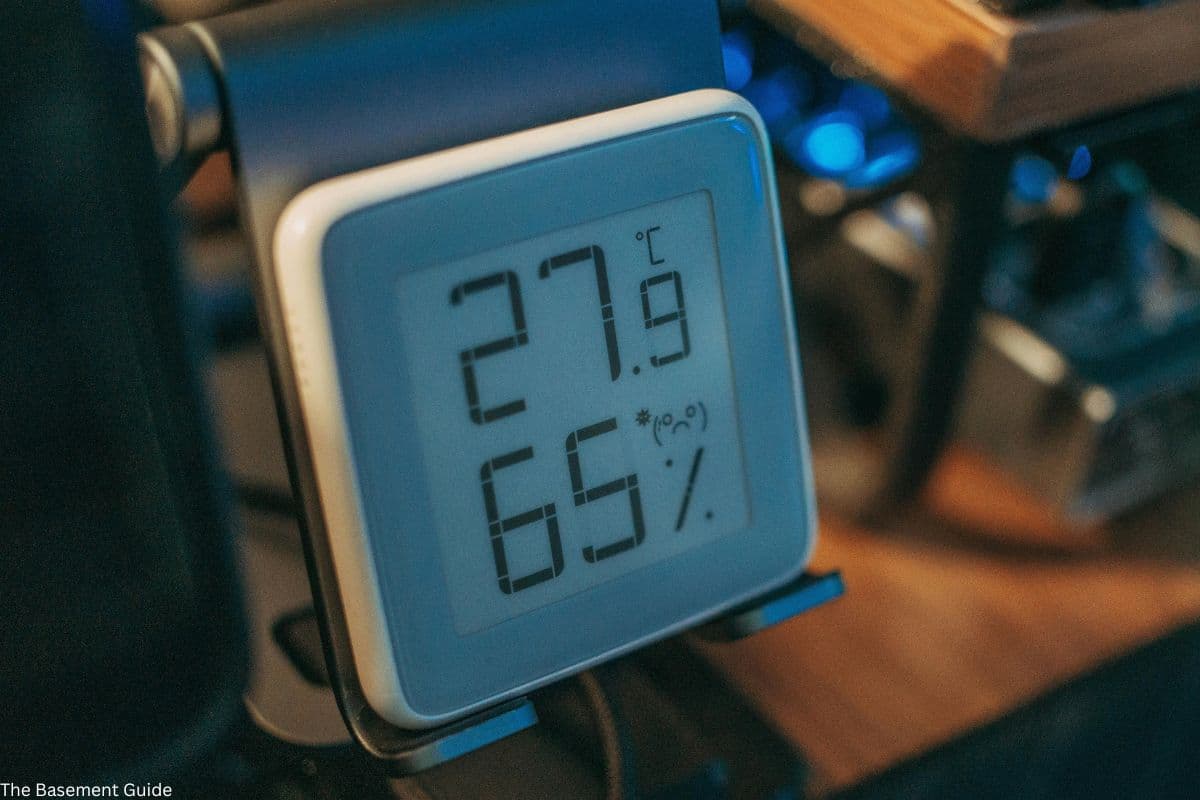
You cannot fix what you do not measure, and you cannot trust your senses to tell you whether humidity is at 55 percent or 70 percent. A digital hygrometer is the only reliable tool for tracking basement humidity. These devices show real-time RH and often include temperature readings.
How to Use a Hygrometer Correctly
- Place it in the center of the basement, away from vents, windows, and exterior doors. Edge locations give misleading readings.
- Wait 24 hours after first placement before recording readings. The device needs to acclimate to ambient conditions.
- Record morning and evening readings for one week. This reveals daily and weather-related variation.
- Note seasonal variation. Summer readings will be higher than winter; both should be within the 30-50 percent target.
- Check after weather events. Heavy rain, sudden temperature swings, and humid weather fronts cause immediate humidity spikes that you should track.
Best Hygrometers for Basement Use
ThermoPro TP49 Digital Hygrometer
Affordable, large LCD display, 18-month battery life, and clear comfort indicators (Dry, Comfortable, Wet). Updates every 10 seconds. Ideal for most basements where you want a reliable single-point measurement without setup complexity.
Check Price on Amazon →Govee H5051 Wi-Fi Hygrometer
Connects to your phone via Wi-Fi for remote monitoring and alerts when humidity hits user-set thresholds (set to 60 percent for a useful warning trigger). Tracks trends over weeks, ideal for basement homeowners who want data-driven decisions about when to run dehumidifiers.
Check Price on Amazon →AcuRite Digital Hygrometer
Simple, accurate, and reliable for basic monitoring. Works well in damp conditions and refreshes every 10 seconds. Best when you need accurate readings without smart features.
Check Price on Amazon →For comprehensive product context, see our best vapor barriers review for the related moisture control product category, and best basement air purifiers review for indoor air quality products.
Quick Fixes for Basement Humidity
If your hygrometer shows humidity consistently above 50 percent, start with low-cost interventions before investing in major systems. These quick fixes provide fast relief and can drop humidity 10 to 20 percent in days. They are not permanent solutions but they buy time while you plan bigger interventions.
Step 1: Improve Airflow
Open basement windows when outdoor humidity is below 50 percent (check weather apps or a basic weather station). Use box fans to push stale air toward windows or doors. If you have bathroom or laundry exhaust fans in the basement, run them to vent moisture-laden air directly outside. Avoid opening windows on humid summer days, which actually increases basement humidity.
Cost: $0 to $50 for box fans. Time: 15 minutes to set up.
Step 2: Seal Small Leaks
Check basement walls and floors for visible cracks, especially around the foundation perimeter and near floor drains. Use hydraulic cement or polyurethane caulk ($10 to $20) to fill cracks. Wrap cold water pipes with insulation foam ($5 per pack) to stop condensation drips that add moisture to the air.
Cost: $30 to $80 in materials. Time: 2 to 4 hours.
Step 3: Absorb Ambient Moisture
Place silica gel packets, calcium chloride desiccant, or rock salt in bowls around the basement. These passive absorbers pull water from the air at minimal cost. Replace them when the desiccant becomes saturated (typically every 1 to 4 weeks depending on humidity load).
Cost: $20 to $50 in desiccants. Time: 30 minutes to set up.
Step 4: Run a Portable Dehumidifier
For faster humidity drops, a portable dehumidifier in the 30 to 50 pint capacity range pulls 1 to 3 gallons of water daily from typical basement air. Set the unit to your target humidity (45 percent is a good first setting) and let it run continuously. Empty the tank or connect a continuous drain hose to a floor drain.
For specific dehumidifier recommendations and sizing guidance, see our best basement dehumidifiers review.
Cost: $150 to $400 for the unit. Time: 30 minutes to set up.
Step 5: Address Outdoor Drainage
Clear gutters and downspouts so water flows away from the foundation rather than pooling near it. Slope soil around the foundation perimeter so rain drains away from the house. Add downspout extensions to direct water at least 6 feet from the foundation. Many basement humidity problems originate from outdoor drainage failures rather than indoor sources.
Cost: $50 to $200 in materials. Time: 4 to 6 hours.
These five quick fixes cost under $200 total and can drop humidity 10 to 20 percent within days. If levels rebound after the fixes, you have an underlying source problem that requires a long-term solution.
Long-Term Solutions for Basement Humidity Control
Quick fixes treat symptoms; long-term solutions address root causes. These approaches cost more upfront but solve humidity problems for 15 or more years and prevent the $5,000 to $15,000 in compound damage that comes from chronic moisture exposure.
Basement Waterproofing
Interior waterproofing systems including French drains and sump pumps ($3,000 to $8,000) collect groundwater that enters through foundation walls and pump it away from the home. Exterior waterproofing membranes ($8,000 to $15,000) stop water at the foundation before it enters. Industry data shows proper waterproofing cuts basement humidity 20 to 30 percent permanently by addressing groundwater intrusion at the source.
For full cost breakdowns, see our basement waterproofing cost guide.
Insulation and Vapor Barriers
Insulating basement walls with rigid foam boards ($500 to $1,500 in materials) and adding plastic vapor barriers blocks soil moisture from migrating through walls into the basement air. This keeps the basement drier and warmer year-round, reducing both humidity and heating costs.
See our basement insulation guide and best vapor barriers review for detailed guidance.
Whole-House or Dedicated Dehumidifier
A whole-house dehumidifier integrated with your HVAC system ($1,000 to $2,500 installed) provides automatic humidity control across all levels of the home. A dedicated basement dehumidifier ($300 to $1,200) handles only the basement but operates more efficiently for that single space.
For dehumidifier selection and sizing, see our best basement dehumidifiers review and dehumidifier myths article.
HRV or ERV System
Heat Recovery Ventilators (HRV) and Energy Recovery Ventilators (ERV) exchange basement air with outdoor air while transferring heat (and moisture, in the case of ERVs) between the air streams. These systems cost $1,500 to $4,000 installed and provide both ventilation and humidity control.
Note that ventilation alone is not the same as humidity control; in humid summer climates, an HRV can pull humid outdoor air into the basement and worsen humidity problems. ERVs handle this better because they keep moisture outside. See our basement ventilation guide for the full distinction between ventilation and dehumidification.
Professional Assessment
For complex or persistent humidity problems, hire a basement waterproofing or HVAC professional for an assessment ($100 to $300). A trained inspector identifies hidden moisture sources, sizes remediation systems correctly, and recommends combinations of solutions that match your specific basement and climate. Combined approaches (waterproofing + dehumidifier + insulation, for example) are often more effective than any single intervention.
Common Mistakes
Trusting your senses to assess humidity. Human perception of humidity is unreliable in the 50 to 70 percent range, which is exactly the range where mold growth begins. A digital hygrometer is the only accurate way to know what your humidity actually is.
Opening windows on humid days. When outdoor humidity is above 50 percent, opening basement windows pulls in more moisture than it removes. Always check outdoor humidity before opening windows for ventilation; ventilate only when outdoor air is drier than indoor air.
Running a dehumidifier without addressing source moisture. A dehumidifier handles symptoms (high humidity in the air) but cannot fix water entering through foundation cracks, broken downspouts, or grading problems. Quick fixes plus a dehumidifier work for moderate problems; severe or persistent moisture requires waterproofing.
Buying an undersized dehumidifier. A 30-pint dehumidifier in a 1,500 square foot basement runs constantly and never reaches target humidity. Match dehumidifier capacity to basement size and humidity load; larger units are more efficient even though they cost more upfront.
Confusing ventilation with dehumidification. A ventilation fan exchanges air with the outside but does not remove moisture from the air. In humid climates, ventilation can make humidity worse. Dehumidification removes moisture from existing air without exchanging it. Most basements need both, but for different reasons. See our basement ventilation guide for the diagnostic distinction.
Ignoring seasonal variation. A basement that hits 65 percent every July is not "fine for most of the year"; it is mold-vulnerable for the months when humidity peaks. Treat seasonal peaks as the design condition, not the average.
Waiting for visible mold before acting. Mold becomes visible after weeks of elevated humidity. By the time you can see it, remediation requires both humidity control AND active mold remediation, costing 3 to 10 times what humidity control alone would have cost.
Sealing the basement without addressing humidity sources. Sealing leaks reduces water entry, but trapped humidity still needs a path out. A perfectly sealed basement at 65 percent humidity will stay at 65 percent humidity indefinitely without ventilation or dehumidification.
When to Call a Professional
Most basement humidity problems can be managed with DIY measurement and quick fixes. Three scenarios require professional intervention:
Visible mold covering more than 10 square feet. Mold remediation at this scale requires professional containment and removal to prevent spore distribution into the rest of the home. Self-remediation at this scale typically results in cross-contamination.
Persistent water intrusion through foundation walls or floors. Active water leaks (not just humidity, but actual water flowing in during rain) require professional waterproofing assessment to identify whether interior or exterior intervention is needed.
Humidity above 70 percent that quick fixes cannot reduce. Persistent severe humidity indicates an underlying source problem (failing drainage, hydrostatic pressure, plumbing leak) that needs professional diagnosis.
Need a basement humidity or waterproofing professional?
Persistent humidity problems often combine multiple causes (drainage, ventilation, hydrostatic pressure) that require professional assessment to diagnose and treat correctly.
Get free quotes from licensed basement professionals near you →Cost Breakdown by Approach
| Approach | Initial Cost | Annual Operating Cost | 10-Year Total | Best For |
|---|---|---|---|---|
| Hygrometer + quick fixes | $30 to $200 | $0 to $50 | $30 to $700 | Moderate humidity (50 to 60 percent) |
| Portable dehumidifier | $150 to $400 | $50 to $150 | $650 to $1,900 | Moderate humidity, basement under 1,500 sq ft |
| Whole-house dehumidifier | $1,000 to $2,500 | $100 to $200 | $2,000 to $4,500 | Large finished basements, integrated control |
| Basement waterproofing | $3,000 to $15,000 | $50 to $100 | $3,500 to $16,000 | Active water intrusion, persistent severe humidity |
| HRV/ERV system | $1,500 to $4,000 | $100 to $200 | $2,500 to $6,000 | Air quality + humidity combined |
| Combined approach | $4,000 to $18,000 | $150 to $300 | $5,500 to $21,000 | Severe humidity with multiple causes |
The honest comparison: ignoring basement humidity for 10 years typically costs $5,000 to $15,000 in mold remediation, structural damage, ruined belongings, and increased energy costs. Almost any meaningful intervention costs less than ignoring the problem and pays for itself in damage avoidance alone.
Related Guides
Exhaust fans, HRV/ERV systems, and the critical distinction between ventilation and dehumidification.
Top-rated dehumidifiers with sizing guidance for finished and unfinished basements.
The most common mistakes homeowners make when using dehumidifiers, including sizing errors.
Tracing musty odors to their source when mold or hidden moisture is present but not yet visible.
The layered moisture management system that keeps mold from establishing in the first place.
Reviewed vapor barriers for blocking soil moisture from migrating through basement walls and floors.
Interior and exterior waterproofing costs and how each addresses persistent moisture intrusion.
Interior and exterior French drain pricing for managing groundwater around the foundation.
What professional mold remediation costs by scale and why early humidity control prevents most of these costs.
Rigid foam, vapor barrier integration, and the right wall assembly for cold-climate basements.
Frequently Asked Questions
What is the ideal humidity level for a basement?
The ideal humidity level for a basement is 30 to 50 percent relative humidity (RH), the same range the EPA recommends for all indoor spaces. Below 30 percent causes dry-air problems including cracking wood, static electricity, and dry skin. Above 60 percent causes mold growth, structural damage, pest invasion, and respiratory health issues. The 30-50 percent range applies year-round regardless of season; basements that drift above 50 percent in summer or below 30 percent in winter need active management to stay within range. Use a digital hygrometer ($10 to $30) to measure actual levels because human perception of humidity is unreliable in the critical 50 to 70 percent range. Aim for the middle of the range (around 40 percent) as your target, with seasonal variation between 35 and 50 percent acceptable.
How do I know if my basement humidity is too high?
Five clear signs indicate basement humidity above 60 percent: (1) musty or damp odor when you first enter the basement, (2) condensation visible on cold pipes, windows, or other cold surfaces, (3) visible mold spots on walls, ceiling, or stored items, (4) peeling paint, warped wood, or efflorescence (white crystalline deposits) on concrete walls, and (5) the air feeling thick or making your eyes water. Any one of these signs means humidity has been elevated for an extended period. Confirm with a digital hygrometer; readings consistently above 60 percent require action within weeks, and readings above 70 percent require immediate intervention. Do not rely on feel alone because human perception of humidity is unreliable in the 50 to 70 percent range where the most important damage occurs.
Can high basement humidity damage my foundation?
Yes, persistent high humidity can contribute to foundation damage through several mechanisms. Excess moisture in the basement air condenses on cool concrete walls, weakening the concrete over years through repeated wet-dry cycling. Moisture also accelerates corrosion of metal reinforcement (rebar) inside foundation walls. Outside the foundation, wet soil expands and presses against walls (hydrostatic pressure), causing cracks that allow more water entry, which compounds the humidity problem. Sustained humidity above 70 percent over 5 to 10 years typically causes $3,000 to $15,000 in structural repairs that proper humidity control would have prevented. The relationship runs both ways: foundation problems cause humidity, and humidity worsens foundation problems. Address both through coordinated waterproofing and humidity control rather than treating them separately.
Is a dehumidifier enough to fix high basement humidity?
A dehumidifier alone is sufficient for mild to moderate humidity problems where the source is occasional weather-related moisture rather than persistent water intrusion. A properly sized dehumidifier (40 to 70 pint capacity for a typical 1,500 square foot basement) can maintain 45 percent RH continuously. However, a dehumidifier cannot fix water actively entering through foundation cracks, failed drainage, or plumbing leaks. For severe or persistent humidity (consistently above 65 percent), the underlying source must be addressed through waterproofing, drainage repair, or vapor barriers in addition to dehumidification. Run the dehumidifier as a continuous solution while planning the long-term fix; over a 10-year period, dehumidification plus source remediation costs $4,000 to $20,000 less than dehumidification alone trying to compensate for an unfixed source.
How often should I check basement humidity?
For initial assessment, check humidity readings morning and evening for one week to establish baseline patterns. After that, check weekly during normal conditions and after weather events (heavy rain, sudden temperature swings, humid weather fronts). Smart hygrometers like the Govee H5051 send phone alerts when humidity exceeds your set threshold (60 percent is a useful warning trigger), eliminating the need for manual checks. Pay particular attention to seasonal transitions; spring and fall often surprise homeowners with sudden humidity spikes as outdoor conditions shift. After installing any humidity control measure (quick fixes, dehumidifier, waterproofing), check daily for the first 2 weeks to verify the intervention is working, then return to weekly monitoring. Basements with finished living space or stored valuables warrant more frequent monitoring than unfinished storage basements.
What is the difference between humidity and moisture in basements?
Humidity refers to water vapor in the air (measured as relative humidity, or RH percentage). Moisture is the broader category that includes humidity plus liquid water (groundwater seepage, plumbing leaks, condensation pooling) and water absorbed by materials (damp drywall, wet concrete, saturated wood). The distinction matters because controls differ. Humidity is controlled through dehumidification (removing water vapor from air) and ventilation (exchanging air with outside). Moisture from liquid sources requires waterproofing, drainage repair, or plumbing repair. Material moisture requires drying time plus removing the source. Most basement humidity problems are actually moisture problems where liquid water is entering and evaporating into the air, raising humidity. Treating only the humidity (with a dehumidifier) without addressing the moisture source produces partial improvement but not a permanent fix. A persistent humidity problem despite continuous dehumidifier operation almost always indicates an unfixed liquid water source.
What if I have a crawl space instead of a basement?
Crawl spaces require similar humidity control with some technical differences. Seal the crawl space with a heavy-mil plastic vapor barrier covering the floor and extending up the walls (crawl space encapsulation). Install a dedicated crawl space dehumidifier sized for the volume; standard basement dehumidifiers often cannot handle the small enclosed space efficiently. Crawl spaces are particularly vulnerable to ground moisture because they lack the concrete floor that basements have. Without encapsulation and dehumidification, crawl spaces commonly run 70 to 90 percent RH year-round and become major sources of mold, pests, and air quality problems for the entire home. The 30-50 percent humidity target applies to crawl spaces just as it does to basements. See our crawl space encapsulation guide for full encapsulation and treatment guidance.
Will a sump pump help with basement humidity?
A sump pump indirectly helps with humidity by removing groundwater that would otherwise seep into the basement and evaporate into the air. By eliminating standing water and reducing wet surfaces, the sump pump removes one humidity source. However, a sump pump alone does not control humidity in the same way a dehumidifier does. Air-borne moisture from outdoor humidity infiltration, condensation on cold surfaces, and material off-gassing continues regardless of sump pump operation. Most basements with humidity problems benefit from a sump pump (for liquid water control) AND a dehumidifier (for air-borne moisture control) used in combination. Installing a sump pump as part of a basement waterproofing system handles the source-water side of the problem; a dehumidifier handles the air-moisture side. See our sump pump cost guide and sump pump buying guide for sump pump selection.
Glossary
Relative humidity (RH)
Relative humidity is the percentage of moisture in the air compared to the maximum amount the air could hold at that specific temperature. Warm air can hold significantly more moisture than cool air, which is why air conditioning often reduces humidity even without a dehumidifier (cooling the air drops the temperature, which reduces the air's moisture-holding capacity, which raises RH percentage temporarily and causes condensation that removes moisture). The 30 to 50 percent RH target for basements is a temperature-independent measurement, applying equally in summer (when the basement might be 75 degrees with high outdoor humidity) and winter (when the basement might be 60 degrees with dry outdoor air). Measure RH with a digital hygrometer for reliable readings.
Hygrometer
A hygrometer is a measurement device that displays relative humidity (RH), often along with temperature. Digital hygrometers are the standard residential tool, costing $10 to $30 for accurate models. They display real-time readings and refresh every 10 to 30 seconds. Smart hygrometers connect to phones via Wi-Fi for remote monitoring and threshold alerts. Place a hygrometer in the center of the basement, away from vents, windows, and exterior doors, for accurate readings. Wait 24 hours after first placement for the device to acclimate to ambient conditions before recording readings. Track readings morning and evening for one week to establish baseline patterns, then check weekly afterward.
Condensation
Condensation occurs when warm humid air contacts a cool surface, causing water vapor to convert to liquid water droplets. In basements, condensation typically forms on cold water pipes, exterior-facing concrete walls, and window glass during humid weather. Visible condensation is one of the clearest signs that humidity is too high, and the water it produces becomes a continuing humidity source as it evaporates back into the air. Reducing condensation requires either lowering the air's humidity (dehumidification) or warming the cool surface (insulation). Condensation on cold water pipes specifically can be eliminated by wrapping pipes in foam insulation ($5 per pack), which is a low-cost step that reduces both humidity and the dripping nuisance.
Dehumidifier
A dehumidifier is a mechanical device that removes water vapor from indoor air by cooling the air below its dew point, condensing moisture out of the air, collecting the water in a tank or draining it continuously, and then warming the dried air back to room temperature. Residential dehumidifiers are rated by the volume of water they remove per day in pints (typically 30 to 70 pints daily for basement applications). Match dehumidifier capacity to basement size and humidity load; an undersized unit runs constantly without reaching target humidity. Whole-house dehumidifiers integrate with HVAC systems for automatic control across all home levels; portable dehumidifiers handle individual rooms or basements only. See our best basement dehumidifiers review for selection guidance.
Vapor barrier
A vapor barrier is a plastic sheet (typically 6 to 20 mil polyethylene) that blocks moisture vapor migration through walls or floors. In basements, vapor barriers are installed on the warm side of insulation (interior side in cold climates, exterior side in hot climates) to prevent humid indoor air from contacting cool surfaces and condensing inside the wall assembly. Vapor barriers are essential in finished basements where drywall and insulation are added to concrete walls; without a vapor barrier, condensation forms inside the wall cavity and causes hidden mold growth. The vapor barrier should be continuous, sealed at all seams and penetrations, and integrated with floor barriers for complete moisture control. Crawl space encapsulation uses similar vapor barrier principles applied to the crawl space floor and walls. See our crawl space encapsulation guide and best vapor barriers review for product selection.
Sump pump
A sump pump is an electric pump installed in a pit (sump basin) at the lowest point of a basement floor, designed to automatically remove groundwater that collects in the pit before it can seep into the basement. The pump activates via a float switch when water reaches a set level and pumps the water through a discharge pipe to the exterior of the home, away from the foundation. Sump pumps are essential in basements with high groundwater tables, persistent foundation water seepage, or municipal drainage requirements. Battery backup sump pumps continue operating during power outages, which is important because storm-related power outages often coincide with the heaviest rain events. Sump pumps reduce basement humidity indirectly by preventing standing water and wet surfaces; combine with a dehumidifier for full humidity control. See our sump pump cost guide and sump pump buying guide for selection.
Hydrostatic pressure
Hydrostatic pressure is the force exerted by groundwater against the outside of foundation walls, increasing as the water table rises and adding stress that can cause cracks, bowing, and water intrusion. Hydrostatic pressure increases dramatically during heavy rain or snow melt, which is why basement leaks often occur during specific weather conditions rather than continuously. Persistent hydrostatic pressure causes foundation walls to crack, bow inward, or fail entirely over years, with repair costs ranging from $3,000 (minor cracks) to $25,000 (major structural repair). Reducing hydrostatic pressure requires improving drainage around the foundation (gutters, downspouts, grading, French drains) and may require professional waterproofing for severe cases. The relationship between hydrostatic pressure and basement humidity is direct: water that enters through hydrostatic-pressure cracks becomes humidity inside the basement.
Mold growth threshold
Mold growth begins at approximately 55 percent RH at typical room temperatures, with active mold colonization occurring at 60 to 70 percent RH and accelerating above 70 percent. Different mold species have different thresholds, but the EPA's general guidance treats 60 percent RH as the threshold above which mold prevention requires active intervention. Mold spores are present in essentially all indoor air at low levels; they germinate and grow when they find a moisture source plus an organic substrate (drywall, wood, cardboard, dust, or even dust on concrete). Once visible mold is established, it produces additional spores that increase ambient mold spore counts and require both source remediation (humidity control) and physical removal of the contaminated material. The 30-50 percent RH target keeps the basement well below the mold growth threshold under all conditions.
Stack effect
The stack effect is a passive air movement phenomenon in which warm air rises through a building and escapes through upper openings (attic vents, upper-floor windows), pulling cooler outside air in through lower-floor openings (basement windows, foundation cracks, first-floor gaps). The stack effect is strongest in winter when indoor and outdoor temperatures differ most. For basements, the stack effect means that air from outside the foundation (often carrying soil moisture, radon, and outdoor humidity) is constantly pulled into the basement and pushed up into the rest of the home. Sealing basement air leaks reduces stack effect intensity and helps stabilize basement humidity, but the broader implication is that basements affect the entire home's air quality and humidity through stack-driven air movement. See our basement ventilation guide for the broader discussion of basement air quality.