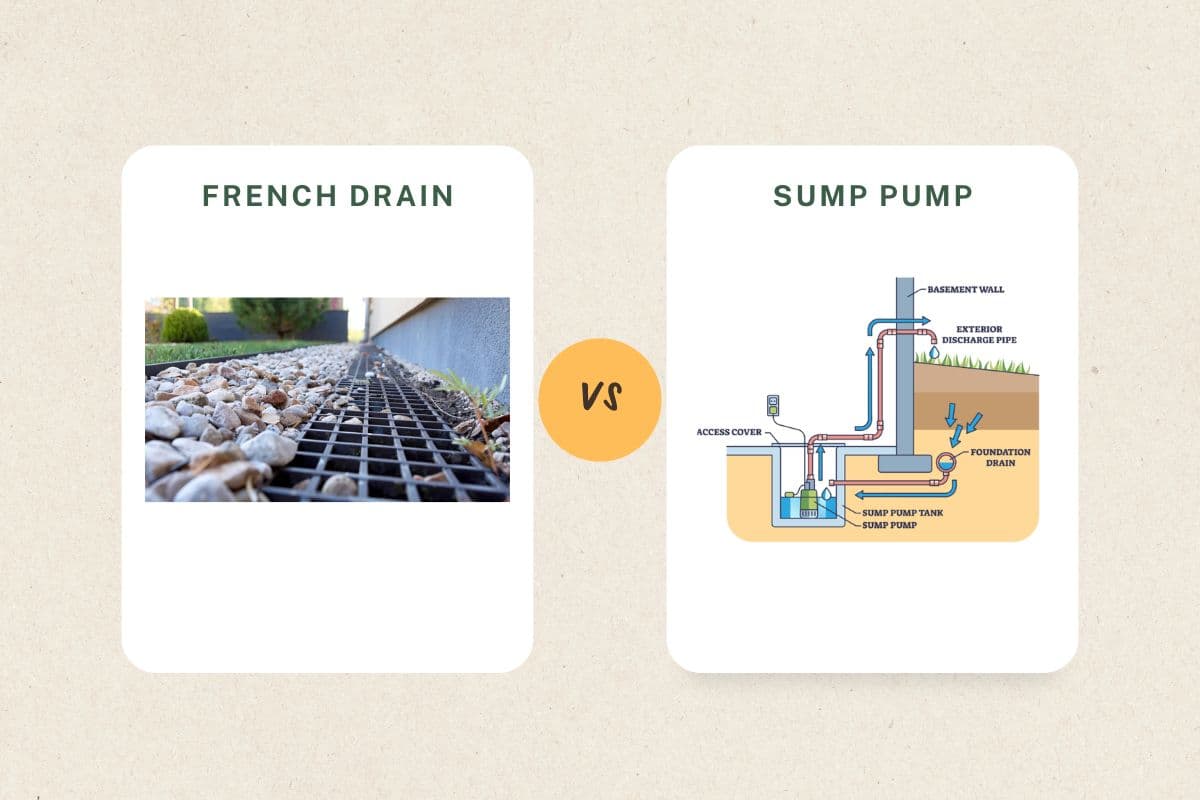
A French drain and a sump pump are the two foundational components of a basement waterproofing system, each solving a different part of the water problem. A French drain is a passive perimeter drainage system, a gravel-filled trench with a perforated pipe that intercepts groundwater before it can build pressure against your foundation walls. A sump pump is an active mechanical device that sits in a pit at the basement’s lowest point and ejects collected water out of the home through a discharge line. In most wet basement situations, the French drain collects and channels water while the sump pump removes it, making them complementary systems rather than competing alternatives.
When it comes to basement waterproofing, choosing between a French drain and a sump pump often comes down to your specific water issues. A French drain is a passive drainage system that redirects groundwater away from your foundation, while a sump pump is an active pump that removes standing water from a pit in your basement floor. Both are popular basement waterproofing methods, but they work best together for full protection against leaks, flooding, and hydrostatic pressure.
In this comparison, we dive into the pros, cons, costs, installation tips, and real-world recommendations. Many homeowners combine an interior French drain with a sump pump for the ultimate setup, but understanding each system’s strengths is key to making the right decision for your home.
Quick Comparison Table: French Drain vs Sump Pump
| Feature | French Drain | Sump Pump |
|---|---|---|
| Type | Passive drainage pipe in gravel trench | Active electric pump in basement pit |
| How It Works | Collects and redirects groundwater | Pumps out accumulated water |
| Best For | Preventing water buildup around foundation | Removing standing water during floods |
| Pros | Low maintenance, long-lasting | Fast action, handles heavy water |
| Cons | Disruptive install, can clog | Needs power, regular checks |
| Average Cost | $3,000–$8,000 interior / $5,000–$15,000 exterior | $1,200–$3,000 installed |
| Lifespan | 20–30 years | 8–12 years (pump replacement) |
| Maintenance | Annual cleaning | Quarterly tests, battery backup |
National averages. Actual costs vary by region, home size, and soil conditions.
What Is a French Drain and How Does It Work?
A French drain — also called a perimeter drain or weeping tile — is a trench filled with gravel and a perforated pipe that collects groundwater and directs it away from your home’s foundation. Interior versions run along the basement floor perimeter, while exterior ones sit outside the foundation walls.
Pros of French Drains
- ✓ Relieves hydrostatic pressure to prevent cracks and bowing walls
- ✓ Passive operation – no electricity needed
- ✓ Long-term solution that protects the entire foundation
- ✓ Pairs well with sump pumps for complete waterproofing
Cons of French Drains
- ✗ High upfront cost and labor-intensive install
- ✗ Can clog with silt over time if not filtered properly
- ✗ Exterior installs disrupt landscaping
- ✗ Not ideal for sudden heavy flooding without a sump pump
French Drain Cost Breakdown
Interior French drain installation averages $3,000–$8,000 ($60–$120 per linear foot) for a typical 1,000 sq ft basement. Exterior costs $5,000–$15,000 ($25–$60 per linear foot). DIY materials run $500–$2,000, but pros are recommended for proper slope and waterproofing.
What Is a Sump Pump and How Does It Work?
A sump pump sits in a pit (sump basin) at your basement’s lowest point. When water enters the pit, a float switch activates the pump to eject water outside through a discharge line. Common types include submersible (quiet and powerful) and pedestal (cheaper but louder). Battery backups or water-powered models add reliability during power outages.
Pros of Sump Pumps
- ✓ Handles large water volumes quickly during storms
- ✓ Affordable and easy to upgrade with smart alerts
- ✓ Essential for flood-prone areas or high water tables
- ✓ Works with French drains as the ejection point
Cons of Sump Pumps
- ✗ Relies on electricity – fails in outages without backup
- ✗ Needs regular maintenance to avoid breakdowns
- ✗ Pump can burn out after 8–12 years
- ✗ Does not prevent water entry – just removes it
Sump Pump Cost Breakdown
Basic submersible sump pump installation averages $1,200–$3,000 ($200–$600 for the unit plus $750–$1,200 labor). Add $100–$300 for a battery backup. Pedestal models start at $100–$300.
📌Top Pick: Zoeller M53 Submersible Sump Pump – Trusted for reliability in high-volume applications.
📌Backup Pick: Liberty Pumps SJ10 Water-Powered Backup – No battery needed, runs on water pressure during outages.
Head-to-Head: Key Things to Consider
Effectiveness
French drains prevent water from reaching your foundation, while sump pumps remove it after entry. For best results, use an interior French drain that channels water to a sump pump.
Installation
French drains require digging (1–2 weeks), making them more disruptive. Sump pumps are installed in 1–2 days with minimal mess.
Cost and Value
French drains have higher upfront costs but lower long-term maintenance. Sump pumps are cheaper initially but need ongoing checks and eventual replacement.
Home Type
Sloped yards suit exterior French drains. Flat or finished basements favor interior drains with sump pumps.
Power and Reliability
Sump pumps need electricity – add a backup for outages. French drains work passively with zero power requirements.
Combined System
Many experts recommend both for comprehensive protection – the drain collects, the pump ejects. In flood-prone areas, this combo can boost home value by 5–10 percent during inspections.
Recommendations and Advice
Choose a French Drain If…
- You have ongoing groundwater issues or want long-term prevention
- Ideal for new builds or major renovations
Choose a Sump Pump If…
- Your basement floods during storms or you need quick water removal
- Great starter option for minor water problems
Go Combined If…
- You want the best basement waterproofing system
- Start with an interior French drain tied to a reliable sump pump
Fix external issues like gutters and grading first. Test soil for high water tables. Hire pros for permits and warranties. Add smart features like Wi-Fi alerts for peace of mind.
Frequently Asked Questions
Which is better, a French drain or a sump pump?
Neither is better on its own because they solve different parts of the water problem. A French drain intercepts groundwater before it builds pressure against your foundation and channels it to a collection point. A sump pump removes that collected water from the home. For minor surface water issues or a basement that rarely floods, a sump pump alone may be sufficient. For chronic groundwater intrusion, hydrostatic pressure, or a high water table, a French drain is the more important piece. For full protection in a flood-prone or chronically wet basement, you need both working together.
How much does a French drain cost vs a sump pump?
Interior French drain installation averages $3,000 to $8,000 for a typical basement, or $60 to $120 per linear foot. Exterior French drains run $5,000 to $15,000 depending on yard conditions and access. A sump pump with professional installation averages $1,200 to $3,000, with the pump unit itself costing $200 to $600 and labor adding $750 to $1,200. A battery backup adds $100 to $300. A combined interior French drain and sump pump system typically runs $4,000 to $10,000 installed and represents the most cost-effective full waterproofing solution for most basements.
Can I install a French drain or sump pump myself?
A sump pump replacement is a realistic DIY project for a handy homeowner, particularly if the sump pit already exists. The pump unit itself costs $200 to $600 and installation involves basic plumbing and electrical connections. A new French drain is a different matter. Proper slope, pipe placement, gravel bed depth, and integration with the existing drainage plane require experience to get right. An improperly sloped French drain will hold water instead of moving it, and an interior installation that is not properly sealed against the footer can allow soil gas and moisture migration. Professional installation with a warranty is strongly recommended for French drains.
Do I need both a French drain and a sump pump for basement waterproofing?
For most homes with recurring water problems, yes. A French drain without a sump pump has nowhere to discharge collected water unless it drains to daylight by gravity, which is only possible on sloped lots. A sump pump without a French drain only removes water after it has already entered the basement, doing nothing to relieve the hydrostatic pressure that causes foundation cracks and bowing walls over time. The combination of an interior perimeter French drain feeding into a sump pit with a reliable pump and battery backup is the system waterproofing contractors install most often because it addresses both pressure and accumulation.
How long do French drains and sump pumps last?
A properly installed French drain lasts 20 to 30 years. The main failure mode is silt clogging the perforated pipe over time, which can be addressed with periodic flushing. A sump pump motor typically lasts 8 to 12 years with regular maintenance including quarterly test runs, annual cleaning of the pit, and float switch inspection. The pit and discharge line are permanent and rarely need replacement. Budget for pump replacement every 10 years as part of normal home maintenance, and always keep a battery backup unit in place so a pump failure during a storm does not result in a flooded basement.
What happens if the power goes out during a storm?
A standard sump pump stops working immediately when power fails, which is precisely when you need it most. A battery backup sump pump activates automatically when the primary pump loses power and can handle moderate water volume for several hours depending on the battery capacity and inflow rate. A water-powered backup uses municipal water pressure to create suction and requires no battery, making it reliable in extended outages but only suitable for homes on city water. For homes in areas with frequent power outages or severe storms, a combination of a primary submersible pump, a battery backup, and a generator transfer switch provides the most complete protection.
Can a French drain work without a sump pump?
Yes, in one specific situation: when the French drain can discharge to daylight by gravity. This requires a sloped lot where the drain outlet exits through the foundation wall or yard at a point lower than the drain itself, allowing water to flow out passively without pumping. This setup works well for exterior French drains on hillside or sloped properties. For flat lots, finished basements, or interior perimeter drains, gravity discharge is not possible and a sump pump is required as the collection and ejection point. If you are unsure whether your lot allows gravity discharge, a waterproofing contractor can assess your grade and drainage plane.
How do I know if I need a French drain, a sump pump, or both?
Start by diagnosing where the water is coming from. Water seeping through foundation walls or up through the floor under hydrostatic pressure points to a groundwater problem that a French drain addresses directly. Water pooling after heavy rain that drains away once the storm passes suggests surface water intrusion that a sump pump may handle on its own. Chronic dampness, efflorescence on walls, or a consistently high water table almost always calls for a combined system. A professional moisture assessment with a thermal imaging camera and moisture meter will identify the source accurately and prevent you from investing in the wrong solution.
Glossary
French Drain
A passive drainage system consisting of a perforated pipe set in a gravel-filled trench that intercepts groundwater and redirects it away from the foundation. Interior versions run along the basement floor perimeter; exterior versions are installed outside the foundation wall. Also called a perimeter drain or weeping tile system.
Sump Pump
An electric pump installed in a pit at the lowest point of the basement that activates when water reaches a set level and ejects it outside through a discharge line. Available in submersible and pedestal configurations; should always be paired with a battery or water-powered backup. See our submersible vs pedestal guide for a full comparison.
Sump Basin
The pit excavated into the basement floor that collects water from the French drain or natural seepage and holds it until the sump pump activates. Also called a sump pit. Sizing the basin correctly for your water volume is important to prevent the pump from short-cycling.
Hydrostatic Pressure
The force exerted by groundwater that has saturated the soil surrounding your foundation. As water accumulates with no place to drain, pressure builds against foundation walls and the floor slab, causing cracks, bowing, and seepage. A perimeter French drain relieves hydrostatic pressure by giving groundwater a path to move before pressure builds.
Perimeter Drain
An interior French drain system installed along the inside perimeter of the basement floor at the base of the foundation wall. Water that seeps through the wall or up through the floor is captured and channeled to the sump pit. The most common interior waterproofing system installed by professional contractors.
Weeping Tile
An older term for a perforated drainage pipe used in French drain systems, originally made from clay tile sections. Modern weeping tile systems use flexible perforated plastic pipe wrapped in filter fabric to prevent silt intrusion. The term is still widely used in Canada and among older contractors.
Discharge Line
The pipe that carries water from the sump pump to a discharge point outside the home, typically to a yard area, storm drain, or dry well at least 10 feet from the foundation. Proper discharge line routing is critical to prevent ejected water from draining back toward the foundation.
Battery Backup Sump Pump
A secondary pump powered by a 12-volt battery that activates automatically when the primary pump fails or loses power. Essential protection for storm events when power outages and peak water inflow occur simultaneously. See our battery vs water-powered backup guide for a full comparison.
Gravity Discharge
A French drain configuration where collected water flows out through a pipe that exits the foundation or yard at a point lower than the drain inlet, requiring no pump. Only viable on sloped lots where a suitable outlet exists below the drain level.
Interior vs Exterior Waterproofing
The distinction between systems installed inside the basement (interior perimeter drains, sump pumps) and systems installed outside the foundation (exterior French drains, exterior membrane coatings). Interior systems manage water after it reaches the foundation; exterior systems intercept it before it makes contact. See our interior vs exterior waterproofing comparison for a full breakdown.
Final Advice
French drain vs sump pump is not an either-or choice – combining them gives the strongest defense against basement water. Assess your water issues, budget, and home layout before deciding. For more guidance, see our French drain cost guide, sump pump cost guide, and complete waterproofing guide.