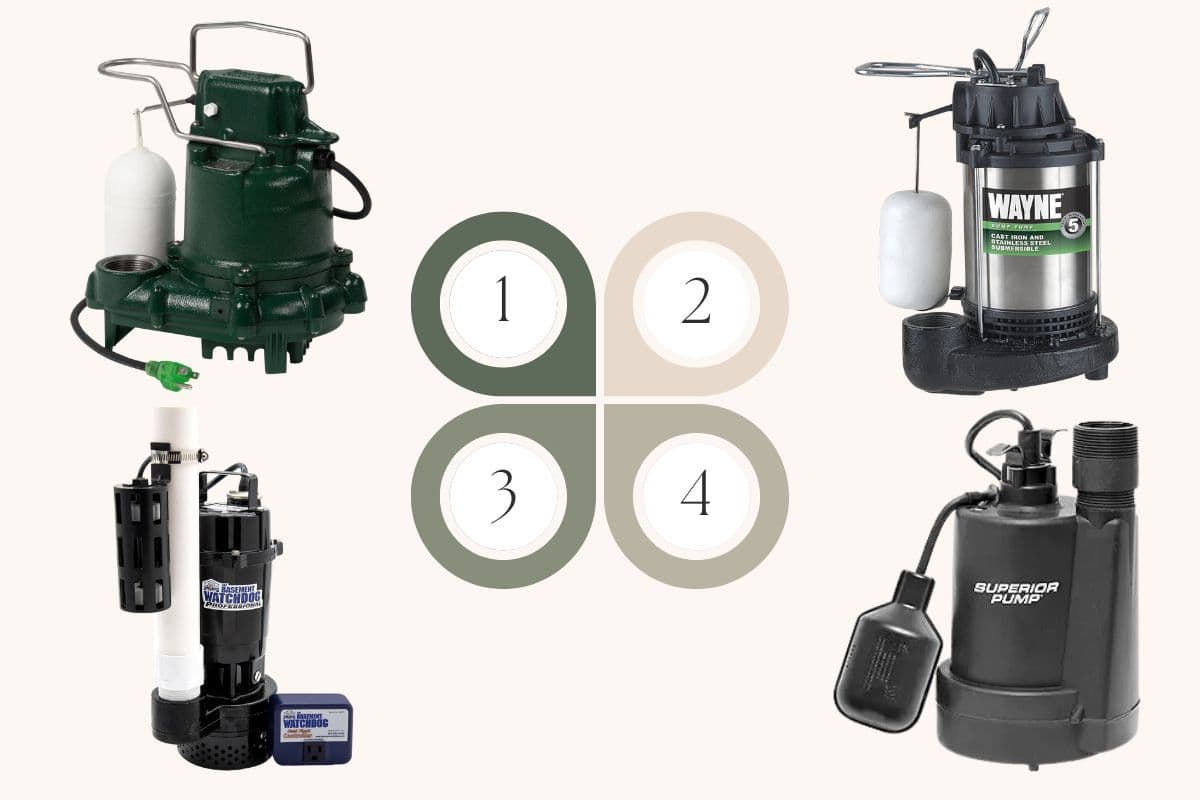
TL;DR
- Best overall: Zoeller M53. Cast iron, simple float switch, and decades of track record. It handles the average basement for about $200.
- Best for heavy rain: Wayne CDU980E. 3/4 HP, about 4,700 gallons per hour at 10 feet of lift, a 5 year warranty, and it usually costs less than the Zoeller.
- Best premium: Zoeller M98. 1/2 HP cast iron with a 2-pole mechanical switch. Buy it if your pump runs daily from spring through fall.
- Best for tight pits: Liberty 257. Fits a 10 inch basin.
- Best budget: Superior Pump 92341. Cast iron for about $140 to $170.
- Best pedestal: Superior Pump 92333. About $110, with an adjustable float.
- Best combo with backup: Basement Watchdog Big Combo. 1/2 HP cast iron primary, battery backup, and phone alerts with the Wi-Fi module.
- The rule that matters most: compare pumps by gallons per hour at 10 feet, never by the "max GPH" on the box. Max GPH is measured at zero lift, and no basement has zero lift.
Quick Picks: Best Sump Pumps for 2026
| Pick | Pump | HP | Flow at 10 ft of lift | Build | Switch | Warranty | Typical price |
|---|---|---|---|---|---|---|---|
| Best Overall | Zoeller M53 | 3/10 | 2,040 GPH | Cast iron | Vertical float | 3 yr | $180 to $230 |
| Best for Heavy Rain | Wayne CDU980E | 3/4 | 4,743 GPH | Cast iron and stainless | Vertical float | 5 yr | $220 to $280 |
| Best Premium | Zoeller M98 | 1/2 | 3,660 GPH | Cast iron | 2-pole mechanical vertical float | 3 yr | $330 to $380 |
| Best for Tight Pits | Liberty 257 | 1/3 | 2,400 GPH | Cast iron | Vertical magnetic float | 3 yr | $210 to $250 |
| Best Budget | Superior Pump 92341 | 1/3 | 2,760 GPH max (0 ft) | Cast iron | Vertical float | See listing | $140 to $170 |
| Best Pedestal | Superior Pump 92333 | 1/3 | 2,280 GPH | Thermoplastic column, stainless impeller | Adjustable mechanical float | 1 yr | $100 to $120 |
| Best Combo with Backup | Basement Watchdog Big Combo (CITS-50) | 1/2 primary | 4,400 GPH max (0 ft) primary, 2,600 GPH max backup | Cast iron primary | Dual reed switches | See listing | $450 to $500, battery often extra |
Flow figures come from manufacturer and distributor spec sheets. Where a maker only publishes a zero-lift rating, we say so. Prices are typical 2026 street prices and move often, so check the current listing.
How We Chose These Pumps
We did not run these pumps in a test pit. Here is what we did instead, and it's what a plumber looks at when they pick a pump for your house.
- Flow at real lift. We compared gallons per hour at 10 feet of vertical lift, which is close to what a typical basement pump pushes once you count the climb from the pit to the discharge exit plus friction in the pipe and check valve.
- Build. Cast iron housings shed motor heat into the water and outlast plastic. Every submersible pick here is cast iron.
- Switch design. The float switch is the number one failure point on any sump pump. We favored vertical floats and magnetic or mechanical switches that can't snag on the pit wall the way tethered floats do.
- Warranty and parts. Three years is the floor for a pump we'd put in a finished basement. Brands with a long history of replacement parts and plumber support (Zoeller, Liberty, Wayne) got the edge.
- Owner track record. We read through long-term owner reports and plumber forums for patterns: switches that stick, seals that leak, motors that die in year two. Pumps with recurring complaints didn't make the list.
- Price per year of service. A $110 pump that lasts 5 years costs more per year than a $200 pump that lasts 10. The cost table below runs the math.
The 10-Foot Rule: How to Compare Sump Pumps
Every sump pump box advertises a big number. The 3/4 HP Wayne says 5,673 GPH. The Watchdog says 4,400. Those are zero-lift numbers, measured with the pump pushing water straight out at floor level. Your pump never works like that.
Your pump lifts water out of the pit, up to the rim joist, through a check valve, and out of the house. That's usually 8 to 12 feet of total head. At that height, flow drops a lot. The Wayne CDU980E goes from 5,673 GPH at zero to 4,743 at 10 feet and 3,571 at 20 feet.
The 10-Foot Rule: compare pumps by flow at 10 feet of lift, then make sure that number beats your pit's fill rate with at least 50% to spare. If a maker won't publish a 10-foot number, treat the box number as a ceiling.
5-Minute Diagnostic: What Size Sump Pump Do You Need?
Do this during or right after a heavy rain, when your pit is filling at its fastest.
- Unplug the pump (or flip the breaker) once the pump has just emptied the pit.
- Time the fill. Mark the water level, start a timer, and stop it after 1 minute. Measure how many inches the water rose.
- Convert to gallons. For a standard 18 inch round pit, each inch of rise is about 1.1 gallons. For a 24 inch pit, it's about 2 gallons per inch. Multiply by inches of rise to get gallons per minute.
- Convert to GPH. Multiply gallons per minute by 60.
- Add margin. Multiply by 1.5. That's the minimum flow you want at 10 feet.
- Plug the pump back in. Do not skip this.
Example: An 18 inch pit rises 20 inches in 1 minute. That's 22 gallons per minute, or 1,320 GPH. With margin, you want about 2,000 GPH at 10 feet. The Zoeller M53 (2,040 GPH) is just enough. If you see that kind of fill rate regularly, step up to the M98 or the Wayne.
Also check these while you're there:
- Pit diameter. Under 11 inches, you need a slim pump like the Liberty 257 or a pedestal.
- Vertical lift. Measure from the pit floor to where the discharge pipe exits the wall. Over 15 feet, look hard at the 1/2 HP and 3/4 HP options.
- Pump age. If yours is 7+ years old, or it runs constantly in dry weather, see our guide to a sump pump running constantly before you buy.
Best Overall: Zoeller M53 Mighty-Mate
Specs: 3/10 HP | 2,040 GPH at 10 ft (34 GPM) | 19 ft shut-off head | cast iron | vertical float switch, on at 7.25 inches, off at 3 inches | 1.5 inch discharge | 10 ft cord | 3 year warranty | about $180 to $230
The M53 is the pump plumbers install when nobody asks for anything special. It's been in production for decades, parts are everywhere, and the design is simple: a cast iron motor housing that sits in water and stays cool, a float that rides up and down on a vertical rod, and a mechanical switch with nothing to program.
It's rated at 3/10 HP, a hair under the 1/3 HP of most competitors. Don't let that bother you. At 10 feet of lift it moves about 2,040 gallons an hour, which covers the average basement with a typical pit and normal groundwater.
Why it's our top pick: reliability per dollar. The cast iron housing and simple switch are the two things that keep sump pumps alive, and the M53 has both for about $200.
Who it's for: most homes with an 18 inch or larger pit, a pump that runs during storms and snowmelt, and lift under 15 feet.
Watch out for: the switch is set to cycle often (7.25 inches on, 3 inches off), so in a small pit with high inflow it will run in short bursts. That's normal, but if your pit fills in under a minute, you need more pump.
Best for Heavy Rain: Wayne CDU980E
Specs: 3/4 HP | 5,245 GPH at 5 ft, 4,743 GPH at 10 ft, 4,240 GPH at 15 ft, 3,571 GPH at 20 ft | cast iron and stainless steel | vertical float switch, on at 9 inches, off at 4 inches | 1.5 inch discharge | 5 year limited warranty | about $220 to $280
If your pit fills fast during a storm, or your old pump has ever failed to keep up, this is the pump. At 10 feet of lift it moves more than twice the water of the Zoeller M53, and it still pushes over 3,500 GPH at 20 feet. It's the strongest pump on this list and often the cheapest one per gallon.
The 5 year warranty is the longest of any pick here. The float sits on a vertical rod with a solid polypropylene float, so there's no foam float to waterlog.
Who it's for: high water tables, homes at the bottom of a slope, basements that take in water every heavy rain, and long or tall discharge runs.
Watch out for:
- It's overkill for a small pit. In a 14 inch pit with modest inflow, a 3/4 HP pump empties the basin in seconds and cycles hard, which wears the switch and motor. Use it where you actually have the water.
- It draws about 10 amps. Put it on its own circuit, and size any backup or generator for it.
- A 1.5 inch discharge is the minimum. On long runs, step up to 2 inch pipe past the check valve to cut friction loss.
Best Premium: Zoeller M98 Flow-Mate
Specs: 1/2 HP | 3,660 GPH at 10 ft (61 GPM) | 23 ft max head | cast iron housing and volute | 2-pole mechanical vertical float switch | 3 year warranty | about $330 to $380
The M98 is the one to buy if your pump runs every day from March to November. It's built like the M53 but bigger, with a 1/2 HP motor, a 2-pole switch rated for heavier duty, and a higher-capacity volute. It moves about 80% more water than the M53 at 10 feet.
You're paying a premium over the Wayne for the Zoeller name and support network. In our view that's worth it in a finished basement. Zoeller parts are easy to find, and almost every plumber has installed one.
Alternative: the Liberty 287 is the closest rival. It's also 1/2 HP cast iron with a vertical magnetic float, a 37 foot shut-off head (better for tall lifts), and a 3 year warranty, at about $330. Pick the 287 if your discharge climbs more than 15 feet.
Who it's for: finished basements, high-inflow pits, homes where the pump runs most days, and anyone who wants to replace a pump once a decade.
Watch out for: it's heavier and wider than the M53. Measure your pit.
Best for Tight Pits: Liberty 257
Specs: 1/3 HP | 2,400 GPH at 10 ft (40 GPM) | 23 ft max head | one-piece cast iron body, epoxy coated | vertical magnetic float switch | fits a 10 inch basin | 10 ft cord | 3 year warranty | about $210 to $250
Older homes and some builder-grade installs have pits that are too narrow for a standard pump and float. The Liberty 257 was designed for this. Its vertical magnetic float switch rides tight against the pump body, so the whole unit fits in a 10 inch basin.
The magnetic switch has no mechanical contact arm to wear out, which is why it shows up in plumber recommendations for reliability even outside small pits. At 10 feet it out-pumps the Zoeller M53 by about 18%.
Who it's for: pits 10 to 14 inches wide, crowded pits with a backup pump, and anyone who wants a magnetic switch.
Watch out for: it's priced about the same as the M53, so in a standard 18 inch pit it's a toss-up. In a pit that also holds a backup pump, the slim profile is worth paying for.
Best Budget: Superior Pump 92341
Specs: 1/3 HP | 2,760 GPH max at 0 ft (46 GPM) | cast iron body | stainless steel impeller | vertical float switch | 3/8 inch solids | about $140 to $170
If you need a pump this weekend and the budget is tight, this is the one to get. You still get a cast iron body and a vertical float switch, the two features that matter most, for about $60 less than the Zoeller M53. The stainless impeller is a nice touch at this price.
Superior only publishes a zero-lift rating for this pump. Expect real flow at 10 feet to be well under 2,760 GPH. Plan on it handling light to moderate inflow, not a pit that fills in a minute.
Who it's for: rentals, unfinished basements, a spare pump to keep on the shelf, and pits that only see water a few times a year.
Watch out for: the warranty isn't clearly published by retailers, so check the listing before you buy. Don't put it in a finished basement with heavy inflow. Spend the extra on the M53 or the Wayne.
Best Pedestal: Superior Pump 92333
Specs: 1/3 HP | 2,280 GPH at 10 ft (38 GPM) | 20 ft max lift | thermoplastic column, stainless steel impeller | adjustable mechanical float, on/off adjustable from 4 to 12 inches | 1 year warranty | about $100 to $120
Pedestal pumps sit on a column with the motor above the water. They're cheaper, easier to service, and the only option for some very narrow or shallow pits. The Superior 92333 is the best value in the category: strong flow at 10 feet for the price and an easy-to-reach float you can adjust.
Who it's for: pits too narrow for a submersible, unfinished basements, and anyone who wants to see and reach the switch without pulling the pump.
Watch out for:
- Noise. The motor runs in open air, so it's louder than a submersible. That matters next to a bedroom or office.
- Lifespan. Expect 5 to 7 years.
- Warranty. One year is short.
Read our full submersible vs. pedestal sump pump comparison before you choose.
Best Combo with Backup: Basement Watchdog Big Combo (CITS-50)
Specs: 1/2 HP cast iron primary, 4,400 GPH max at 0 ft | battery backup pump, 2,600 GPH max at 0 ft | dual reed switches | 24/7 controller monitoring of pump, power, and battery | text, email, and app alerts with the BW-Fi module (sold separately) | about $450 to $500, battery often sold separately
Most sump pump failures happen during the storm, when the power goes out or the primary pump gets overwhelmed. A combo system puts a 1/2 HP primary and a battery backup on one pre-plumbed discharge, so you don't have to fit two pumps, two check valves, and a controller into one pit yourself.
The Watchdog's controller is the selling point. It watches the primary pump, AC power, and battery, and with the Wi-Fi module it tells your phone when something goes wrong. If you travel or have a finished basement, that alert is worth more than the pump.
Who it's for: finished basements, homes in areas with storm outages, and people who are away from home often.
Watch out for:
- Battery cost. Budget $150 to $250 for a deep cycle battery if one isn't included, and plan to replace it every 3 to 5 years.
- Zero-lift ratings only. Basement Watchdog publishes the 0 ft numbers, so real flow at 10 feet will be lower.
- The alternative. If you'd rather keep your current primary, or want a water-powered backup that never needs a battery, see our guides to sump pump backup power and battery vs. water-powered backups.
Best Sump Pump for Heavy Rain and Basements That Flood Regularly
Most "best sump pump" questions come from people who just watched their pump fall behind in a storm. If that's you, here's what actually fixes it, in order.
- Confirm the pump was the problem. A pump that's too small runs nonstop and the water still rises. A pump with a failed switch doesn't run at all. A clogged or frozen discharge makes the pump run and the water doesn't drop. Each one has a different fix. Our sump pump running constantly guide walks through it.
- Size up using the 10-Foot Rule. Time your pit fill during the next storm. If inflow is over about 1,500 GPH, a 1/3 HP pump is on the edge. Move to the Wayne CDU980E (4,743 GPH at 10 ft) or the Zoeller M98 (3,660 GPH).
- Add a backup. Heavy rain and power outages arrive together. A battery backup or water-powered backup covers both a power loss and a primary failure. Many homes with chronic water run two pumps in the pit.
- Upgrade the discharge. Going from 1.5 inch to 2 inch discharge pipe on a long run, and swapping a cheap check valve for a quiet spring-loaded one, can recover several hundred gallons per hour.
- Cut the inflow. Downspouts that dump next to the foundation send roof water straight to your pit. Extending downspouts 6 to 10 feet and fixing negative grading often does more than a bigger pump. See our basement winterizing checklist for the full exterior list.
Bottom line: for a basement that floods regularly, the setup to beat is the Wayne CDU980E or Zoeller M98 as the primary, plus a battery or water-powered backup, plus a high water alarm or leak sensor on the floor. See our picks for the best water leak detectors.
Submersible or Pedestal? The Short Answer
Get a submersible if your pit is at least 11 inches wide and the basement is finished or will be. Submersibles are quieter, cooler running, and last longer.
Get a pedestal if your pit is very narrow or shallow, the space is unfinished, and you want the cheapest pump that's easy to service.
The full comparison goes deeper.
Sump Pump Cost and 10-Year Cost of Ownership
The sticker price is only part of it. Pumps last different amounts of time, and backups add battery replacements. Here's what each type actually costs over 10 years, pump hardware only.
| Setup | Upfront hardware | Expected life | Replacements in 10 years | 10-year hardware cost |
|---|---|---|---|---|
| Thermoplastic pedestal (Superior 92333) | $100 to $120 | 5 to 7 years | 1 | $200 to $240 |
| Budget cast iron submersible (Superior 92341) | $140 to $170 | 5 to 8 years | 1 | $280 to $340 |
| Standard cast iron submersible (Zoeller M53, Liberty 257) | $180 to $250 | 7 to 10 years | 0 to 1 | $180 to $500 |
| High-capacity cast iron (Wayne CDU980E, Zoeller M98) | $220 to $380 | 7 to 10+ years | 0 to 1 | $220 to $760 |
| Combo with battery backup (Watchdog Big Combo) | $450 to $500 plus $150 to $250 battery | Pump 7 to 10 years, battery 3 to 5 years | 1 to 2 batteries | $750 to $1,250 |
What to add on top:
- Professional installation: usually $150 to $400 for a straight swap, and more if the pit, discharge, or check valve needs work. See our sump pump cost guide and replacement cost calculator for full numbers.
- Check valve: $20 to $50. Replace it when you replace the pump.
- Electricity: small for most homes. A 1/3 HP pump draws roughly 400 to 700 watts while running, so even a busy pump usually costs a few dollars a month in wet season.
The math that matters: the cheapest pump over 10 years is usually a standard cast iron submersible. Paying $80 more upfront buys you one fewer replacement and one fewer weekend in the pit.
Common Mistakes When Buying a Sump Pump
- Shopping by max GPH. It's a zero-lift number. Compare at 10 feet.
- Buying the biggest pump you can find. A 3/4 HP pump in a small pit with light inflow short-cycles and wears itself out. Match the pump to your measured fill rate.
- Choosing a tethered float in a small pit. Tethered floats swing in a wide arc and snag on the pit wall, the backup pump, or the discharge pipe. That's one of the most common causes of a pump that won't turn on. Vertical floats avoid it.
- Reusing the old check valve. A worn check valve lets water fall back into the pit and makes the new pump run twice as often. Replace it with the pump.
- Skipping the weep hole. Most submersibles need a small 1/8 inch hole drilled in the discharge pipe between the pump and the check valve to prevent air lock. Check your manual.
- Plugging into an extension cord. Plug directly into a dedicated GFCI outlet. Extension cords drop voltage and are a common failure point.
- Not testing it. Pour a 5 gallon bucket into the pit every few months, and every fall before the wet season. If the pump doesn't kick on, you want to know now.
- No backup in a finished basement. One storm with the power out can ruin flooring, drywall, and furniture. Ten-year cost tables don't capture that.
When to Call a Pro
Most sump pump swaps are a 1 to 2 hour DIY job if the new pump matches the old pump's discharge and the pit is in good shape. Call a plumber or waterproofing contractor when:
- There's no pit yet, or you're adding a second pit. That's concrete cutting and drainage work.
- The pit is cracked, collapsing, or filling with silt and gravel. The liner needs replacement.
- You're upsizing to 3/4 HP and need a new circuit, or the discharge needs to go from 1.5 to 2 inch.
- Your discharge line is buried and freezes or clogs. See our guide to frozen pipes in the basement for the winter side of this.
- Water rises in the basement even though the pump runs. That points to a drainage problem bigger than the pump. Start with our complete basement waterproofing guide.
Frequently Asked Questions
What is the most reliable sump pump brand?
Zoeller, Liberty, and Wayne have the strongest long-term track records for residential pumps. Zoeller and Liberty in particular are the brands most plumbers install, which means parts and service are easy to find. Within any brand, reliability comes down to two features: a cast iron housing and a vertical float switch. A cheap pump from a good brand with a tethered float will fail sooner than a cast iron vertical-float pump from any of the three.
Zoeller vs. Wayne: which is better?
Zoeller wins on track record and plumber support. Wayne wins on flow per dollar and warranty. The Wayne CDU980E moves about 4,700 GPH at 10 feet with a 5 year warranty for around $250. The Zoeller M98 moves about 3,700 GPH with a 3 year warranty for around $350. If you need maximum water moved, buy the Wayne. If you want the pump your plumber knows best, buy the Zoeller.
What's the best sump pump for a basement that floods regularly?
A high-capacity cast iron primary (the Wayne CDU980E or Zoeller M98), a backup pump in the same pit, and a water alarm on the floor. A bigger pump alone doesn't fix flooding if the power goes out, the switch sticks, or the discharge freezes. The backup and the alarm cover those failures. Then cut the inflow with downspout extensions and grading so the pumps work less.
What horsepower sump pump do I need?
For most homes, 1/3 HP is enough. Move to 1/2 HP if your pit fills faster than about 1,500 gallons per hour in a storm, or your discharge lifts more than 15 feet. Move to 3/4 HP only for high water tables or heavy, sustained inflow. Horsepower is a rough guide. Flow at 10 feet of lift is the number to compare.
How long do sump pumps last?
Cast iron submersibles usually last 7 to 10 years, and well-sized ones in clean pits often go longer. Thermoplastic and pedestal pumps typically last 5 to 7 years. Battery backups need a new battery every 3 to 5 years. If your pump is past 7 years and you're heading into the wet season, replacing it on your schedule beats replacing it during a storm.
Is a cast iron sump pump worth the extra money?
Yes, in almost every case. Cast iron pulls heat away from the motor into the surrounding water, which extends motor life, and it doesn't crack or warp. The price difference is often $40 to $80, which you recover by skipping one replacement over 10 years.
What's the best sump pump for a finished basement?
A quiet, cast iron submersible with a vertical switch, paired with a battery backup and an alert. The Zoeller M98 or Wayne CDU980E as the primary, or the Basement Watchdog Big Combo if you want one pre-plumbed system with phone alerts. Pedestal pumps are usually too loud for finished space. For hiding the pump without blocking access, see our sump pump cover and design ideas.
Can I replace a sump pump myself?
Usually, yes. If the new pump uses the same discharge size and fits your pit, it's a matter of unplugging the old pump, cutting or unthreading the discharge, setting the new pump on a solid base, reconnecting with a new check valve, drilling the weep hole if the manual calls for it, and testing with a bucket of water. Our sump pump buying guide covers installation details. Call a pro if you're changing pipe size, adding a circuit, or the pit needs work.
Sump Pump Glossary
Head (total dynamic head): The total height and friction your pump has to overcome, from the water in the pit to the discharge exit. Flow drops as head rises.
GPH at 10 feet: Gallons per hour the pump moves with 10 feet of head. The most useful number for comparing residential pumps.
Shut-off head: The height at which the pump can no longer move any water. Your actual lift should be well below it.
Vertical float switch: A float that rides up and down on a rod mounted to the pump. It needs less pit width and can't snag the way a tethered float can.
Tethered float switch: A float on a flexible cord that swings up to turn the pump on. It needs a wider pit and is more prone to snagging.
Vertical magnetic float (VMF): Liberty's switch design that uses a magnet to trigger the pump, with no mechanical arm to wear.
Check valve: A one-way valve on the discharge pipe that keeps pumped water from falling back into the pit.
Weep hole: A small hole drilled in the discharge pipe below the check valve that lets trapped air escape and prevents air lock.
Short cycling: A pump turning on and off rapidly, usually from an oversized pump, a small pit, or a failing check valve. It wears out switches and motors.
Combo system: A primary pump and a backup pump sold together on a shared discharge, usually with a controller and alarm.
Related Guides
- Sump Pump Buying Guide
- Submersible vs. Pedestal Sump Pump
- Sump Pump Backup Power Options
- Battery vs. Water-Powered Backup Sump Pumps
- Sump Pump Running Constantly? 8 Causes and Fixes
- Sump Pump Cost
- Sump Pump Replacement Cost Calculator
- Sump Pump Cover Ideas and Ways to Hide a Sump Pump
- Best Water Leak Detectors
- How to Winterize a Basement
From Our Network
If you found this guide helpful, these resources from our partner sites cover related topics for homeowners managing water and drainage on their property.
The Septic Guide covers septic system alarms and monitoring, a similar set-it-and-forget-it protection system for homes on septic.
The Garage Guide covers garage drainage and floor drain maintenance for homeowners managing water intrusion across multiple areas of the home.