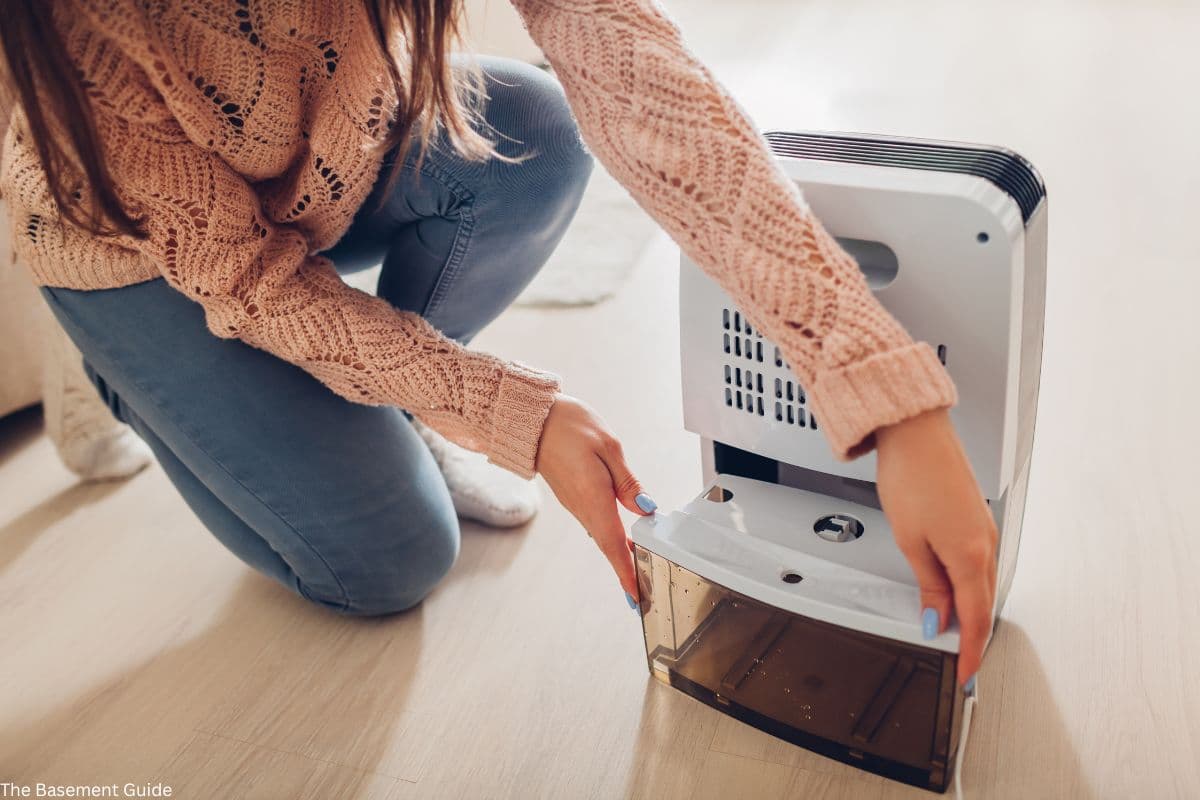
Dehumidifier Myths
The Science of Proper Sizing
Why your 30-pint unit is failing and the science-based guidelines to choose the right dehumidifier for your space.
A dehumidifier is an appliance that removes excess water vapor from indoor air to maintain relative humidity at a level that prevents mold growth, dust mite proliferation, wood warping, and structural moisture damage. Basement dehumidifiers face a harder job than units used in living spaces above grade — cooler temperatures reduce the efficiency of standard compressor-based units, higher moisture loads from soil and foundation seepage demand more removal capacity, and the enclosed nature of most basements limits the natural air exchange that helps moderate humidity elsewhere in the home. Proper dehumidifier selection requires matching the unit's pint capacity to the actual square footage and dampness level of the space using current DOE standards, which changed in 2019 and made older pint ratings non-comparable to newer ones. The most common dehumidifier failure is not a defective unit — it is a correctly functioning unit that was simply sized for a smaller or drier space than the one it is being asked to control.
Dehumidifiers play a key role in controlling indoor humidity, preventing mold growth, improving indoor air quality, and protecting your home from moisture-related damage. Yet widespread misinformation leads many homeowners to buy undersized models that cannot keep up with real-world conditions.
This results in constant running, higher energy bills, persistent dampness, and ongoing frustration. In this in-depth guide, we debunk the most common dehumidifier myths, explain the science behind how dehumidifiers work, detail proper sizing using current industry standards, and share practical advice to select, install, and maintain the best dehumidifier for your basement, crawl space, living area, or entire home.
Whether you face musty basements, high humidity in bathrooms, or whole-house moisture problems, understanding dehumidifier capacity, pint ratings, and humidity control will help you reach the EPA-recommended ideal indoor relative humidity range of 30–50% for comfort, health, and home protection.
What to Consider Before Buying a Dehumidifier
Excess humidity above 60% relative humidity promotes mold, dust mites, wood warping, and respiratory issues. Before purchasing, evaluate these factors:
Space Size & Type
Basements often require larger capacities due to cooler temperatures and higher moisture loads, while living rooms may need smaller portable units.
Local Climate
High-humidity regions (such as the Southeast) demand more powerful dehumidifiers, while drier areas need less capacity.
Moisture Sources
Ongoing problems like leaks or poor ventilation versus seasonal spikes require different approaches to humidity control.
Energy Efficiency
Choose Energy Star certified models to reduce electricity costs by 10–20%.
Features
Look for auto defrost (for cool spaces), built-in condensate pumps (for easy drainage), and smart app control for remote monitoring.
Budget
Portable dehumidifiers range from $150 for compact units to over $1,000 for whole-house systems.
Health Priorities
If allergies or asthma are concerns, select models with HEPA filtration or air purification options.
⚠️ Pro Tip
Start by testing your space with a reliable hygrometer ($10–$30). Track relative humidity over several days. Consistent readings above 60% signal the need for a properly sized dehumidifier.
The Science of Dehumidifiers: How They Work
Most dehumidifiers use compressor-based refrigeration, similar to a small air conditioner. They cool incoming air below its dew point, causing water vapor to condense into liquid that collects in a bucket or drains away. Desiccant dehumidifiers absorb moisture with materials like silica gel and perform better in very cold environments but use more energy.
Key Performance Metrics
Pint Capacity
The amount of water removed per day (measured in pints). Note: DOE test standards changed in 2019, shifting from 80°F/60% RH to 65°F/60% RH. This makes newer ratings more realistic but lower than older ones.
Energy Factor
Measured in liters per kilowatt-hour. Higher values indicate better efficiency. Aim for 1.5 L/kWh or above.
Airflow (CFM)
Measured in cubic feet per minute. Higher CFM improves circulation speed in larger rooms.
Operating Temperature Range
Compressor models lose efficiency below 41°F, while low-temperature models include auto defrost to prevent coil icing.
🔑 Key Insight
Cooler air holds less moisture, so basements at 55–65°F require dehumidifiers specifically rated for lower temperatures to maintain performance and avoid freezing.
Common Dehumidifier Myths Debunked
Myth 1
Bigger Is Always Better
Reality: Oversized dehumidifiers short-cycle (turning on and off rapidly), which reduces moisture removal efficiency and increases wear. The Association of Home Appliance Manufacturers (AHAM) recommends sizing based on square footage and dampness level.
Myth 2
A 30-Pint Dehumidifier Is Enough for Most Homes
Reality: Under current DOE standards, a 30-pint dehumidifier removes roughly 20–25 pints in cooler, humid conditions. For a 1,000 sq ft very damp basement, you often need 50–70 pints. Undersizing causes nonstop operation, higher utility bills, and incomplete humidity control—allowing mold to persist above 55% relative humidity.
Myth 3
Dehumidifiers Dry the Air Too Much
Reality: Units with built-in humidistats maintain your set level (such as 45% RH) and shut off automatically. Over-drying rarely occurs unless settings are incorrect.
Myth 4
Dehumidifiers Use Too Much Electricity
Reality: Energy Star certified models consume 15% less power. A typical 50-pint unit uses 500–700 watts, costing about $0.10–$0.20 per hour at average rates. Smart features further reduce energy use.
Myth 5
Portable Dehumidifiers Perform as Well as Whole-House Systems
Reality: Portables excel for targeted areas, but whole-house dehumidifiers integrated with HVAC systems handle larger volumes more efficiently—though they require professional installation.
Myth 6
No Maintenance Is Needed
Reality: Dirty filters and coils cut efficiency by 20–30%. Clean filters monthly, empty buckets daily, and descale coils annually to extend life and maintain performance.
Myth 7
Dehumidifiers Eliminate All Mold
Reality: They control humidity to prevent new growth but do not remove existing mold. Fix leaks, improve ventilation, and consider professional mold remediation when needed.
The Science of Proper Dehumidifier Sizing: Step by Step
Follow AHAM and DOE guidelines for accurate sizing:
Measure the area in square feet (length x width). Add 10% capacity for ceilings over 8 feet.
Assess dampness level: Moderately damp (occasional musty smell), Very damp (visible condensation), Wet (standing water or frequent flooding), Extremely wet (post-flood conditions).
Adjust for temperature: Subtract 10–20% for warmer spaces (above 70°F), add for cooler ones.
Select capacity using the chart below (based on 2026 DOE standards at 65°F / 60% RH).
Dehumidifier Sizing Chart
| Space (sq ft) | Moderately Damp | Very Damp | Wet | Extremely Wet |
|---|---|---|---|---|
| Up to 500 | 20–30 pints | 30–40 pints | 40–50 pints | 50+ pints |
| 500–1,000 | 30–40 pints | 40–50 pints | 50–60 pints | 60–70 pints |
| 1,000–1,500 | 40–50 pints | 50–60 pints | 60–70 pints | 70–90 pints |
| 1,500–2,000 | 50–60 pints | 60–70 pints | 70–90 pints | 90+ pints |
| 2,000+ | 60+ pints or whole-house | 70+ pints | 90+ pints | Whole-house system |
📝 Example
An 800 sq ft very damp basement requires 40–50 pints. A 30-pint unit would be undersized—explaining poor performance.
🧮 Advanced Formula
Capacity (pints/day) = (Square feet × Dampness factor × Temperature adjustment) ÷ 50. Use dampness factor: 1 (moderate), 1.5 (very damp), 2 (wet). Temperature adjustment: 1 (warm), 1.2 (cool).
Best Dehumidifier Recommendations for 2026
Budget (Under $200)
Frigidaire 35-Pint
Energy Star rated with auto humidistat. Suitable for small, mildly damp spaces.
Check Price on Amazon →Mid-Range ($200–$400)
hOmeLabs 4,500 Sq Ft Energy Star
Low-temperature operation to 41°F with built-in pump. Excellent for basements.
Check Price on Amazon →Premium Portable (Over $400)
AprilAire E070
70-pint capacity, quiet operation (45 dB), optional HEPA filter. Ideal for allergy sufferers.
Check Price on Amazon →Whole House (Over $1,000)
Santa Fe Compact 70
Ducted installation, highly efficient for larger homes. Professional installation required.
Check Price on Amazon →Smart models now include Alexa or Google Home integration for real-time relative humidity monitoring via mobile apps. Check warranties (1–5 years) and verify no active recalls on the Consumer Product Safety Commission website.
Installation and Maintenance Tips
Place the unit on level ground, at least 6–12 inches from walls for proper airflow.
Connect a hose for continuous drainage to avoid manual emptying.
Elevate basement units on blocks to protect against minor flooding.
Run on lower fan speeds when possible and clean filters every two weeks.
Use GFCI outlets in damp locations for safety.
With regular care, expect 5–10 years of reliable service.
Frequently Asked Questions
Why does my dehumidifier run constantly but never reach my target humidity?
The most common cause is a unit that is undersized for the space. Under current DOE test standards (65 degrees Fahrenheit / 60 percent relative humidity), a unit labeled 30 pints removes significantly less moisture in a cool, damp basement than its rating suggests — often 20 to 25 pints per day in real conditions. Compare your basement square footage and dampness level against the sizing chart above and confirm the unit's capacity matches. Other causes include a dirty filter reducing airflow, iced coils from operating in temperatures below 41 degrees Fahrenheit without auto defrost, or an active moisture source like a foundation crack or plumbing leak that is adding water faster than the unit can remove it.
Why does my 30-pint dehumidifier collect little water?
Two likely causes: the unit is undersized and running continuously without being able to pull ahead of the moisture load, or it is operating in a space that is too cold for efficient compressor operation. Check the coils — if they are iced over, the unit is too cold to run effectively and needs either an auto-defrost model or to be moved to a warmer location. Also clean the filter and confirm the intake and exhaust vents are not blocked by a wall or stored items. If the unit is warm, running, unobstructed, and still collecting almost nothing, the space may genuinely be at or near target humidity already — confirm with a separate hygrometer rather than relying solely on the unit's built-in reading.
Do dehumidifiers reduce allergies?
Yes, indirectly and meaningfully. Dust mites thrive at relative humidity above 50 percent and die off when humidity drops below 45 percent — maintaining a basement at 40 to 50 percent relative humidity creates an environment that significantly reduces dust mite populations over time. Mold requires surface moisture and ambient humidity above 60 percent to colonize new areas, so keeping humidity in the 40 to 50 percent range prevents new mold growth. Models with HEPA filtration or UV sterilization add a layer of airborne particle capture on top of the humidity benefit. Keep in mind that a dehumidifier does not remove existing mold — it only prevents new growth. Visible mold requires physical remediation before humidity control can be fully effective.
What changed with dehumidifier pint ratings after 2019?
The Department of Energy updated its test standard in 2019, changing the test conditions from 80 degrees Fahrenheit and 60 percent relative humidity to 65 degrees Fahrenheit and 60 percent relative humidity. Because cooler air holds less moisture, units remove less water per day under the new test conditions. A unit that was rated 70 pints under the old standard might be rated 45 to 50 pints under the new standard — even if it is the exact same machine. This means pre-2019 and post-2019 pint ratings are not directly comparable. When sizing a replacement unit, always use the current DOE pint rating and the sizing chart in this guide rather than trying to match the pint number on your old unit.
Can dehumidifiers run in winter?
Standard compressor-based dehumidifiers lose efficiency and can ice up when air temperatures drop below 41 degrees Fahrenheit. If your basement stays above 55 degrees in winter, a standard unit with auto defrost will run adequately. For basements that drop below 55 degrees, a low-temperature rated model with auto defrost is necessary — these are designed to operate effectively down to 33 to 36 degrees Fahrenheit. Desiccant dehumidifiers use a moisture-absorbing material rather than refrigeration and are the most effective option for very cold spaces, though they consume more energy than compressor units at equivalent capacity. In most finished, conditioned basements that stay above 60 degrees year-round, a standard Energy Star unit runs reliably through winter without issue.
Where should I place a dehumidifier in a basement?
Position the unit near the center of the space where possible, at least 6 to 12 inches from walls on all sides to allow unrestricted airflow through the intake and exhaust. Avoid placing it in a corner or against the wall the unit draws air from — this significantly reduces the volume of air processed per hour. If the basement has separate rooms, place the unit in the largest or most moisture-prone room and leave interior doors open. Elevate the unit on blocks or a small platform if the floor is prone to minor seepage — most units are not designed to operate while partially submerged. Connect a drain hose to the continuous drain port so the unit runs unattended without requiring manual bucket emptying, particularly important for high-moisture seasons.
How do I know if my dehumidifier is actually working?
The best confirmation is a separate hygrometer — a standalone humidity meter costing $10 to $30 that gives you an independent reading of the room's relative humidity. If the unit is running and the hygrometer confirms the space is holding at 40 to 50 percent relative humidity, it is working correctly regardless of how much water is in the bucket. If humidity stays consistently above 55 to 60 percent despite the unit running continuously, the unit is undersized, malfunctioning, or competing with an active moisture source. Check the filter for blockage, inspect the coils for ice, and confirm there is no standing water or active leak feeding moisture faster than the unit can remove it. An undersized unit that runs constantly is not working effectively — it is simply losing the race.
How much does a dehumidifier cost to operate?
A 50-pint Energy Star certified unit running 8 to 12 hours daily costs approximately $20 to $50 per month at average US electricity rates of $0.13 to $0.16 per kilowatt-hour. Units that run continuously because they are undersized for the space cost significantly more — an undersized 30-pint unit running 24 hours a day can cost as much as or more than a properly sized 50-pint unit running 10 hours a day, while delivering inferior humidity control. Choosing an Energy Star certified model and sizing correctly for the space are the two most impactful ways to minimize operating cost. Smart models with app control allow you to monitor run time and adjust settings remotely, which can further reduce energy use during periods when the basement is unoccupied.
Glossary of Dehumidifier Terms
Relative Humidity (RH)
The amount of water vapor present in air expressed as a percentage of the maximum amount the air can hold at that temperature. Warmer air holds more moisture than cooler air, which is why the same absolute moisture level produces higher relative humidity in a cool basement than in a warm room above grade. The EPA recommends maintaining indoor relative humidity between 30 and 50 percent to prevent mold, dust mites, and moisture damage.
Dew Point
The temperature at which air becomes fully saturated with moisture and water vapor begins to condense into liquid. Compressor-based dehumidifiers work by cooling incoming air below its dew point, causing moisture to condense on the coils and drip into the collection bucket. Understanding dew point explains why dehumidifiers lose efficiency in cold spaces — there is less moisture differential to exploit at lower temperatures.
Humidistat
A built-in sensor and control that measures ambient relative humidity and automatically turns the dehumidifier on and off to maintain a user-set target level. A properly functioning humidistat prevents over-drying and reduces energy consumption by running the unit only when needed. Separate standalone hygrometers are more accurate than most built-in humidistats and are useful for verifying actual room conditions.
Pint Capacity (DOE Rating)
The volume of water a dehumidifier removes per day measured in pints, tested under standardized conditions set by the Department of Energy. Since 2019, the test standard uses 65 degrees Fahrenheit and 60 percent relative humidity, producing lower but more realistic ratings than the pre-2019 standard of 80 degrees Fahrenheit. Pre-2019 and post-2019 pint ratings are not directly comparable — always use the current rating when sizing a replacement unit.
Short-Cycling
A condition where a dehumidifier turns on and off rapidly without completing a full operating cycle, reducing moisture removal efficiency and increasing mechanical wear. Most commonly caused by an oversized unit that reaches its target humidity quickly in a small space, or by a malfunctioning humidistat. An appropriately sized unit for the space runs longer, more complete cycles that remove more moisture per hour of operation.
Energy Factor (EF)
A measure of dehumidifier efficiency expressed in liters of water removed per kilowatt-hour of electricity consumed. Higher values indicate better efficiency. Energy Star certified dehumidifiers meet minimum energy factor thresholds set by the EPA and typically use 15 percent less energy than non-certified models at equivalent capacity.
AHAM (Association of Home Appliance Manufacturers)
The industry organization that publishes dehumidifier sizing guidelines and capacity standards. AHAM's sizing recommendations, which account for square footage and dampness level, are the standard reference used by manufacturers and HVAC professionals for matching dehumidifier capacity to space conditions.
Auto Defrost
A feature that temporarily reverses the refrigeration cycle or shuts the compressor off when the evaporator coils begin to ice over, allowing the ice to melt before resuming normal operation. Essential for basements that drop below 55 degrees Fahrenheit — without auto defrost, coil icing reduces airflow to near zero and the unit stops removing moisture entirely despite appearing to run normally.
Desiccant Dehumidifier
A dehumidifier that removes moisture by passing air through a rotating wheel coated with a hygroscopic material (typically silica gel) that absorbs water vapor, which is then driven off by a heater into a separate exhaust stream. Effective at temperatures well below the 41-degree threshold where compressor units lose efficiency, making them the preferred option for unheated basements in cold climates. Generally more expensive to purchase and operate than equivalent-capacity compressor units in moderate temperature conditions.
Condensate Pump
A small integrated or add-on pump that automatically moves collected water from the dehumidifier's reservoir up and out through a drain hose to a sink, floor drain, or exterior discharge point. Eliminates the need for manual bucket emptying and allows the unit to run unattended. Essential for basement installations where the floor drain or sink is not lower than the unit's reservoir outlet.
Final Thoughts
Avoid common myths and size your dehumidifier correctly using science-based guidelines to ensure efficient operation, lower energy costs, and effective humidity control. If your current 30-pint dehumidifier struggles, the issue is likely mismatched capacity rather than a defective unit. Measure your space, evaluate conditions, and choose wisely.
For tailored recommendations, use online calculators from AHAM.org or consult a local HVAC professional.
Related Guides
How to Prevent Basement Mold
Critical steps to prevent mold growth and protect your family.
Basement Insulation Guide
Proper insulation works hand-in-hand with humidity control.
Basement Waterproofing Cost Guide
What to expect for professional waterproofing pricing in 2026.
Sump Pump Buying Guide
Choose the right sump pump to protect your basement from flooding.
Best Basement Flooring Options
Choose moisture-resistant flooring for your basement.
Mold Remediation Cost Guide
What to expect for professional mold removal pricing in 2026.
Musty Basement Smell Guide
Track down and eliminate that damp, earthy basement odor for good.
Best Basement Dehumidifiers 2026
Top-rated 50-pint dehumidifiers tested for basements with real performance data.
Get Expert Humidity Control Advice
Connect with local waterproofing and HVAC professionals for a free assessment of your moisture problems.