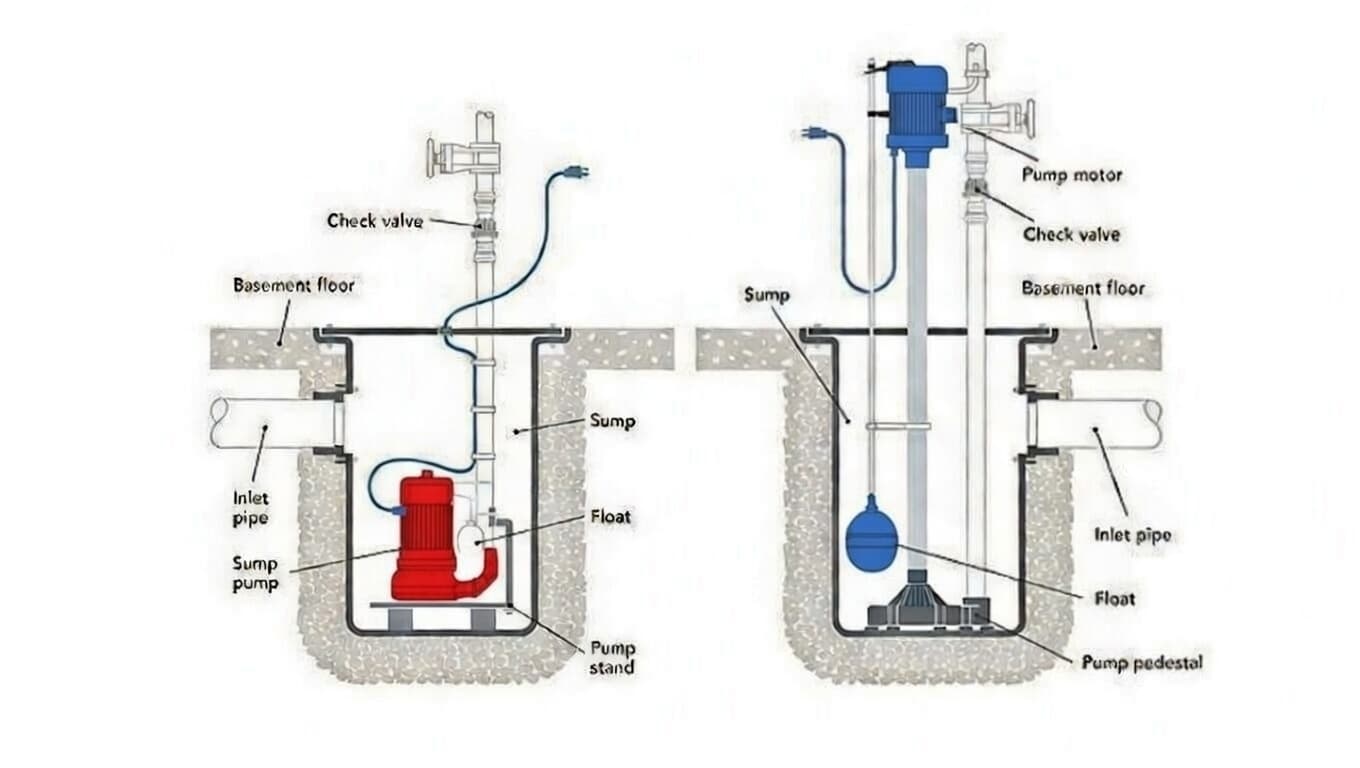
If your basement floods during storms or you are dealing with a high water table, a sump pump is your first line of defense. But with two main types—submersible and pedestal—picking the right one matters. Submersible pumps sit underwater in the sump pit, while pedestal models keep the motor above ground.
This guide compares them based on power, noise, cost, and more. Whether you are searching for the best sump pump for basement flooding or want to understand the key differences, we will help you decide. Many homeowners pair their primary pump with a battery backup for full protection.
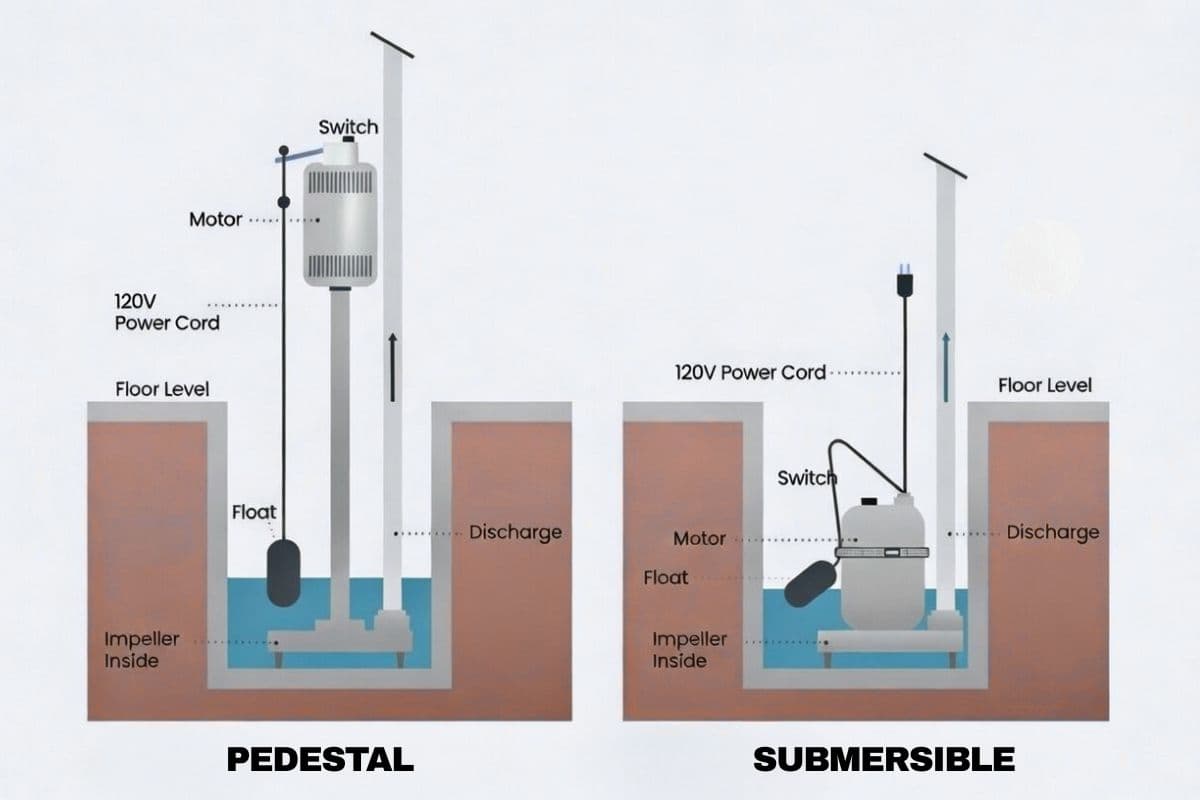
The submersible versus pedestal choice is not simply a preference decision but a compatibility decision driven by three site-specific factors: pit depth, flood frequency, and whether the basement is finished or unfinished. Submersible pumps require a pit at least 18 to 24 inches deep to fully submerge the unit and require no visual clearance above the pit, making them compatible with finished basements where the pit is covered with a sealed lid. Pedestal pumps require a shallower pit but their tall exposed motor shaft (3 to 4 feet above the pit) is incompatible with finished basement spaces and requires visual access for monitoring. The performance gap between the two types is also meaningful: submersible pumps handle 3,000 to 5,000 gallons per hour at higher horsepower ratings, while pedestal pumps are typically limited to 2,000 to 3,500 gallons per hour at lower horsepower, making submersible the appropriate choice for basements with chronic flooding or high water tables and pedestal more suitable for occasional or light-duty applications.
Quick Comparison Table
| Feature | Submersible | Pedestal |
|---|---|---|
| Placement | Fully in the sump pit, submerged | Motor above pit, impeller in water |
| Power (HP Range) | 1/3 to 1 HP, handles heavy flow | 1/4 to 1/2 HP, moderate flow |
| Noise Level | Quiet (45–50 dB, motor muffled) | Louder (55–65 dB, motor exposed) |
| Lifespan | 6–15 years (exposed to water) | 10–25 years (motor stays dry) |
| Cost (Unit + Install) | $150–$600 / $300–$1,000 total | $80–$300 / $200–$600 total |
| Maintenance | Harder (remove from pit) | Easier (motor accessible) |
| Best For | Deep pits, frequent flooding | Shallow pits, budget setups |
What Is a Submersible Sump Pump?
A submersible sump pump is a sealed unit that sits at the bottom of your sump pit, fully underwater when active. It uses a float switch to detect rising water and pumps it out through a discharge line. Models like those from Zoeller or Wayne have cast-iron housings for durability and can handle solids up to 1/2 inch.
Pros
- ✓ More powerful (3,000–5,000 GPH) for fast removal in heavy rain
- ✓ Quieter operation—water muffles noise, great for finished basements
- ✓ Space-saving—fits entirely in the pit, no visible parts
- ✓ Handles debris with vortex impellers for grit and small solids
Cons
- ✗ Higher cost—units start at $150, plus install
- ✗ Tougher maintenance—must pull it out of the pit
- ✗ Shorter lifespan—constant water exposure can corrode parts
- ✗ Risk of overheating if run dry
Best for basements with deep pits or chronic flooding. They work well in cold climates with auto-defrost features.
What Is a Pedestal Sump Pump?
A pedestal sump pump has the motor mounted on a tall shaft above the pit, with only the impeller in the water. The float rod activates when water rises, and it is easier to spot issues since the motor is visible.
Pros
- ✓ Affordable—cheaper to buy and install, often under $300 total
- ✓ Easy access—motor stays dry and above ground for simple repairs
- ✓ Longer life—less water exposure means 15–25 years of service
- ✓ Good for shallow pits where submersibles will not fit
Cons
- ✗ Noisier—exposed motor can hit 60 dB
- ✗ Less power—typically 2,000–3,500 GPH
- ✗ Takes space—tall design (3–4 feet) sticks out in low-ceiling basements
- ✗ Vulnerable—can be knocked over or misaligned
Best for budget setups or occasional use in dry climates.
Key Things to Consider
Flood Risk
Submersible for heavy water—higher head pressure, up to 25 feet lift. Pedestal for light duty at 15–20 feet. If your basement has recurring waterproofing issues, go submersible.
Noise and Space
Submersible if quiet matters—especially in finished basements. Pedestal if access and visibility are more important to you.
Cost and Maintenance
Pedestal wins on upfront savings and ease of service. Submersible wins on long-term power and performance. Check our cost guide for full pricing details.
Installation
Both are DIY-able with basic tools, but submersible needs a larger pit (18–24 inches deep vs 12–18 for pedestal).
Durability
Submersible handles debris better. Pedestal lasts longer if kept dry. Many opt for submersible primaries with battery backups for outages.
Our Top Picks
Best Submersible: Zoeller M53 (1/3 HP, 2,580 GPH)
Cast-iron construction, reliable float switch, handles solids. The go-to for heavy-duty basement protection.
Best Pedestal: Superior Pump 92333 (1/3 HP, 2,760 GPH)
Affordable, easy to maintain, and solid performance for light to moderate use.
General Sizing Advice
- • 1/3 HP for basements up to 1,000 sq ft
- • 1/2 HP for larger spaces or heavy water volume
- • Add a check valve to prevent backflow
- • Test monthly and pair with French drains for best results
Which Type Is Right for Your Situation?
| Your Situation | Recommended Type | Reason |
|---|---|---|
| Sump pit 18 to 24 inches or deeper | Submersible | Sufficient depth to fully submerge the unit |
| Sump pit shallower than 18 inches | Pedestal | Submersible will not fit properly in a shallow pit |
| Finished basement, quiet operation needed | Submersible | Water muffles motor noise, unit concealed under sealed pit cover |
| Unfinished basement, easy maintenance priority | Pedestal | Motor is visible and accessible above the pit without removal |
| Chronic or heavy flooding, high water table | Submersible | Higher horsepower and GPH capacity handles large water volumes |
| Occasional or light water entry, dry climate | Pedestal | Lower horsepower sufficient, longer motor lifespan in low-use application |
| Budget under $200 for the unit | Pedestal | Submersible cast-iron models start above $200, pedestal starts under $100 |
| Maximum lifespan priority | Pedestal | Motor stays dry, 15 to 25 year lifespan versus 6 to 15 for submersible |
| Handles debris or grit in water | Submersible with vortex impeller | Vortex impellers handle solids up to 1/2 inch, pedestal impellers cannot |
| Low-ceiling finished basement | Submersible | Pedestal shaft extends 3 to 4 feet above pit, incompatible with low ceilings |
| Replacing existing submersible | Submersible replacement | Pit is already sized for submersible, no modification needed |
| Replacing existing pedestal | Pedestal or upgrade to submersible if pit allows | Match existing type or assess pit depth for potential upgrade |
| Adding battery backup to existing system | Either type with compatible backup | Match backup system to primary pump brand for easiest integration |
Frequently Asked Questions
Which is better, submersible or pedestal sump pump?
Neither is universally better; the right choice depends on your pit depth, flood frequency, basement finish level, and budget. Submersible pumps are better for basements with deep pits (18 to 24 inches or more), chronic or heavy flooding, finished basements where a quiet and concealed installation is important, and situations where high flow capacity (3,000 to 5,000 GPH) is needed to keep up with water intrusion. Pedestal pumps are better for shallow pits where a submersible will not fit, basements with occasional or light water entry that does not demand high horsepower, budget-conscious installations where the lower upfront cost and longer motor lifespan matter, and unfinished basements where the exposed motor shaft is not a visual concern. The most important factor is matching the pump type to your pit dimensions and water volume, because an undersized or wrong-type pump that cannot keep up with inflow is worse than either type working correctly. See our sump pump buying guide for a complete pump selection framework including horsepower sizing and backup options.
How much does a sump pump cost?
Submersible pump units cost $150 to $600 depending on horsepower, housing material (cast iron versus thermoplastic), and brand, with cast-iron models like the Zoeller M53 at the higher end and thermoplastic models at the lower end. Pedestal pump units cost $80 to $300, making them the more affordable upfront option, though the lower horsepower ceiling means they may not be suitable for high-volume applications. Professional installation adds $200 to $500 for a straightforward swap of an existing pump in an established pit, or $500 to $1,200 for a new pit installation that involves concrete cutting, pit forming, and discharge line routing. A complete system with primary pump, sump pit, discharge line, and battery backup typically costs $1,500 to $3,500 professionally installed for a submersible setup. The cost difference between submersible and pedestal narrows significantly when you factor in the longer motor lifespan of pedestal pumps and the lower replacement frequency. See our sump pump cost guide for a full pricing breakdown by system configuration.
Can I install a sump pump myself?
Yes, replacing an existing pump in an established pit is a manageable DIY task for a homeowner comfortable with basic plumbing and electrical work. The process involves disconnecting the old pump's discharge pipe and power cord, lifting it out of the pit, lowering the new pump into position, reconnecting the discharge line with a union fitting, and plugging in the power cord, which typically takes 1 to 2 hours. Installing a new pit from scratch is a more involved project requiring concrete cutting, pit excavation, pit liner installation, gravel bedding, discharge line routing, and electrical connection, which most homeowners prefer to have done professionally for $500 to $1,200. Always install a check valve on the discharge line to prevent backflow into the pit when the pump shuts off, and confirm the discharge outlet is directed at least 10 feet from the foundation. Test the completed installation by pouring a bucket of water into the pit and confirming the float switch activates, the pump runs, and the water discharges correctly before covering the pit. See our backup power for sump pumps guide for how to add battery backup to any DIY installation.
Do sump pumps help with mold?
Yes, sump pumps directly reduce mold risk by eliminating the standing water and elevated humidity that mold requires to grow in basement spaces. A functioning sump pump removes water before it can spread across the floor and saturate organic materials like wood framing, drywall, carpet, and stored items that mold feeds on. The indirect benefit is equally important: a sump pump that keeps the basement dry makes it possible to run a dehumidifier effectively, because a dehumidifier cannot maintain safe humidity levels if water is actively entering the space faster than the dehumidifier can process it. However, a sump pump alone does not prevent mold in basements where moisture is entering through wall cracks or vapor transmission rather than through the floor, because those moisture sources do not reach the pit where the pump operates. For complete mold prevention, a sump pump must be paired with crack sealing, proper humidity control, and where needed, interior wall drainage that routes wall moisture to the pit. See our how to prevent basement mold guide for the full layered prevention approach.
What is the lifespan of a sump pump?
Submersible pumps typically last 6 to 15 years depending on usage frequency, water quality, housing material, and maintenance. Cast-iron submersible pumps like the Zoeller M53 last toward the upper end of that range because cast iron resists corrosion better than thermoplastic, while entry-level thermoplastic submersibles in high-use applications may need replacement at the lower end. Pedestal pumps last 10 to 25 years because the motor stays dry above the pit, avoiding the corrosion and seal degradation that shortens submersible motor life. The single most important factor in maximizing lifespan of either type is testing the pump at least annually by pouring water into the pit and verifying proper activation and shutoff, and replacing the battery backup every 3 to 5 years to maintain reliable operation during power outages. Pumps in basements with frequent or heavy flooding cycle on and off more often and wear out faster than pumps in basements with occasional water entry, which is why high-use applications benefit from cast-iron submersible models with longer rated service life. See our best sump pumps 2026 guide for current top-rated models by use case and durability rating.
Glossary of Sump Pump Terms
GPH
Gallons per hour, the standard unit for measuring a sump pump's flow rate capacity at a given head pressure. A pump rated at 3,000 GPH at 10 feet of head can remove 3,000 gallons per hour when pumping water 10 feet vertically to the discharge outlet, but the actual flow rate decreases as head pressure increases. Matching GPH capacity to the volume of water your basement receives during peak inflow events is the primary sizing criterion for any sump pump selection. See our sump pump buying guide for how to calculate the required GPH for your specific basement.
Head Pressure
The vertical distance water must be lifted from the sump pit to the discharge outlet, measured in feet, which determines how much work the pump motor must do and directly affects the pump's actual flow rate. As head pressure increases, a pump's effective GPH decreases, which is why manufacturers publish pump curves showing flow rate at multiple head heights rather than a single GPH rating. A typical residential discharge runs 8 to 15 feet of head, and pumps should be sized based on their rated capacity at the actual head height of the installation rather than the maximum GPH spec.
Float Switch
The sensor mechanism that activates and deactivates a sump pump by detecting the water level in the pit, rising with the water to trigger the pump on and dropping as the pit empties to shut it off. Tethered float switches allow the activation and shutoff points to be adjusted by repositioning the tether length, while vertical float switches activate at a fixed height and are more reliable in narrow pits where a tethered float might catch on the pit wall. Float switch failure is one of the most common causes of sump pump performance problems, and inspecting the float for freedom of movement should be part of every annual pump test.
Check Valve
A one-way valve installed on the discharge line above the pump that prevents water from flowing back down into the pit after the pump shuts off, avoiding the short-cycling that occurs when backflow water immediately re-triggers the float switch. Without a check valve, the pump runs in short repeated cycles that waste energy and accelerate motor wear, because each cycle pumps a small amount of water up the discharge line only to have it flow back into the pit when the pump stops. Check valves cost $10 to $30 and should be installed as part of any sump pump installation or replacement. See our sump pump buying guide for installation guidance.
Battery Backup
A secondary pump system powered by a dedicated battery that activates automatically when the primary pump fails or loses power, providing continued water removal during the storms and power outages that coincide with the highest water inflow events. Battery backup systems typically provide 7 to 10 hours of pumping capacity on a fully charged battery, with water-powered backup systems providing unlimited runtime at the cost of municipal water consumption. Backup batteries require replacement every 3 to 5 years to maintain reliable capacity, and the backup system should be tested annually alongside the primary pump. See our backup power for sump pumps guide and battery vs water-powered sump pump backup comparison for full guidance.
Final Advice
Submersible vs pedestal sump pump comes down to your basement's needs—go submersible for heavy duty, pedestal for simple savings. Test water levels first, and add a backup for peace of mind.
For more on protecting your basement from water damage, check out our complete waterproofing guide and best dehumidifiers for basements.
After deciding between submersible and pedestal, use our sump pump replacement cost guide to estimate your specific installed price based on pump type, backup choice, labor scope, and region.
Related Guides
On thebasement.guide
Sump Pump Buying Guide
The complete pump selection guide covering horsepower sizing, float switch types, pit sizing, installation requirements, and how to pair a primary pump with battery backup for full protection.
Best Sump Pumps 2026
Top-rated submersible and pedestal pump reviews with honest performance assessments, pricing, and recommendations by use case and budget.
Sump Pump Cost 2026
What sump pumps cost by type, horsepower, and installation configuration, including new pit installation pricing for homes that do not yet have a system.
Backup Power for Sump Pumps
Why battery backup is essential for any sump pump installation and how to choose between battery-powered and water-powered backup systems.
Battery vs Water-Powered Sump Pump Backup
A head-to-head comparison of the two backup power options, including runtime, cost, installation requirements, and which is appropriate for different basement situations.
Smart Sump Pumps Guide
How WiFi-connected sump pumps with remote monitoring alerts provide early warning of pump failure and water intrusion before flooding occurs.
French Drain Cost 2026
What interior perimeter drainage systems cost, the drain tile infrastructure that routes water to the sump pit that the pump then removes.
French Drain vs Sump Pump
How interior drain tile and sump pumps work together as a system rather than as competing solutions, and when each component is necessary.
Why Is My Basement Still Flooding With a Sump Pump?
The most common reasons a functioning sump pump fails to prevent basement flooding, including undersizing, float switch problems, and discharge line issues.
Complete Basement Waterproofing Guide
How sump pumps fit into a complete waterproofing system alongside interior drainage, wall sealing, and exterior drainage management.
Basement Waterproofing Cost 2026
Full pricing for complete waterproofing systems that pair interior drainage with sump pump installation.
How to Prevent Basement Mold
How sump pump performance directly affects mold risk by controlling standing water and humidity levels in below-grade spaces.
Best Water Leak Detectors
Sensors that provide early warning of sump pump failure or unexpected water entry before flooding becomes severe.
Basement Flooding Insurance
What homeowners insurance covers when a sump pump fails during a storm event and water damages the basement.
From Our Network
Septic System Alarms
For homes where the basement sump pump discharge routes near the septic system, monitoring both systems with alarms provides early warning of failure in either. This guide covers septic alarm options alongside the water leak detectors used with sump systems.
Septic Overflow After Rain
For homes with both a sump pump and a septic system, the same rain events that trigger sump pump activation can also overflow the septic system. This guide covers the septic side of heavy rain water management.