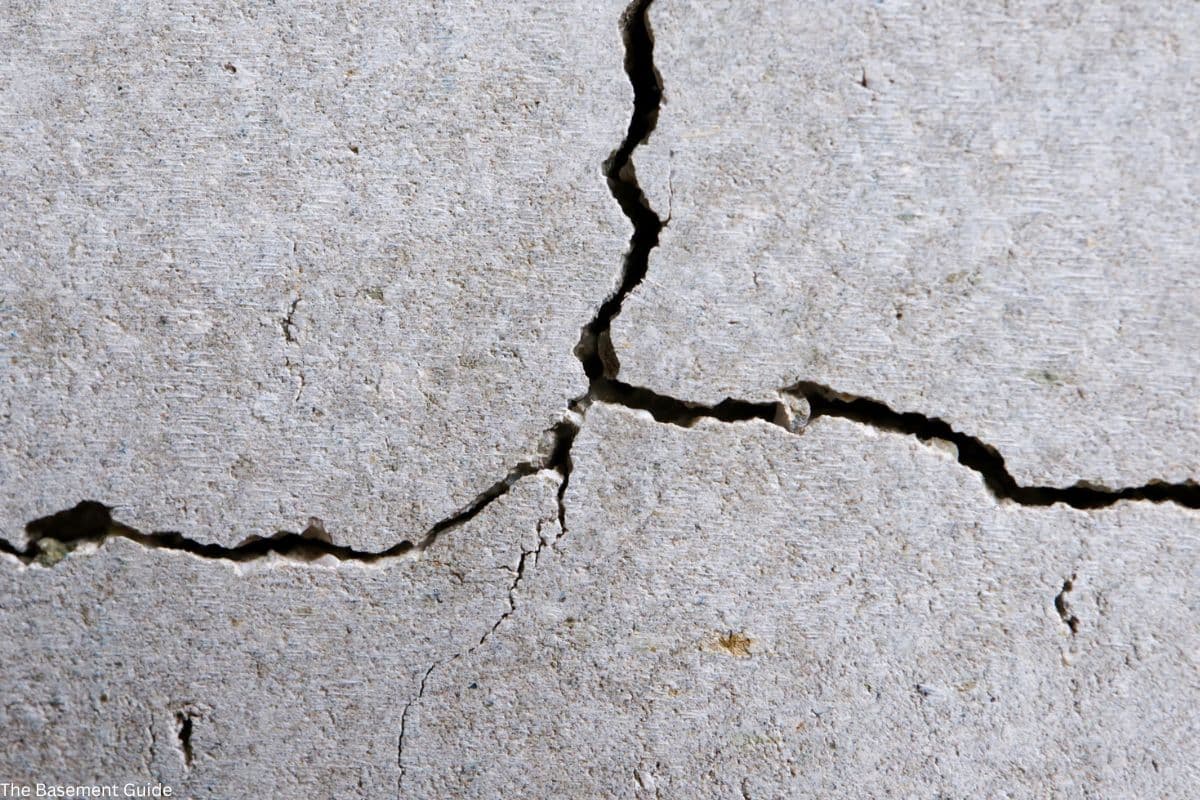
Nearly every concrete foundation develops cracks over time. Concrete shrinks as it cures, soil shifts with moisture changes, and water pressure pushes against basement walls from the outside. The question is not whether your foundation will crack. The question is whether the cracks you have are cosmetic—safe to monitor or seal yourself—or structural—requiring professional repair before they get worse and more expensive.
This guide explains the four main types of foundation cracks, what causes each one, how to tell whether a crack is serious, what each type of repair costs, and exactly what to do next.
Foundation cracks are fractures in the concrete or masonry of a basement wall or floor that form when the stress acting on the material exceeds its tensile strength, which concrete has very little of despite its compressive strength. The direction a crack runs is the most reliable diagnostic signal because it reflects the direction of the force that caused it: vertical cracks form when concrete shrinks or settles evenly, diagonal and stair-step cracks form when one section of the foundation moves more than another, and horizontal cracks form when lateral soil pressure pushes inward against the wall. Width and whether the crack is growing are the two secondary factors that determine urgency: a hairline crack that has been stable for years is a different problem than a 1/4-inch crack that has widened by 1/8 inch over the past month. The practical implication of this framework is that two cracks can look similar on the surface but require completely different responses depending on their orientation, width, and rate of change.
If you already know your crack needs repair and want pricing, jump to our foundation crack repair cost guide. If your wall is bowing inward rather than just cracked, see our bowing basement walls guide.
Quick Foundation Crack Diagnosis Table
| Crack Type | Direction | Width | Typical Cause | Risk Level | What to Do |
|---|---|---|---|---|---|
| Hairline / Shrinkage | Vertical or random | Less than 1/16 inch | Normal concrete curing and drying | Low | Monitor. Seal if desired. |
| Vertical | Straight up and down | 1/16 to 1/4 inch | Concrete shrinkage or minor settlement | Low to Moderate | Monitor monthly. Seal with injection. |
| Settlement | Vertical, one side higher | 1/4 inch or wider | Uneven soil compaction or shifting | Moderate to High | Professional evaluation recommended. |
| Stair-Step | Diagonal steps following mortar joints | Varies | Differential settlement in block/brick foundations | High | Professional evaluation required. |
| Horizontal | Runs horizontally across the wall | 1/8 inch or wider | Hydrostatic pressure or lateral soil pressure | Very High | Call a professional immediately. |
Vertical Foundation Cracks — The Most Common Type
Vertical cracks run straight up and down or nearly so, within about 30 degrees of vertical. They are the most common type of foundation crack and are usually the least serious.
What Causes Vertical Foundation Cracks
Vertical cracks form when concrete shrinks as it cures and dries. All concrete shrinks during the curing process, and this shrinkage creates internal tension that eventually produces cracks. These cracks typically appear within the first 1 to 3 years after a home is built, though they can develop at any time. Minor soil settlement can also produce vertical cracks when one section of the foundation settles slightly more than an adjacent section.
How to Identify a Vertical Crack
The crack runs from top to bottom or partway along the wall. Both sides of the crack are at the same level, meaning there is no height difference between the left and right sides. Width is typically 1/16 to 1/8 inch for shrinkage cracks, though settlement-related vertical cracks can be wider.
When to Worry About Vertical Cracks
Most vertical cracks under 1/4 inch wide with no height difference between sides are cosmetic and do not indicate structural problems. However, you should monitor any vertical crack and take action if it widens beyond 1/4 inch, one side becomes higher than the other indicating settlement, water begins leaking through the crack, or new vertical cracks appear suddenly.
If water is entering through a vertical crack, sealing it prevents moisture problems, mold growth, and efflorescence even if the crack itself is not structural.
How to Repair Vertical Cracks
Hairline cracks under 1/16 inch can be left alone or sealed with a surface-applied concrete sealant. Cracks 1/16 to 1/4 inch wide are best repaired with epoxy injection for dry, non-moving cracks or polyurethane injection for actively leaking or slightly moving cracks. Epoxy injection bonds the concrete back together and restores structural strength. Polyurethane injection creates a flexible, waterproof seal that can accommodate slight movement.
DIY cost: $20 to $80 per crack using a consumer injection kit. Professional cost: $250 to $800 per crack. See our foundation crack repair cost guide for a full pricing breakdown.
📌 Recommended product: Emecole Metro DIY Basement Wall Crack Repair Kit — one of the most popular epoxy kits available. Comes with everything you need and works well for cracks up to 1/4 inch wide.
Settlement Foundation Cracks — Vertical but More Serious
Settlement cracks look similar to vertical shrinkage cracks at first glance, but there are key differences that indicate a more serious underlying problem.
What Causes Settlement Cracks
Settlement cracks form when the soil beneath part of the foundation compacts, erodes, or shifts unevenly. This causes one section of the foundation to sink relative to the rest, creating stress that produces cracks. Causes include poorly compacted fill soil under the foundation, erosion from water flow beneath the slab, drought conditions that cause clay soils to shrink, and plumbing leaks that wash away soil under the foundation.
How to Identify a Settlement Crack
The crack runs vertically but is wider than a typical shrinkage crack—often 1/4 inch or more. The critical distinguishing feature is that one side of the crack is higher than the other, meaning the foundation has actually shifted. You may also notice doors or windows sticking upstairs, sloping floors, or gaps between walls and ceilings in the area above the affected foundation section.
When to Worry About Settlement Cracks
Any crack where one side is higher than the other warrants professional evaluation because it indicates active foundation movement. Even if the crack appears stable today, the soil conditions that caused it may still be changing. Settlement can be progressive, meaning it gets worse over time if the underlying cause is not addressed.
How to Repair Settlement Cracks
Minor settlement cracks can be sealed with epoxy or polyurethane injection to prevent water entry, but the seal alone does not fix the settlement. For active settlement, a foundation specialist may recommend underpinning—installing piers beneath the foundation to stabilize it on deeper, more stable soil—or mudjacking—injecting material beneath the slab to fill voids and raise sunken sections. These are professional repairs.
Professional crack sealing cost: $300 to $800 per crack. Underpinning cost: $1,000 to $3,000 per pier—most homes need 6 to 12 piers.
Stair-Step Foundation Cracks — Common in Block and Brick Foundations
Stair-step cracks follow the mortar joints in a block or brick foundation wall, creating a pattern that looks like a staircase going diagonally across the wall.
What Causes Stair-Step Cracks
Stair-step cracks are caused by differential settlement, which means one section of the foundation is sinking faster than an adjacent section. The crack follows the mortar joints because mortar is weaker than the blocks or bricks themselves, so the stress concentrates along the joint lines. Common triggers include soil washout from poor drainage, tree root activity near the foundation, and seasonal soil expansion and contraction in clay-heavy areas.
How to Identify a Stair-Step Crack
The crack follows a diagonal path up the wall, stepping from one horizontal mortar joint to a vertical mortar joint and then to the next horizontal joint, creating the characteristic staircase appearance. The crack may be wider at one end than the other, indicating which direction the settlement is occurring.
When to Worry About Stair-Step Cracks
Stair-step cracks should always be evaluated by a professional. While a single short stair-step crack in an older block wall may be stable, these cracks often indicate ongoing differential settlement that will worsen over time. If the crack is wider than 1/4 inch, is growing, or is accompanied by wall bowing, the situation requires prompt attention. See our bowing basement walls guide for more on how wall bowing and cracking are related.
How to Repair Stair-Step Cracks
For stable stair-step cracks, tuckpointing—removing damaged mortar and replacing it with new mortar—restores the joint and prevents water entry. For active settlement, the foundation may need structural stabilization through wall anchors, carbon fiber straps, or underpinning before the crack itself is repaired. Sealing the crack without addressing the settlement will result in the crack reopening.
Tuckpointing cost: $5 to $25 per square foot. Wall anchor cost: $150 to $400 per anchor—most walls need 3 to 5.
Horizontal Foundation Cracks — The Most Serious Type
A horizontal crack running across a basement wall is the most serious type of foundation crack and requires immediate professional attention. It indicates that the wall is under significant lateral pressure and is beginning to bow inward.
What Causes Horizontal Foundation Cracks
Horizontal cracks are caused by hydrostatic pressure—the force of water-saturated soil pushing against the wall, expansive clay soils that swell when wet, frost heave in cold climates, or a combination of these forces. The crack typically appears at the midpoint of the wall height because that is where the wall is weakest relative to the lateral pressure being applied. Horizontal cracks are a direct warning sign that the wall is bowing, which can progress to structural failure if left unaddressed.
How to Identify a Horizontal Crack
The crack runs horizontally—parallel to the floor and ceiling—across the wall, usually at approximately the midpoint height. It is often 1/8 inch wide or more. You may also see inward displacement of the wall below or above the crack line. In concrete block walls, the crack typically follows a horizontal mortar joint.
When to Worry About Horizontal Cracks
Always. Every horizontal crack in a foundation wall is a structural concern. The wall is telling you that it cannot fully resist the lateral forces being applied to it. Even a thin horizontal crack indicates the onset of bowing. If the wall has already moved inward—you can check with a straightedge or plumb line—the problem is actively progressing.
How to Repair Horizontal Cracks
Horizontal cracks require structural repair, not just sealing. The most common repairs are carbon fiber straps for minor bowing under 2 inches (cost $2,000 to $5,000), wall anchors for moderate bowing (cost $3,000 to $8,000), or steel I-beams for severe bowing (cost $4,000 to $10,000). The repair must also address the source of the lateral pressure through improved drainage, grading, or waterproofing.
See our bowing basement walls guide for a detailed breakdown of every repair method, and our interior vs exterior waterproofing guide for approaches to reducing hydrostatic pressure.
How to Monitor Foundation Cracks at Home
Not every crack requires immediate professional attention, but every crack deserves monitoring. Here is a simple monitoring system you can set up in 5 minutes.
- Step 1 Photograph each crack. Hold a ruler or tape measure next to the crack and take a close-up photograph. This gives you a dated visual record with a scale reference.
- Step 2 Mark the ends. Use a pencil to draw a short line across the end of each crack and write the date next to it. If the crack grows past your mark, you know it is actively extending.
- Step 3 Measure the width. Measure the widest point of the crack. A credit card is approximately 1/32 inch thick, which can serve as a quick reference.
- Step 4 Recheck every 30 days. Compare current measurements and photos to your originals. Look for changes in width, length, or height difference between sides.
Stop monitoring and call a professional if:
- • The crack widens beyond 1/4 inch
- • One side becomes higher than the other
- • Water begins leaking through the crack
- • New cracks appear suddenly
- • The wall shows any inward displacement
- • You see stair-step or horizontal cracking
How to Prevent New Foundation Cracks
You cannot prevent all foundation cracks—concrete shrinkage cracks are inevitable—but you can prevent most of the serious structural cracks by controlling water and soil conditions around your foundation.
- • Maintain gutters and downspouts. Clean gutters at least twice a year and extend downspouts so they discharge water 6 to 10 feet from the foundation.
- • Grade soil away from the house. The ground surface should slope away from the foundation at a rate of at least 1 inch per foot for the first 6 to 10 feet.
- • Fix water intrusion promptly. If water is entering your basement through walls or the floor, address it with proper waterproofing before cracks develop or worsen.
- • Control interior humidity. Keep basement humidity below 50 percent with a properly sized dehumidifier.
- • Schedule annual inspections for older homes. A professional foundation inspection costs $100 to $300 and catches early movement before it becomes expensive.
Foundation Crack Repair Cost Summary 2026
| Crack Type | DIY Repair Cost | Professional Repair Cost | Notes |
|---|---|---|---|
| Hairline / Shrinkage | $10 to $30 (sealant) | $150 to $400 | Often cosmetic. Sealing is optional unless water is entering. |
| Vertical (1/16 to 1/4 inch) | $20 to $80 (injection kit) | $250 to $800 per crack | Epoxy for dry cracks. Polyurethane for leaking cracks. |
| Settlement | Not recommended | $300 to $800 sealing + $6,000 to $30,000 underpinning | Professional evaluation required. |
| Stair-Step | Not recommended | $500 to $2,500 tuckpointing or $3,000 to $8,000 wall anchors | Must address settlement cause, not just the crack. |
| Horizontal | Not recommended | $2,000 to $10,000 structural repair | Always structural. See bowing walls guide. |
For detailed pricing on every repair method, see our foundation crack repair cost guide.
Three Proven Repair Products Available on Amazon (2026)
Here are three highly rated, readily available products that actually work well for homeowners dealing with foundation cracks.
1. Emecole Metro DIY Basement Wall Crack Repair Kit
Best all-around epoxy kit for vertical and settlement cracks. Strong bond, easy to use, and comes with full instructions.
Check Price on Amazon →2. Applied Technologies Polyurethane Foundation Crack Repair Kit
Excellent for actively leaking cracks. The polyurethane expands when it meets water and creates a flexible, waterproof seal. 40 ft version.
Check Price on Amazon →3. Loctite PL Premium Construction Adhesive
Great for sealing the surface after injection or for small non-structural cracks. Bonds extremely well to concrete and stays flexible.
Check Price on Amazon →What to Do Based on What You See
| What You See | Crack Type | Risk Level | Action |
|---|---|---|---|
| Thin vertical crack, less than 1/16 inch, not growing, no water | Hairline shrinkage | Low | Seal with epoxy or masonry caulk, monitor annually |
| Vertical crack, 1/16 to 1/4 inch, stable, no displacement | Shrinkage or minor settlement | Low to moderate | Seal with DIY epoxy injection kit, monitor monthly |
| Vertical crack, wider than 1/4 inch, one side higher than other | Settlement with displacement | Moderate to high | Professional evaluation, epoxy injection or structural repair |
| Vertical crack, any width, visibly growing over weeks or months | Active settlement | High | Professional evaluation immediately |
| Diagonal crack running from corner of window or door | Settlement stress concentration | Moderate | Monitor closely, professional evaluation if growing |
| Stair-step crack following mortar joints in block wall | Differential settlement | High | Professional evaluation, carbon fiber or wall anchors likely needed |
| Horizontal crack at midpoint of wall | Lateral soil pressure, bowing | Very high | Call professional immediately, do not delay |
| Horizontal crack with inward wall bulge visible | Active bowing | Critical | Emergency professional evaluation today |
| Crack with water actively leaking through | Any type with water intrusion | High | Polyurethane foam injection to seal, address drainage |
| Multiple new cracks appearing in short period | Systemic foundation stress | High | Professional evaluation immediately |
| Crack with gap forming between wall and floor or ceiling | Advanced wall movement | Critical | Emergency professional evaluation today |
| Any crack in home being sold or purchased | Any type | Requires documentation | Independent structural engineer report before closing |
Frequently Asked Questions
Are foundation cracks normal?
Yes, nearly every foundation develops cracks over time and the majority are cosmetic rather than structural. Concrete shrinks as it cures in the first few years after a home is built, producing hairline vertical cracks that are extremely common and pose no structural risk. Soil settlement, seasonal moisture changes, and freeze-thaw cycles also produce minor cracking that is normal in any foundation over decades of use. The key distinction is not whether cracks exist but what type they are, how wide they are, and whether they are growing. Vertical hairline cracks that have been stable for years require nothing more than sealing to prevent water entry. Horizontal cracks and actively growing cracks of any orientation are the ones that require professional evaluation.
How do I know if a foundation crack is serious?
The four factors that determine whether a foundation crack is serious are its direction, its width, whether it is growing, and whether water is coming through it. Horizontal cracks are always serious and require professional evaluation immediately because they indicate lateral soil pressure that is bowing the wall inward. Stair-step cracks in block walls are serious because they indicate differential settlement of the foundation. Vertical cracks wider than 1/4 inch or showing displacement where one side is higher than the other warrant professional inspection. Any crack that has visibly grown since you last checked it, or that is accompanied by water leaking through the wall, should be evaluated by a professional regardless of its direction or current width. See our bowing basement walls guide if you also notice inward wall movement alongside the cracking.
Can I repair foundation cracks myself?
Minor vertical and hairline cracks can be sealed by a capable DIYer using epoxy injection kits or polyurethane foam kits that are widely available and designed for homeowner use. Epoxy injection bonds the crack faces together and restores some structural continuity, while polyurethane foam expands on contact with moisture and creates a flexible waterproof seal better suited for actively leaking cracks. The repair products listed in this guide are the same materials professional contractors use in many cases, and the instructions are straightforward for cracks up to 1/4 inch wide in poured concrete walls. DIY repair is not appropriate for horizontal cracks, stair-step cracks, cracks with displacement, or any crack that is actively growing, because these indicate structural movement that surface sealing will not address. See our foundation crack repair cost guide for when professional repair is required and what it costs.
How much does foundation crack repair cost?
Foundation crack repair costs $250 to $800 per crack for professional epoxy or polyurethane injection, with most single-crack repairs in the $300 to $500 range. DIY epoxy injection kits cost $50 to $150 per crack and are suitable for minor vertical cracks in poured concrete walls. Structural repairs for horizontal cracks or bowing walls cost significantly more: carbon fiber strap installation runs $2,000 to $5,000, wall anchor systems run $3,000 to $8,000, and full wall replacement runs $10,000 to $25,000 depending on the extent of damage. The cost difference between a $300 crack injection today and a $15,000 wall replacement later is the primary reason early monitoring and prompt repair matters. See our foundation crack repair cost guide for a full breakdown by crack type and repair method.
What causes horizontal cracks in basement walls?
Horizontal cracks are caused by lateral soil pressure pushing inward against the foundation wall, most commonly from hydrostatic pressure when soil becomes saturated with water after heavy rain or snowmelt. The crack typically forms at or near the midpoint of the wall height where bending stress from the lateral load is greatest, and it almost always indicates that the wall has already moved inward to some degree. Expansive clay soils that swell when wet and freeze-thaw cycles in cold climates are the other primary causes of horizontal cracking, as both create repeated lateral stress cycles that eventually exceed the wall's bending capacity. Horizontal cracks are the most serious crack type and should never be monitored and waited on the way minor vertical cracks can be. Call a foundation repair professional as soon as a horizontal crack is identified. See our bowing basement walls guide for the full repair options and costs.
What is the difference between epoxy and polyurethane crack repair?
Epoxy injection bonds the two faces of a crack together with a rigid, high-strength adhesive that restores structural continuity to the concrete and creates a waterproof seal. It is the preferred method for dry, stable cracks in structural walls where restoring strength matters alongside sealing the crack. Polyurethane foam injection expands on contact with moisture and creates a flexible, compressible seal that accommodates minor future movement without re-cracking. It is the preferred method for actively leaking cracks because the moisture in the crack activates the expansion, and its flexibility means it performs better than rigid epoxy in cracks that may experience ongoing minor movement. The practical rule is to use epoxy for dry structural cracks and polyurethane for wet or actively leaking cracks. See our foundation crack repair cost guide for how the material choice affects total repair cost.
When should I call a professional for foundation cracks?
Call a professional immediately for any horizontal crack, any crack with displacement where one side is higher than the other, any stair-step crack in a block wall that is wider than 1/4 inch, or any crack that has grown measurably since you first noticed it. Also call a professional if multiple new cracks appear in a short period, if doors or windows are suddenly sticking or not closing properly, or if you see a gap forming between the wall and the floor or ceiling joists. For minor vertical hairline cracks with no growth and no water leakage, professional evaluation is not urgent but is still worthwhile at least once to confirm the crack is stable. When in doubt, a foundation inspection costs $100 to $300 and provides documentation that protects you during a future sale. See our how to hire a basement waterproofing contractor guide for how to find a qualified specialist.
Glossary of Foundation Crack Terms
Hairline Crack
A very thin crack less than 1/16 inch wide that is typically cosmetic and caused by normal concrete shrinkage during the curing process in the first few years after a foundation is poured. Hairline cracks pose no structural risk and require only surface sealing to prevent water from entering and widening the crack through freeze-thaw cycles. Monitor them annually and seal with a concrete crack filler or masonry caulk if water entry is observed. See our foundation crack repair cost guide for sealing product pricing.
Hydrostatic Pressure
The lateral force exerted by water-saturated soil against a foundation wall or floor, which increases with soil moisture content and depth and is the primary cause of horizontal cracks and basement wall bowing. After heavy rain or snowmelt, saturated soil can exert more than 100 pounds per square foot of lateral pressure against a basement wall that was designed to handle far less. Reducing hydrostatic pressure through improved grading, gutters, and drainage is the most effective long-term strategy for preventing both cracks and water intrusion. See our complete basement waterproofing guide for drainage solutions that reduce hydrostatic pressure.
Differential Settlement
The condition where one section of a foundation sinks or shifts more than another due to variations in soil composition, moisture content, or compaction beneath different parts of the foundation, producing diagonal or stair-step cracks that follow the path of least resistance through mortar joints or concrete. Differential settlement is more damaging than uniform settlement because the uneven movement creates shear forces the structure was not designed to resist, which is why stair-step cracks in block walls are treated as a high-risk finding requiring professional evaluation. Clay-rich soils with high moisture variability and poorly compacted fill soil beneath new construction are the most common causes of differential settlement in residential foundations. See our bowing basement walls guide for how differential settlement interacts with lateral wall movement.
Epoxy Injection
A repair method where low-viscosity liquid epoxy resin is injected into a crack under pressure through ports installed along the crack face, bonding the two sides of the crack together and restoring structural continuity to the concrete while creating a waterproof seal. Epoxy injection is the preferred repair for dry, stable cracks in structural walls where restoring tensile strength matters alongside waterproofing, and it is the same method used by professional contractors as DIY homeowner kits. Epoxy is not appropriate for actively leaking cracks where moisture will prevent adhesion, for which polyurethane foam injection is the better choice. See our foundation crack repair cost guide for epoxy injection pricing by crack type.
Polyurethane Injection
A foundation crack repair method where liquid polyurethane foam is injected into a crack. The foam expands on contact with water, filling the crack and creating a flexible, waterproof seal. Best used on actively leaking cracks.
Carbon Fiber Straps
High-strength reinforcement strips made from woven carbon fiber fabric bonded to a bowing or cracked wall surface with structural epoxy, used to prevent further inward movement in walls that have bowed 2 inches or less or to reinforce walls with horizontal cracking before displacement progresses. Carbon fiber is approximately 10 times stronger than steel in tension, making straps an extremely effective stabilization method despite their thin profile and minimal visual footprint. Proper installation requires the wall surface to be clean, dry, and free of paint or efflorescence for the epoxy bond to achieve its rated strength. See our bowing basement walls guide for full carbon fiber strap repair costs and when this method is appropriate.
Underpinning
A structural repair method that extends the foundation's support to deeper, more stable soil. Steel push piers or helical piers are driven through the existing foundation to load-bearing soil or bedrock.
Tuckpointing
The process of removing damaged or deteriorated mortar from the joints of a block or brick wall and replacing it with fresh mortar. Repairs stair-step cracks and prevents water entry.
Control Joint
A groove cut or formed into a concrete surface during construction to create a deliberate weak point where shrinkage cracking can occur in a straight, predictable line rather than randomly. Cracks along control joints are intentional and not a structural concern.
Related Guides
On thebasement.guide
Full pricing for every crack repair method including DIY epoxy injection, professional polyurethane foam, carbon fiber reinforcement, and full wall replacement, with cost ranges by crack type and severity.
The companion guide for when cracking is accompanied by inward wall movement, covering all four repair methods, 2026 costs, and the decision framework for choosing between carbon fiber straps, wall anchors, I-beams, and full replacement.
How to address the hydrostatic pressure that causes horizontal cracks and water intrusion through foundation walls, with every waterproofing method compared by cost and effectiveness.
What drainage and waterproofing improvements cost alongside crack repair, relevant for budgeting the pressure-reduction work that prevents new cracks from forming after repairs are complete.
How interior drainage and exterior membrane systems each address the water pressure that drives cracking, and which approach works best depending on crack type and foundation construction.
The white mineral deposits that often appear at or near foundation cracks as moisture migrates through the wall, and what efflorescence indicates about the duration and severity of the water pressure problem.
How water enters through foundation cracks and what to do when crack sealing alone is not sufficient to stop water intrusion through a wall under ongoing hydrostatic pressure.
How pre-1970 foundations with thinner walls, minimal reinforcement, and no waterproofing membrane develop crack patterns differently from modern construction, and the repair approaches suited to older masonry and stone foundations.
How to evaluate foundation cracks during a home purchase, what questions to ask, how to document what you find, and how to use crack findings in price negotiations.
How to find and vet a qualified foundation repair specialist, the questions to ask before signing a contract, and the red flags that indicate an unreliable contractor.
What homeowners insurance covers when water enters through foundation cracks, and the coverage gaps that leave most crack-related water damage uninsured under standard policies.
How documented crack repairs and waterproofing improvements affect appraisal outcomes, and why repair receipts and contractor warranties matter as much as the repairs themselves during a home sale.
How controlling basement humidity reduces the freeze-thaw cycling in foundation cracks that widens them over time, and the humidity targets that protect both the foundation and finished spaces.
From Our Network
The same expansive clay soils and poor exterior drainage that cause foundation cracking also stress septic drainfields on rural properties. This guide covers the warning signs that drainage problems are affecting the septic system alongside the foundation.
For homeowners addressing both foundation drainage and septic system issues driven by the same saturated soil conditions, this guide covers septic repair costs that may need to be budgeted alongside foundation crack repair.
External Resource
The American Concrete Institute's technical standards for concrete crack classification, acceptable crack widths by structural application, and repair method specifications used by professional foundation engineers.